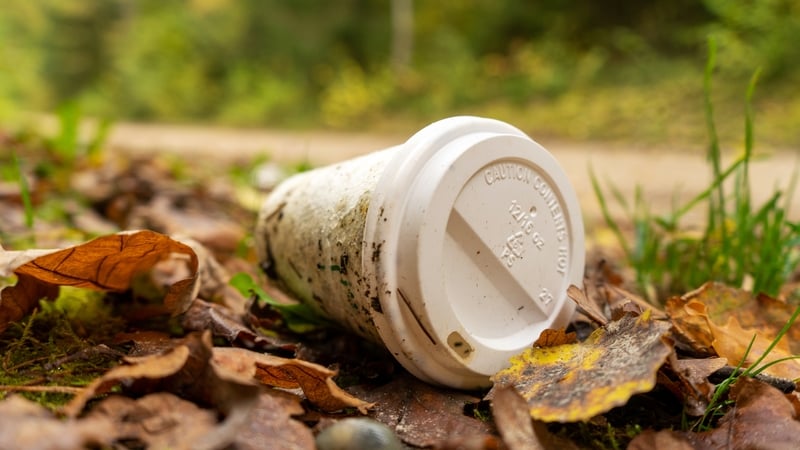
Coffee cups are the most commonly found litter and a "likely collapse of reusable coffee cup schemes" was disappointing, according to business group IBAL.
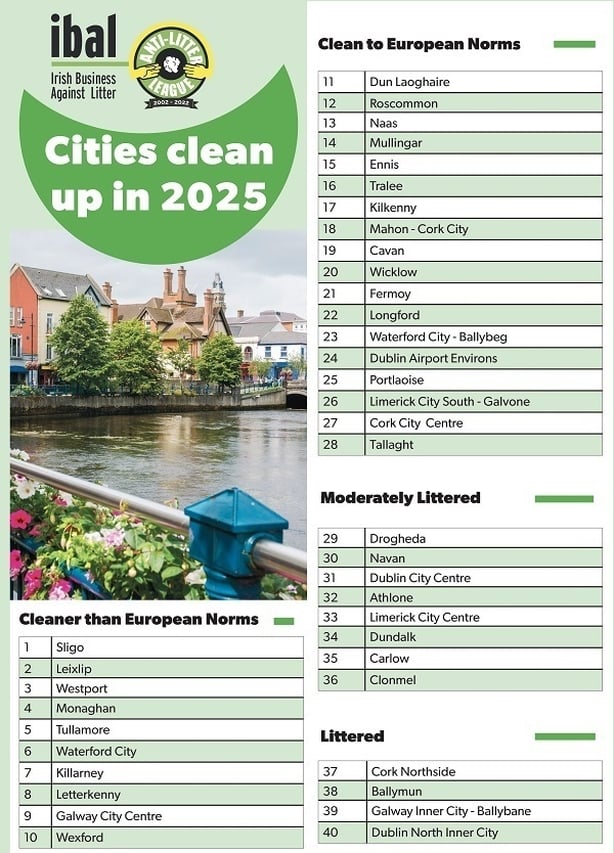
Its latest survey showed that Sligo replaced Naas as Ireland's cleanest town and that none of the 40 towns and cities surveyed was found to be "seriously littered" last year.
Sligo was labelled a litter blackspot in 2007, but was noted for its strong performances in recent years by An Taisce, which conducts the surveys on behalf of the Irish Business Against Litter.
The town's Quayside Shopping Centre was deemed "absolutely spotless", while its bus and train stations were also commended for their cleanliness.
Waterford retained the title of Ireland's cleanest city, ahead of Galway, while Galvone in Limerick achieved clean status for the first time, having been deemed "seriously littered" in previous years.
Mahon in Cork and Tallaght in Dublin were also among the urban areas which achieved clean status, and Dublin's North Inner City, while at the foot of the rankings, was much improved on 2024.
IBAL's Conor Horgan said there had been progress in many socially disadvantaged areas in 2025 and there was also a drop in the number of sites with large amounts of litter or dumping, and it is the first survey where no bottle bank was deemed a litter blackspot.
However, Ballybane village and Industrial Estate in Galway were both found to be "subject to long-term dumping and neglect" while a wasteground at Fairfield Meadows on Cork's northside had "phenomenal levels of dumping".
Speaking on RTÉ's Morning Ireland Mr Horgan said litter blackspots are disappearing.
He said that four years ago the survey had 48 blackspots, which has since been reduced to 11.
Mr Horgan added that there had been significant improvements year-on-year in cities, and that local authorities are doing a better job targeting those sites.
The survey also found that the Deposit Return Scheme was having a positive impact, with a 10% drop in the prevalence of cans and plastic bottles compared to 2024.
But the survey found that coffee cups were found in one fifth of the sites surveyed.
Mr Horgan said the likely collapse of reusable coffee cup schemes in towns such as Killarney is a disappointment and such schemes will only work with statutory backing.
He said that "without Government intervention coffee cups will remain an unsightly and entirely unnecessary blot on the landscape across our towns".