


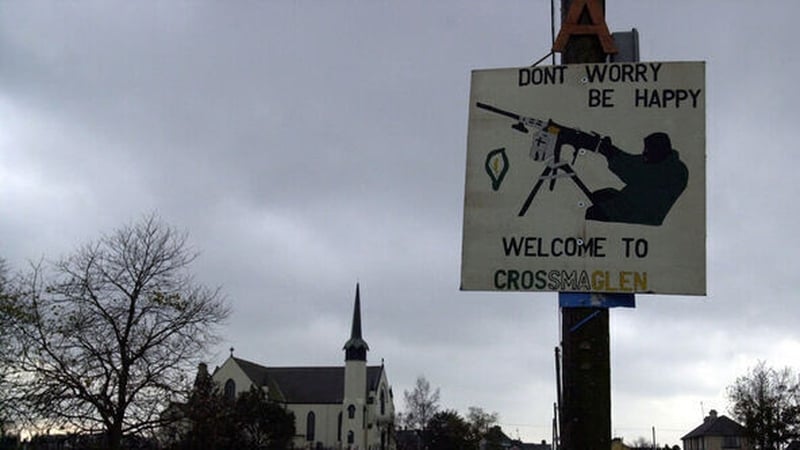
A leading politician's reaction to plans for extensive construction work at Crossmaglen Barracks in south Armagh in April 1994 is contained within newly-released files at the National Archive.
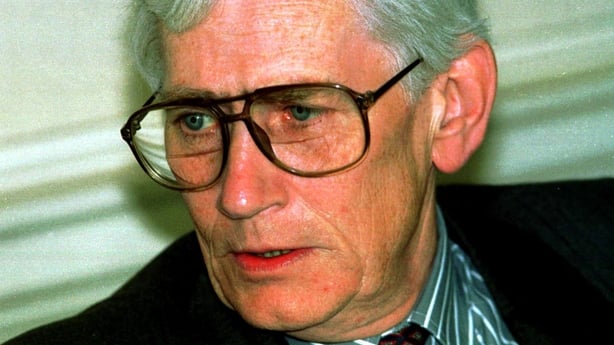
SDLP MP Séamus Mallon was thought to be "privately understanding of the need for greater protection at the base, but is expected to be publicly critical".
The note reveals the impact the works, as outlined to Mr Mallon by the Northern Ireland Secretary Patrick Mayhew, were having on both sides of the community.
One document dated 8 April 1994 noted an Irish official’s concern that "sensitive political and confidence issues would arise in relation to such a major operation in this area, especially at this time".
There had been consideration on the British side about the signal that such large-scale construction months ahead of an anticipated IRA ceasefire could send out, but the decision was made that "the work should go ahead".
Publicly, Mr Mallon said he feared the work would increase local support for the IRA, though Mr Mayhew replied: ''If it does, it does. I am not going to put at risk soldiers and police officers... because it may increase support for the IRA'."
A protest was held in Crossmaglen that month, where 500 people marched to highlight "the military stranglehold" on the town, following the Cardinal Tomas Ó Fíach Cup match between Armagh and Tyrone.
In a briefing for foreign affairs officials, the Northern Ireland Office stressed the need for the work.
They said that: "Security forces morale at Crossmaglen was at a low ebb - under threat from Mark XV mortar developed by the South Armagh Provisional IRA in the base and sniper attack outside."
Such were the sensitivities around the work that builders had to be protected by 150 Royal Ulster Constabulary and 1,000 soldiers during three months of construction.
The works were not welcomed in the town, causing traffic delays and the temporary disruption for access to some of Crossmaglen GAA’s lands.
There had been "fears" raised with residents that the extra checkpoints and other security measures taken to protect the workers, military and police would "not be fully dismantled" when the construction finished.
In a letter from Dick Spring, minister for foreign affairs at the time, to the Northern Ireland secretary, he wrote: "As I feared, there have also been efforts by the paramilitaries to exploit the situation so as to bolster their position in the area, thereby adding further to the anxiety of local people."
Asking the secretary for clarity that this ongoing disruption would not happen, Mr Spring asked that efforts be made to "get the message across to the local community" that this would not be the case.
Later, the Northern Ireland Office (NIO) offered "deep gratitude" to the Irish side for "the back-up provided by the gardai and the army on our side".
John Steele, a senior NIO official, said: "Without it, unquestionably, lives would have been lost."
[Based on document 2023/50/419]
Up and coming Churchill a figure of 'great potentialities'
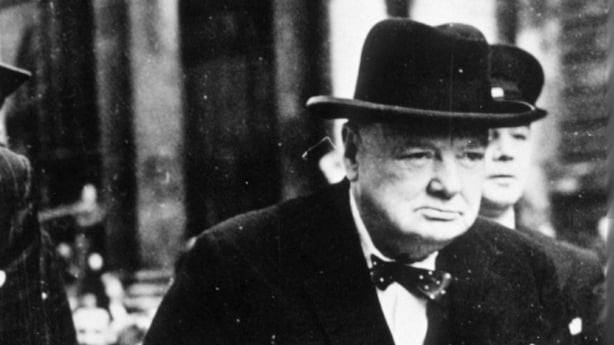
Winston Churchill was a figure of "great potentialities and of overweening ambition," was how one Irish official described the up and coming political leader in 1936 as he was rising through the ranks.
In a briefing note prepared for then-taoiseach Eamon de Valera about the British politician, there is a hand written note on the margins indicating that it was exchanged between him and then-minister for finance Seán McEntee.
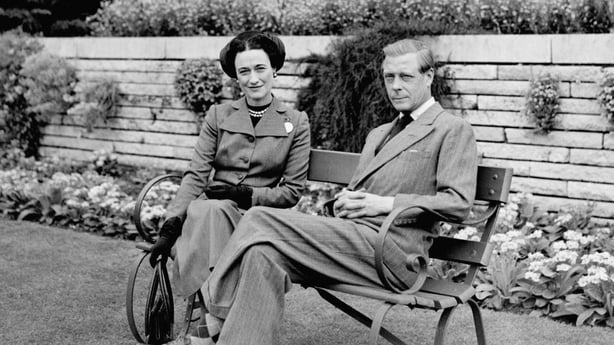
At the time, the UK political landscape was dominated by the constitutional crisis over the abdication of King Edward VIII.
He had shocked the establishment by choosing to abdicate from his role as king, so he could marry the divorcee Wallis Simpson.
While it is unclear who wrote the briefing note back in late 1936, the author’s strong views on Churchill were clear.
He was described as "venal and unscrupulous" in the document, released as part of the State Papers.
The character assessment was prepared to assist the Government to navigate the fall out from the abdication which had caused political waves in Britain as then-prime minister Stanley Baldwin and his cabinet had opposed the decision.
Through the lens of the Irish official, the description of Winston Churchill and his willingness to exploit the king's determination to marry in order to further his own political ends was unflinchingly portrayed.
"As to the politician - there is Winston Churchill, the deadly enemy of Baldwin, venal and unscrupulous," the notes stated, adding that his whole political life has been "a gamble".
The note also states that the gamble to support the king means that if the king were to win, "his new Prime Minister would exercise a personal domination that has not been known in Britain since the days of Walpole".
There is clear recognition that the Irish officials can see a positive for the country if the king was to abdicate.
"If the proposed marriage takes place, whether by special legislation or otherwise, it will undoubtedly weaken the British monarchy as an institution and weaken the Constitutional position in Great Britain of the British Cabinet," a memo said.
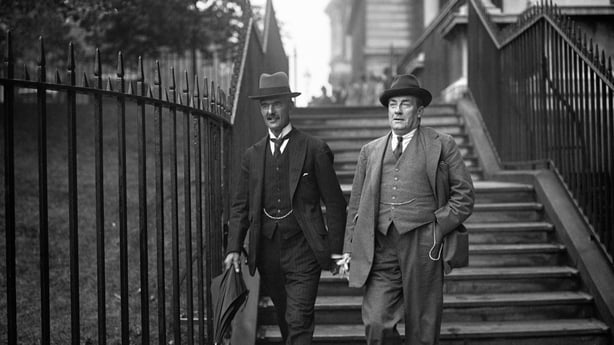
For the time, 1936, there is an intriguing observation for an Irish official that a "very large portion of the British people have very lax views in regard to marriage and divorce".
When King Edward abdicated in December 1936, the throne went to his younger brother, King George VI, and Mr Baldwin decided to retire immediately after the coronation of the new king.
While Mr Churchill had been deeply critical of Mr Baldwin, for his part, Mr Baldwin praised the ambitious politician.
In 1935 Baldwin wrote to his friend J.C Davidson about Mr Churchill: "If there is going to be a war – and no one can say that there is not – we must keep him fresh to be our war Prime Minister."
Mr Churchill succeeded Prime Minister Neville Chamberlain in May 1940.
His years in the role of prime minister until his retirement in 1955, has led him to be regarded as one of Britain’s’ most inspirational leaders.
[Based on document 2025/115/994]
Legal challenge to 1985 Anglo-Irish Agreement of huge significance to Ireland, UK
In January 1986, the secretary General of the Department of Foreign Affairs Noel Dorr described the Anglo-Irish Agreement "as an extremely delicately drafted and balanced text".
Documents included in the newly released files at the National Archives demonstrate the significance that both the Irish and British governments gave to a legal challenge of the November 1985 agreement, and the possible ramifications of the case were discussed at length by Irish and British officials.
The case challenging the legality of the Anglo-Irish agreement was taken by two leading Ulster Unionists, brothers, Christopher and Michael McGimpsey. Their case advanced the argument that the Irish Government had acted unconstitutionally by entering into the treaty with Britain.
Articles 2 and 3 of the Irish Constitution claimed jurisdiction over the whole island, and their case argued that the Irish government had implicitly renounced that by accepting that Northern Ireland would stay part of the UK unless the majority decided to change.
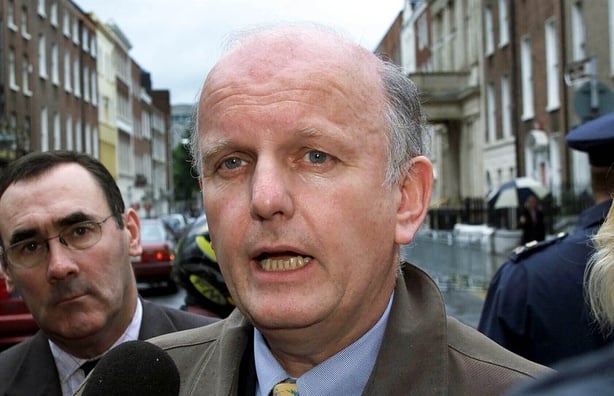
The McGimpsey brothers were subsequently described in the High Court in Dublin by Justice Barrington in March 1990 as "patently sincere and serious people who have raised an important constitutional issue which affects them and thousands of others on both sides of the border".
The case wound its way through the courts but was ultimately rejected, with a ruling that the government had acted constitutionally and that an international agreement recognising the principle of consent did not mean that the constitutional claim itself had been abandoned.
Files released show how behind the scenes, officials on both sides were concerned about the possible implications of the case.
This case followed the potential path of the challenge taken in 1973 to the Sunningdale Agreement by former Fianna Fáil TD Kevin Boland, by then leading Aontacht Éireann.
Like the McGimpseys, he had argued that Sunningdale’s acceptance that "there could be no change in the status of Northern Ireland until a majority in the North so decided" was unconstitutional because it conflicted with Articles 2 and 3.
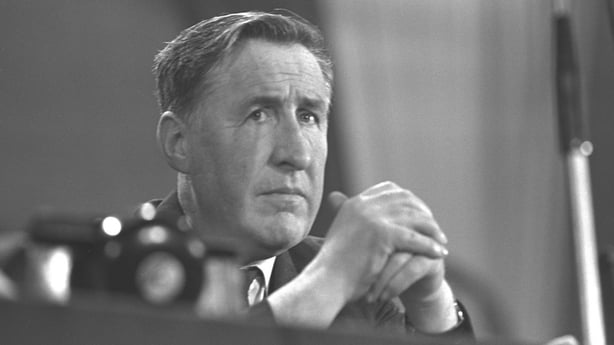
In its rulings, the High Court and the Supreme Court in Dublin, on appeal, rejected Mr Boland’s challenge, but they ruled that Sunningdale was not a legally-binding treaty altering sovereignty, but rather a policy declaration.
The political impact of this ruling had been a challenge for the Irish government and fed into concerns about the McGimpsey case.
In a meeting with Irish diplomats in late January 1985, British officials said the Anglo-Irish Agreement offered "a voice for nationalists balanced by a reassurance to unionists on the status of Northern Ireland".
British ministers showed "great concern", recorded diplomat, Seán Ó hUiginn that what might be said in open court could be used as a stick with which to beat the British government both by unionists" and by disgruntled Conservatives.
Discussions between officials shows that when the British officials saw the Irish government’s defence, they were concerned that it could be argued that an internationally-binding treaty commitment had been weakened to no more than a policy pledge regarding the accepted status of Northern Ireland.
Files released in 2015 as part of the Northern Ireland State Papers showed that there had been high-level concern in the Northern Ireland Office (NIO) in particular, that a verdict ruling the agreement unconstitutional, would undermine the Irish government’s support for it.
A letter from Mr Dorr to Matt Russell, Attorney General’s (AG) senior legal adviser, dated 8 March 1988 observes that the Anglo-Irish Agreement "was, as you are aware better than most, an extremely delicately drafted and balanced text".
He added that the "best approach politically", especially regarding relations with London and with the Unionists, would be "to assert that the national aspiration to unity excludes the use of violence".
He made the point that his "understanding" was that the Irish government wanted to "win the case", writing: "The two governments approached the issue 'with different title deeds.’"
"The agreement did not seek to resolve this, or to define the present status of Northern Ireland. Indeed, it carefully avoided doing so," he added.
"Rather, both governments agreed in Article 1 of the agreement on the circumstances in which any change in that status, however defined, would come about," Mr Dorr told the AG official.
In the end, the High Court ruled against the McGimpsey case.
[Based on document 2025/124/463]
Galway nurses strike over poor quality food in 1965
The sight of members of the nursing profession taking to the streets in protest over varying issues over the years has been well documented, but now newly released files from 1965 give more insights into an unusual strike taken over poor quality food at Galway's Merlin Hospital.
Documents reveal that senior staff were determined to ensure nurses "behave responsibly" after being embarrassed when the nurses’ strike hit the headlines.
Nursing staff were critical of the low-grade food provided, saying that cabbage was the only vegetable available to them for almost three months.
The strike was organised after repeated complaints were ignored, the nurses said, claiming that the food was "inferior" and was "advertised for and bought on the basis of whoever submits the lowest bid".
Their list of complaints also included on going issues with blue-mould in the bread and the poor quality of the meat in their dinners.
When the strike appeared in The Connacht Tribune on 8 August 1965, a senior medical member wanted the nurses disciplined as they considered the strike to be in breach of hospital rules.
The protest included more than 100 nurses refusing to go to the dining hall to have their midday meal while the hospital director and matron complained that they were not notified in advance of this action.
Sister Teresa Jackson described the quality of the food, saying that "fresh vegetables were not served when in season with the exception of cabbage," adding that "the bread is often musty" and that there is "no variety in the diet".
She said that she agreed with the nurses' action regarding the food situation and that they had "registered previous complaints but without satisfaction".
A subsequent inspection of the hospital by a department official found that the complaints were "exaggerated".
However, it was confirmed that blue mould was in some bread supplies. The inspector found that the menus were repetitive, writing that they seemed "rather monotonous and to lack variety".
However, he noted that in his opinion, the food he examined was of "satisfactory quality".
The inspector addressed the nurses’ food strike action though with a word of warning for managers writing: "Any reprimand of the nurses will damage an already delicate situation and will very probably bring the Health Institution Board into direct conflict with the Workers Union of Ireland representing the nurses."
A later report into the controversy from the Western Regional Sanatorium Board dated 8 September 1965 was less sympathetic.
It stated that the action of the nurses in abstaining from meals "without warning constituted undoubtedly a breach of what is normally accepted as necessary hospital discipline".
The report noted that nurses had complained about the food being of "exceptionally bad quality" and "inedible".
However it found that "the normal machinery available for dealing with complaints had certainly not been exhausted," and noted concerns over undermining the authority of senior hospital managers.
The report’s author noted that the "competent authority" should leave the nursing staff in no doubt as to "the necessity to behave responsibly".
"The food contained adequate calories", the report noted, adding that that it was the "same food" provided to patients, and it had helped "great numbers of patients" to recover from very serious conditions and that "astonishing weight gains had been observed".
[Based on document 2025/161/144]
