


The Provisional IRA and other paramilitary groups were laundering tens of millions of pounds sterling every year through the construction sector in Northern Ireland in the final years before ceasefires were announced and peace talks took hold.
According to government files, this was taking place due to "pay up or else" extortion, social security fraud, inland revenue fraud, "doubling up" of individual workers' social welfare payments, VAT fraud and other long-stated criminal money-washing tactics - and was increasing construction costs by as much as 10% per project.
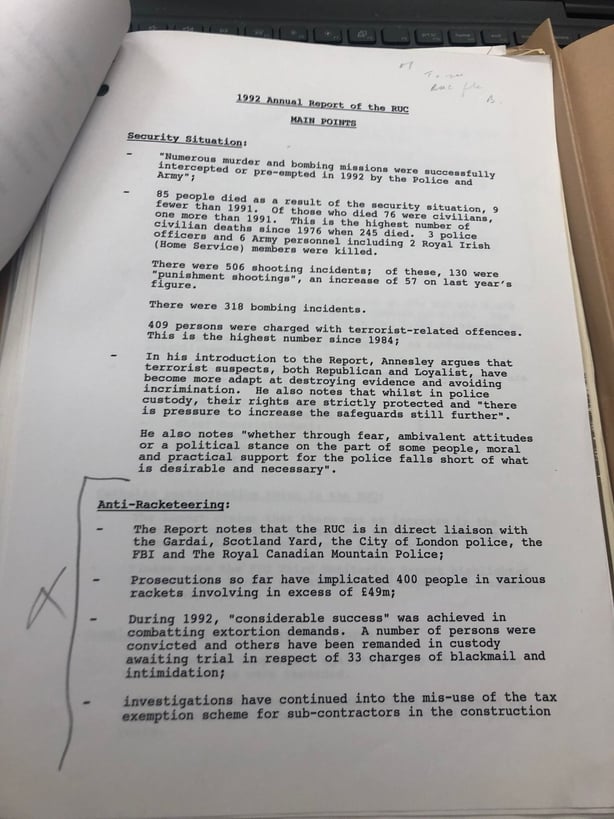
In 1992 alone, this was estimated by the annual report of the Royal Ulster Constabulary, which was given to gardaí and confirmed by the Department of Justice, to be in the region of £49m.
The widely held belief was formally outlined in more than 60 pages of government documents from the 1990s, which have been released for the first time as part of the annual State Papers transfers to the National Archives of Ireland.
In one detailed file sent in February 1993 to the Department of Foreign Affairs by the Northern Ireland Office’s assistant under secretary of state for security, labelled "Terrorist Exploitation of the Construction Industry in Northern Ireland", it said: "The total cost to the exchequer from fraud in the construction industry in Northern Ireland is millions of pounds annually."
"It is believed, on good grounds, that a proportion of the proceeds of those frauds goes to support terrorism," adding that given the fact the situation was "a sensitive issue" the department was "not prepared to disclose the names of those consulted".
A linked file from February 1993, said while it is "widely accepted" actions in Northern Ireland to address racketeering and money laundering were "biting" and that "terrorists are finding it steadily harder to raise funds", there was a "significant exception".
It added: "The construction industry continues to be an important source of funds and influence for both republican and loyalist terrorists."
The file continued that among the concerns raised were the use of "false names of individuals on site", using company documents "unlawfully", and deliberate attempts to "submerge their fraud in widespread, ordinary criminal fraud and so escape effective investigation".
It said other actions included "terrorists offering 'protection’ to contractors, sometimes less sophisticated methods are employed including ‘pay up or else’," a situation the files said meant that "extortion payments have increased costs by as much as 10%", saying this is reflected in "inflated tenders".
Latest stories from 2025 State Paper release
The file argued that new rules could be introduced to ensure cash was not kept on building sites, meaning "the need to keep records would make payment of protection money more difficult", and that individual workers should be licenced so that tax evasion or VAT fraud could be caught early.
However, noting that one consequence of such moves would be a "loss of privacy" for legitimate individual workers, it acknowledged changes would be fought against, adding: "The industry continues to be at risk of exploitation by terrorist racketeers and gangsters, and all the people in Northern Ireland suffer the consequences of the industry’s problems."
In response to the information, a Mr O'Brien of the Department of Justice wrote to the department’s assistant secretary Caoimhín Ó hUiginn in June 1993 to say that while "there is no exactitude as to the amount of money obtained by the IRA from racketeering, it is on a very large scale".
A code of practice for the sector in Northern Ireland was subsequently introduced in an effort to address the situation in 1995.
However, by 1996, fresh concerns were raised over the possibility that paramilitary groups which had announced ceasefires and were meant to be winding down may have seen the prospect of "peace dividend" inward investment into Northern Ireland as an opportunity to continue extortion and racketeering tactics.
[Based on document 2023/50/387]
