


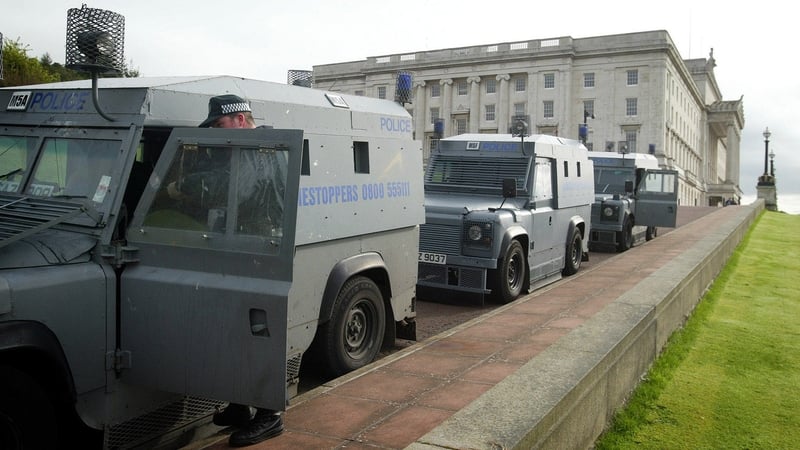
Tensions emerged between officials from the Irish and UK governments on Friday 4 October 2002 after PSNI officers raided Sinn Féin offices at the Northern Assembly in Stormont and arrested four members of the party.
Called 'Stormontgate', the raid was carried out to retrieve documents from an alleged IRA spy ring.
Irish officials were "deeply" concerned about the "grave implications" the incident could have for the political process at the time, newly-released State Papers confirm.
Among those arrested at Stormont were Denis Donaldson, the then-head of Sinn Féin's administration office at Stormont, who was subsequently revealed as an informer before he died in April 2006.
On the day of the raid, Tom Lynch wrote a briefing note from the British-Irish intergovernmental secretariat stating that "while acknowledging" that the raid was "primarily a policing and security matter" the Irish side "would be concerned that the basis for the raid would prove to be well founded".
Prime minister Tony Blair's chief of staff Jonathan Powell rang Irish officials that afternoon saying that "we had rather a large problem", adding that the evidence they had leading to the raid "was damning" and the situation was "pretty grim".

The phone calls kept coming, with Sinn Féin’s Ted Howell ringing Dublin later that day to "register deep concern". He said that it was a "carefully orchestrated mess" and was going to cause ructions.
Then, on 7 October 2002, Jonathan Philipps from the Northern Ireland Office (NIO) was in contact with
the Department of Foreign Affairs and described the events the previous Friday as "serious and significant".
Irish official Brendan Scannell noted that he had "expressed dissatisfaction at the flow of information" about the arrests to Mr Phillips.
In response, Mr Phillips referred to the coincidence of key officials being missing on Friday and the fact that "it was the weekend".
He continued that "we should not under estimate" the fundamental crisis in unionism following "Friday’s events".
Mr Scannell wrote: "I said while I did not want to equate the feelings of both communities" there was also "outrage amongst nationalists in the way the raid at Stormont was carried out".
The next day, a note on discussions between the Irish side and British Joint Secretary Chris McCabe showed that Mr McCabe accepted that the flow of information had been "very poor".
He added that the British side and "much of the NIO" itself had been "starved of information" too.
Mr McCabe said that there was an "intense feeling of betrayal" within the NIO at the theft of the documents which led to the raid.
He said that their thinking on the impact of the raid and the political crisis now was "fairly fluid" but that the "general thrust was to suspend before (First Minister of Northern Ireland David) Trimble walks out".

Ray Bassett, in a note to Irish officials, reiterated "our difficulties" with suspension and postponing the election.
There was a danger that without political activity some activists would "drift into other less desirable activities" on the streets Mr Bassett said.
Also on 7 October, a briefing note for then-taoiseach Bertie Ahern, before he met Sinn Féin, had suggested questions, including: "Did you know what was going on?", "Did Donaldson have confidential material at home?" and were they "as surprised as us" at the raid.
There is a note too that "the agreement is at stake", referring to the Good Friday Agreement.
The release of papers also contain minutes from a phone call between former Norther Ireland secretary John Reid and then-minister for foreign affairs Brian Cowen on the day of Stormontgate.
By 14 October 2002 , the Northern Assembly had been suspended and direct rule was reimposed.
In December 2005, all charges from Stormontgate were dropped, with the PSNI confirming that its investigation was over.
[Based on document 2025/127/105]
Other revelations from Day Three of this year's State Paper release include how the State dealt with the fallout of the 1995 Lansdowne Road riot.
The riot infamously occurred during the first half of a friendly match between the Republic of Ireland and England on 15 February 1995.
Ireland were leading England 1-0 through a goal from striker David Kelly when the match was called off after just 28 minutes, due to violence by English hooligans against both Irish and legitimate English fans.
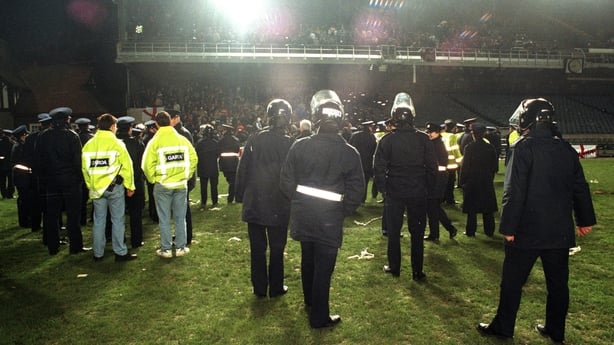
Ministers were also told that garda reserve numbers at the stadium were "insufficient", new files reveal.
While the Football Association of Ireland (FAI) had "not clearly understood or remembered" pre-game safety information.
Government ministers were also told that away fans attending matches at the country's biggest football stadium should be limited to the "lower deck" of the ground to ensure public safety.
[Based on document 2025/115/986]
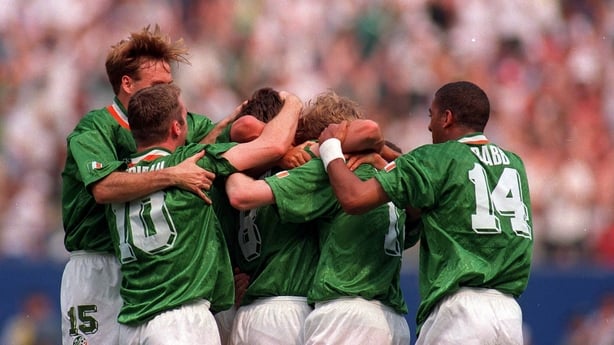
In a separate, but also football-related, file published for the first time today, were details of how Irish embassy officials in the US gave thousands of pounds worth of World Cup tickets to Irish fans ahead of the tournament.
Irish fans travelling to follow Jack Charlton's men across the US were left ticketless in Florida after a British travel agent suddenly went bust, leaving supporters stranded.
However, the embassy stepped in as they feared the incident could lead to a "riotous situation".
[Based on documents 2025/124/180 and 2025/124/178]
Another document released today shows how the Provisional IRA and other paramilitary groups laundered tens of millions of pound sterling every year through the Northern Ireland construction centre in the final years leading up to ceasefires and peace talks.
This was taking place due to a number of factors including "pay up or else" extortion, social security and inland revenue, and VAT frauds, a "doubling up" of workers' social welfare payments and other long-stated criminal money washing tactics.
Construction costs rose as much as 10% per project, the new files shows.
[Based on document 2023/50/387]
Almost half a century ago, overcrowding and a lack of bed capacity was identified as a major issue at University Hospital Limerick (UHL), another new document released under the State Papers shows.
Today, UHL regularly tops waiting lists for hospital beds - but the overcrowding situation around 1979 and 1980 prompted repeated efforts by health officials to address it.
This ranged from pleas to secure extra bed capacity, assessing beds in other Limerick facilities, hiring extra nurses and securing the appointment of more consultants.
[Based on document 2025/161/17]
In 1995, there were escalating fears of a radiation accident at the Sellafield/Thorp nuclear facilities in the UK, leading the government to consider taking legal action.
Then-taoiseach John Bruton was taking the issue extremely seriously, and went as far as raising it directly with the then-prime minister John Major.
According to a newly-released briefing document, the possibilities for legal action were greatly assessed.
[Based on document 2025-115-541]
