
2025 was the year climate scientists agreed it would be impossible to limit global warming to 1.5C above pre-industrial levels.
The target was agreed by world leaders back in 2015.
This means a certain amount of damage to the Earth's environment due to human-induced climate change is irreversible.
In Ireland, several reports this year found that the state of the country's environment was getting worse.
Met Éireann climatologist Paul Moore explained that as Ireland warms, extreme weather events will become more frequent.
Mr Moore told RTÉ’s This Week that sea level rise is "locked in", even if global warming was limited to 1.5C.
Listen: Global warming has consequences for everyone on the planet
We need your consent to load this rte-player contentWe use rte-player to manage extra content that can set cookies on your device and collect data about your activity. Please review their details and accept them to load the content.Manage Preferences
"That means when we get an extreme rainfall event and high tides or spring tides together, we have compound events where you get tidal lock, you get coastal flooding as well as the rainfall and not being able to run out into the sea," he said.
Mr Moore added: "So those compound events where sea level rise will come in conjunction with storms and heavy rainfall events causing more impacts.
"That's something that's definitely going to increase."
There has been a 0.2 metre rise in the sea level off the Irish coast between 1901 and 2018.
The National Climate Change Risk Assessment identified 115 risks for Ireland in a warming world, among them were coastal flooding, erosion and extreme winds.
Extreme weather events in Ireland in 2025
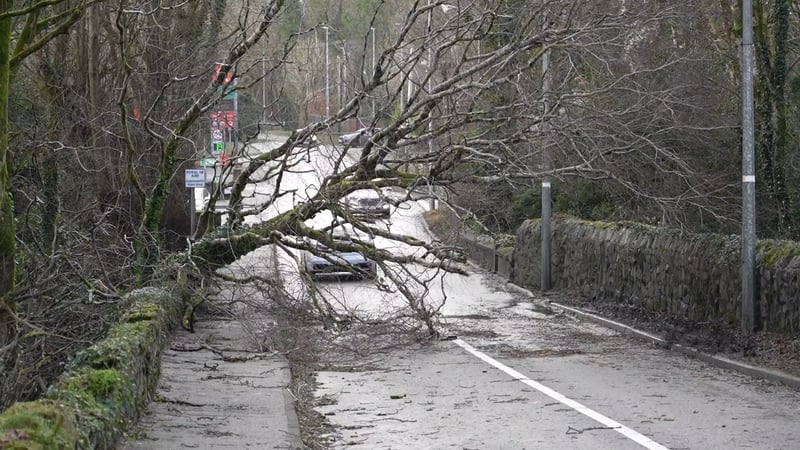
This year began with Storm Éowyn, which broke Irish records for both wind speeds and gust.
The warmest spring on record in Ireland was this year, as was the warmest summer.
Almost half of the rainfall this year has occurred since September.
Of the 12 months of the year only January and September were cooler than average this year.
"We're looking like we're going to be in the top three warmest years on record this year again," Mr Moore said.
While not all-weather events can be attributed to climate change, the WASITUS project is beginning to perform rapid-attribution studies on Irish weather events.
One such study this year found that Ireland's hottest summer on record was 40 times more likely due to climate change.
"Those nighttime temperatures during summer are now one in 15-year events and pre-industrial would have been a one in a 600-year event," Mr Moore said.
"If we continue to warm to a 3C warmer world, those kinds of nighttime summer temperatures will be every other year."
Environmental damage in 2025
Over the summer, a report from the Environmental Protection Agency (EPA) found that reductions in the country's greenhouse gas emissions are too slow.
The latest projections show that emissions could fall by up to 23% by 2030 if all climate policies currently in train by the Government are fully implemented on time.
The Government has agreed to a legally-binding emissions reduction of 51% by 2030.
In October, an EPA report on surface water quality showed that Ireland is continuing to decline and only 1,523 out of 3,189 rivers passed the quality test as set out in the Water Framework Directive.
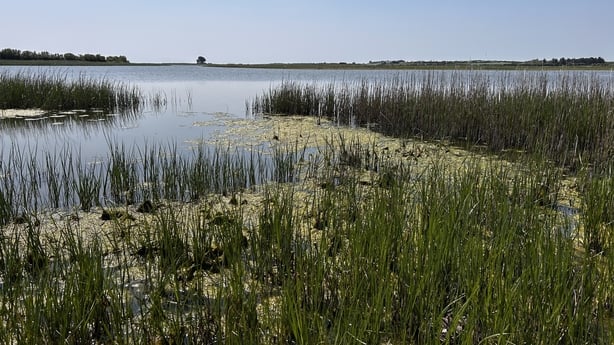
Earlier this month, a report from the National Parks and Wildlife Services found that 90% of Ireland’s natural habitats are in poor condition and have declined over the past six years.
Ecologist Padraic Fogarty said the solutions are known, but just need to be implemented
"We have no shortage of reports and recommendations and yet the kind of action that we need always seems to be elusive and down the line," he said.
Mr Fogarty said there are positive environmental developments in the return of the corncrake population and increased community efforts to restore bogs and old-fashioned hay meadows for wildlife.
However, the collapse in the mackerel population off the Irish coast is a further alarm bell for Irish sea life, he said.
The poor quality of Irish lakes Lough Neagh and Lady Island Lake in Wexford as well as the large-scale fish kill in the river Blackwater in Cork show that freshwater life is also in significant decline.

"Nature can't take everything that we throw at us, but it is also verifiably true that nature has incredible powers to restore itself," Mr Fogarty said.
He added: "We know that if you protect marine life, that fish life will bounce back very quickly. We know that we can get insects and birds and butterflies back into our fields and our countryside relatively quickly.
"We know even that water quality would improve quite quickly if we were to reduce the amount of pollution. that we're putting into the river. So, I think all this points to the urgent need to start doing many of the things that we have been promising that we will do for 20 or 30 years now."
Increased greenhouse gas emissions
This year marked the end of coal power-generation in Ireland. Wind is the single largest energy source in the country.
Clean energy is growing rapidly both in Ireland and internationally.
However, a report from the Environmental Protection Agency found the country was going backwards in efforts to meet its legally-binding greenhouse gas emissions targets.
In March, the Government green-lit a liquified natural gas terminal which it said would be used as the State’s back-up gas reserves on the same day that the Climate Change Advisory Council warned that unless further action is taken, Ireland will face up to €26 billion in fines for failing to meet EU Climate Targets
"2025 may be remembered as the year climate change stopped feeling like a future risk," said Professor of Sustainable Energy at University College Cork Hannah Daly.
"The impacts in extreme weather, food price inflation and flooding, they're all being felt very close to home," she added.
Every fraction of a degree above 1.5C means more damage, however Prof Daly said it was important to keep in mind that that also means that every action that reduces greenhouse gas emissions is worth doing.
"The more we emit now, the more profoundly our climate will change and the harder it will become to bring temperatures back down to safe levels later," she said.
She added: "Every tonne of greenhouse gases that we add to the atmosphere causes warming and causes damage.
"On the other hand, every action that we take to limit greenhouse gases, to restore our ecosystems, to transition away from fossil fuels, leaves us with a more secure and sustainable future.
"I personally find that framing very motivating and very positive because this is the future that we all choose."