


Some other stories from the State Papers include concerns over concert safety, Irish files about the abdication of King Edward VIII, VIP disruption at Dublin Airport, CSO relocation to Cork, a UN future for Northern Ireland, outsourcing cervical smear tests and British attitudes to Irish Unity:
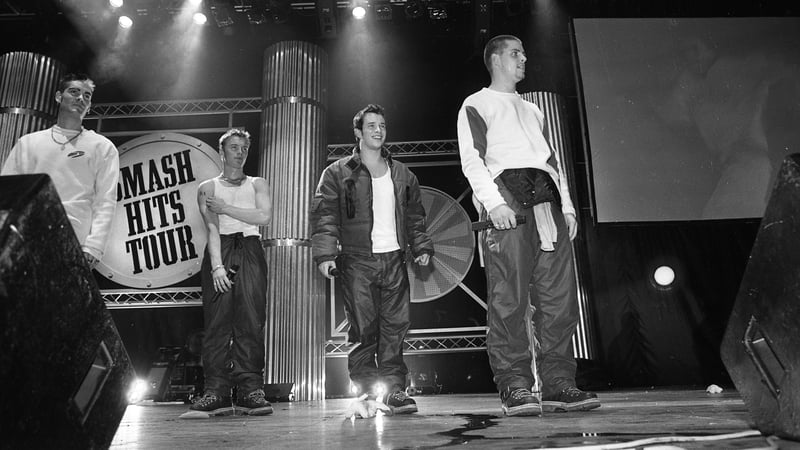
Call for new concert rules after 'heat and hysteria' of Boyzone gig
The government's attorney general said there was an "urgent need" for new laws to clampdown on what type of concerts were allowed to take place in Ireland after 12 people were reportedly hospitalised with "heat and hysteria" after a 1995 Boyzone gig.
The office of the attorney general issued the unusual call for action after the incident took place during a concert in the National Basketball Arena in Tallaght, Dublin, at the height of the band's fame.
After garda reports said a number of people had to be "carried outside", the then government's attorney general Dermot Gleeson wrote to then justice minister Nora Owen to say there was an "urgent need" to restrict future concerts due to the reported hospitalisations.
The planned gig in Tallaght had already been subject to "serious local objections", and resulted in a temporary licence not being applied for the holding of the concert, with gardaí instead agreeing to an arrangement where they could enter the premises at any time they felt necessary to calm any incidents.
However, despite the arrangement, Mr Gleeson still had concerns, writing six weeks after the concert that Ireland had "an inadequate statutory basis for dealing with music concerts where large numbers of people, particularly young people, congregate".
British asked Irish not to publish any files on 1936 abdication
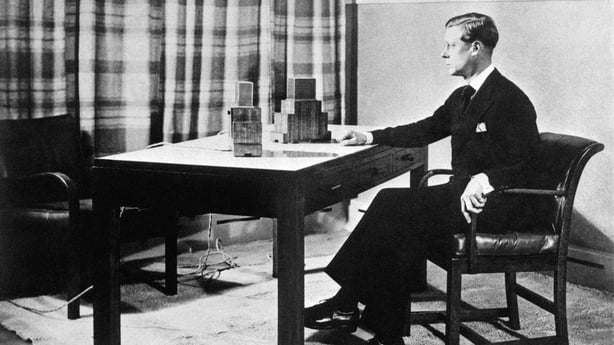
The British government asked Irish officials to withhold from public release any documentation relating to the 1936 abdication of King Edward VIII.
Confidential files released as part of the State Archive revealed Britain's sensitivity to any documentation releases in respect of the Royal Family despite the passage of almost 32 years since the king stepped down after less than a year on the throne in favour of his younger brother, King George VI, so he could marry an American divorcee.
London was particularly concerned that what it termed "a crucial conversation" between taoiseach Eamon de Valera and Assistant Permanent Undersecretary of State for Dominion Affairs Harry Batterbee about King Edward VIII's position in respect of his desire to marry US divorcee Wallis Simpson may be contained in Irish records.
On 16 June 1967, the British Ambassador contacted the Department of External Affairs (now the Department of Foreign Affairs) to inform them that London would not release any of the papers in respect of the abdication of King Edward VIII three decades before.
An Irish civil servant also noted that the Secretary of the Department of External Affairs, H. J. McCann "was disposed to fall in with the British wishes in this respect". [Based on documents in 2025/115/994]
VIPs causing too much disruption at Dublin Airport
Greeting foreign dignitaries when they arrive in Ireland is an important part of the work of Irish airports.
But it does come with some practical difficulties, as a file from this year's State Papers explains.
In the aftermath of a number of VIP visits, in 1993 Aer Rianta contacted the government to ask if it wouldn't mind moving any future dignitary landings to any time "other than mid-morning" to avoid the usual passenger rush hour at Dublin Airport.
Aer Rianta contacted the Department of Foreign Affairs to apprise the government that it had been criticised over the visit of the President of Germany the previous year as the welcoming ceremony had delayed other passengers from getting off flights into the terminal building.
It noted that all activity on the tarmac at Dublin Airport comes to a halt for the duration of such ceremonies which usually last about 15 minutes.
A senior Aer Rianta executive, Don Treacy, expressed concern that the arrival of such VIP guests in the summer would occur when Dublin Airport was at its busiest and asked if it was possible that they could be invited to arrive at a time other than mid-morning.
The chief of protocol at the Department of Foreign Affairs, Brendan Moran, told Mr Treacy that mid-morning was the usual time when visiting heads of state arrived at Dublin Airport.
He explained that there was a set pattern of events for the first day of a State visit including lunch at Arás an Uachtaráin and a wreath-laying ceremony at the Garden of Remembrance.
However, Mr Moran said it might be possible, subject to the President's agreement, to move welcoming ceremonies to Arás an Uachtaráin instead of the airport if it was proving too disruptive for Aer Rianta.[Based on documents in 2025/115/704]
Opposition to CSO's move to Cork
Plans to move the headquarters of the Central Statistics Office from Dublin to Cork in the early 1990s were strongly criticised by the CSO’s own top executive who branded its proposed relocation to the Cork suburb of Mahon as "totally unsuitable".
Newly released files from the National Archives show the National Statistics Board (NSB), the CSO’s advisory body, also expressed concern that the decentralisation plans could impact on "the quality and timeliness of official statistics and the general efficiency of the office."
The NSB urged then taoiseach Charles Haughey in December 1991, to rescind the government’s decision to move the CSO to Cork, claiming the proposal posed "a real threat to the CSO's ability to perform its functions satisfactorily, even in the medium-term".
Documents released under the 30-year rule show that CSO director Donal Murphy informed the Department of Finance in January 1992 that the selection of the site in Mahon - which has been the headquarters of the CSO since February 1994 - over a city centre location would "compound the problems we anticipate in relocating to Cork."
"We wish to complete the move as efficiently as possible and do not want it to be further complicated by a very unsuitable location for staff," said Mr Murphy.
He urged the government to take his view into consideration in the decision on the location of the new CSO headquarters. [Based on documents in 2025/115/354]
Top secret report on making Northern Ireland a UN trusteeship
Irish officials examined a secret report in the 1970s which theorised how Northern Ireland could become a United Nations trusteeship - meaning UN forces would be based there - due to the Troubles.
The confidential study was so secret that one government memo warned that it must be done without consulting the UN - or even Ireland's mission to the UN in New York.
One potential model for the arrangement was the temporary administration of Jerusalem by the First Committee of the UN General Assembly.
The report was examined by, among others, then foreign affairs minister and future taoiseach Garret FitzGerald and then attorney general Declan Costello.
In a letter to Mr FitzGerald on 9 January 1976, Mr Costello wrote that he found the report "very helpful". [Based on documents in 2025/124/469]
Decision to source cervical smear tests abroad based on cost
The government was told in the mid-1980s that it might be cheaper to send cervical smear tests abroad for testing instead of examining results in Ireland - a situation which contributed to the cervical cancer checks scandal three decades later.
New files released as part of the State Papers show that one of the reasons given for the belief it would be cheaper to take this step was because otherwise Ireland would have to pay for the training of lab engineers in Irish hospitals. [Based on documents in 2025/115/13]
John Major said British government had 'no special interest' in unity option
Then British prime minister John Major told then taoiseach Albert Reynolds that London would "facilitate" Irish unity if there were ever a "majority" in Northern Ireland who wished it to happen.
However, Mr Major also stressed that London had "no special interest" in the matter and "cannot be persuaders", with the Conservative leader joking that "not even a Labour government" in Britain could tell unionists "to go".
The conversation is noted in State Papers marked "secret" from September 1992, during a meeting between Mr Major and Mr Reynolds in London.

During the meeting, Mr Major also said while there was at the time hopes of a push towards peace "unionist consensus will not carry a referendum, [and] that means nationalists would have to consent formally to partition" for a peace deal to pass.
On the issue of Irish unity, Mr Major also said the UK government's approach to any future hypothetical discussion would involve having "the attitude of benevolent onlookers".
Both Mr Major and Mr Reynolds then agreed to continue their discussion informally, without commitment and without note taking, the files confirmed. [Based on documents in 2023/50/204]
