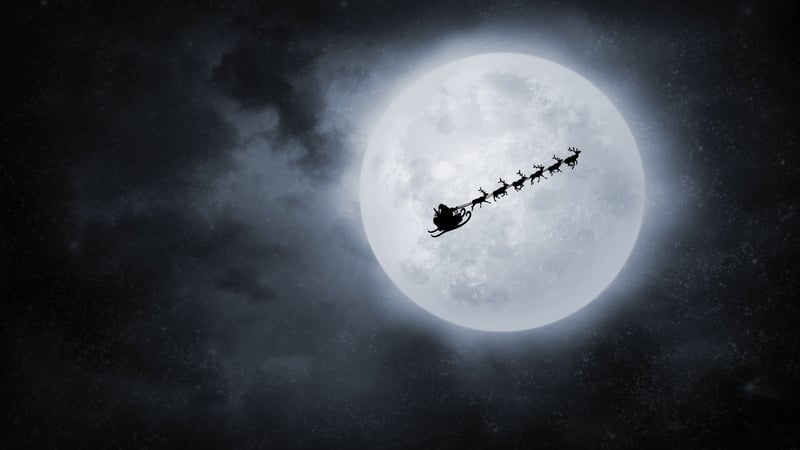

Look, in the sky - it's a bird, it's a plane, no it's... it's actually Santa's sleigh, sleighing its way around the world.
But how did it get there? Many people have been busy hand-making mince pies for the main man, and haven't the time to answer such questions, but we do.
The first port of call is to hear what the younger generation thinks.
Some of the students at the Leah Moran Stage School in Kildare had some of their own ideas as to how Santa's sleigh gets into the sky.
"The reindeer's hooves are magic so wherever they walk, there's an invisible path under them", said eight-year-old Theo.
"The reindeers help Santa, the elves give them some magic", said Pippa, aged six.
Wynter, also aged six, thinks - "Santa's making the reindeers go up there because he feeds them special food."
But are they right? Is it all magic, or do engines and technology play a part?

Well, who better than Dr Stephen Scully, Chief Sleigh Scientist, and lecturer in engineering at South East Technological University, to explain how sleighs are engineered.
He's been working with sleighs since Mrs Claus was just Miss Claus.
"So, Santa uses a combination of flying reindeer and magic Christmas dust, and the sleigh is no ordinary sleigh either.
"It's designed to be aerodynamic and light and uses a special quantum anti-gravity technology," said Dr Scully.
"One of the elements is the 'Rapid Environmental Integrated Navigation Direct Energy Emission Radiator system'.
"We call that in the business the 'Reindeer System'.
"It is zero emissions, so it's environmentally friendly and combines state-of-the-art aero sleigh technologies and magic elf dust", he explains.
But is it safe?
Dr Scully said yes due to the use of rocket boosters, which are used for sustained lift and manoeuvring at higher altitudes, as well as turbulence.
Furthermore, there is no fear that Santa will miss any homes because new technology means the sleigh is now fitted with "an advanced AI navigation that has optimised the parcel delivery system and means we won't repeat the sleigh-tastrophe of 1647", added Dr Scully.

But it's not all good engineering.
From Mrs Claus packing figgy pudding in Tupperware for the journey, to air traffic controllers clearing airspace, it does take a team to get Santa around the world in just one night.
And of course, as the children guessed, Santa's reindeer are central.
Ireland was trusted with minding two of the VIP reindeer ahead of the big night because of the high standard of care we show animals here.
Head Reindeer Trainer at Elf Town in the RDS in Dublin, Daniel Soluns, said they were given Comet and Cupid, as Santa likes to split all the reindeer into pairs.
"That just means that they can have all the rest that they can get; they do have a schedule of sleep", explained Mr Soluns.

All of their food is carefully measured out to ensure they are well-fuelled come Christmas Eve.
"Food is very precise, and they get fed carrots and moonbeams and basically, what that is, moonbeams, just kind of help them have the energy for 24 hours so they can fly longer without getting tired.
"And of course, carrots help their vision, and it helps Rudolph's red nose", explained Mr Soluns.
But that's not all - Mr Soluns said to ensure that they are quick enough to get all around the world, they have physical training sessions too.
"They have lots of practices and lessons, like it could be cloud hopping lessons, or sleigh guiding lessons, zoom laps as well to make sure that they're getting faster and faster each year", he said.

So now that we've got the sleigh into the sky through magic and aerodynamics, I know what you're thinking - presents.
Fear not, because in every country, Santa has a designated hub for Santa toy production, to ensure all toys are carefully designed and accurately packed.
In Ireland, Katherine Staunton from Nimble Fingers in Stillorgan, Dublin, has been leading the operation, as they are Ireland's chosen hub.
"So, we've been dealing with Santa for quite a long time now. My dad actually dealt with them probably from the '80s, so we just carried that on", said Ms Staunton.
He stops at their shop, parks his sleigh on the roof, jumps down the chimney, and they make sure they have all the gifts ready to go.
"We have a lot of contact from the elves, so we know what needs to be prepared, and sometimes he leaves a bit of a mess," explained Ms Staunton.
When asked if presents could fall out of the sleigh during turbulence, Ms Staunton said that while that has happened in previous years, they are now under very strict instructions in terms of packing.
"The elves make us pack them very neatly now, and we have to put them in boxes and kind of reinforce things sometimes as well if they're quite small so that nothing falls out", she said.

So, there you have it, we've unwrapped how Santa's sleigh gets into the sky with all toys arriving in perfect condition.
All that is left is to get some last-minute advice from the students at the Leah Moran Stage School in Kildare.
For nine-year-old Brady, it's all about rising early.
"You have so many people to deliver presents to, you should leave about an hour earlier, so you have more time," he advised.
Whereas, Natalie, also aged nine, wants Santa to get his beauty sleep: "I think he should get a really good sleep."
"I think he should grab a blanket so he can stay a little bit warm", said Rosie, aged seven, and Pippa, aged six, is urging him to "stay away from dirty beer".
And finally, six-year-old Ellie has some practical advice to avoid boredom on his travels:
"He needs to listen to Spotify on the way because he has a big, long journey around the whole entire earth."
So, as you close your eyes and wait for Santa's arrival, you can rest assured that he has a solid sleigh, energised reindeer, a good navigation system, and well-packed presents.