


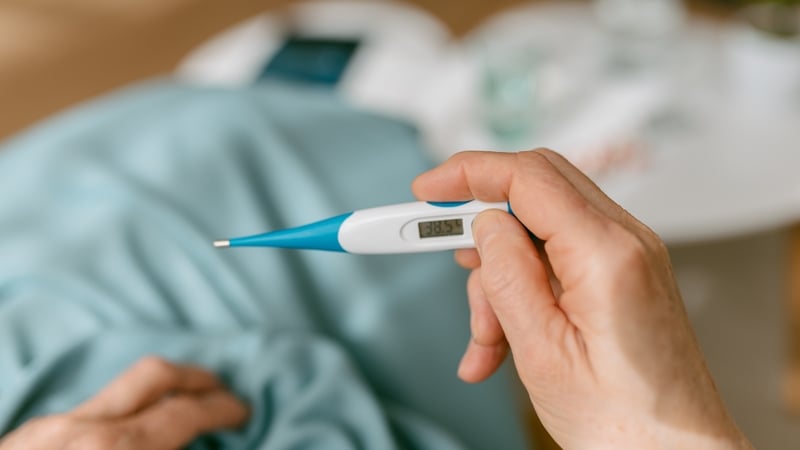
The Health Service Executive (HSE) has said that flu cases are likely to peak during Christmas week.
According to a statement from the HSE as of 16 December, there were 634 people in hospital with the flu, with modelling indicating that the flu outbreak will peak on Christmas week.
It is expected that there will be between 800 to 1,100 people with flu in hospital on any one day at the height of flu.
An emergency doctor working at Cork University Hospital said there has been a steady stream of patients of all ages with flu-like symptoms, alongside their regular emergency work, putting pressure on the whole hospital system.
Dr Seán Underwood, who has just completed a 24-hour shift, told RTÉ's This Week that: "A lot of people are really unwell with fever, severe aches, cough and breathlessness."
We need your consent to load this rte-player contentWe use rte-player to manage extra content that can set cookies on your device and collect data about your activity. Please review their details and accept them to load the content.Manage Preferences
He added that admissions have climbed as the flu hit earlier this year than in previous years. "In vulnerable groups it can indeed be life-threatening. 62 admissions this year to ICU and 17 deaths so far," he said.
He said in terms of preparedness, there were some improvements from previous years.
"We're very thankful for our GP colleagues, for instance, extending their opening hours. We're very thankful for the public for increasing their levels of vaccination."
Dr Underwood said vaccination levels were up on previous years and Ireland was doing well compared to some European neighbours.
He said there had been an improvement too, in the numbers of patients discharged.
"We doubled our consultant presence over the weekends and all of this is obviously solid work that we've done to prepare ourselves for this," he said.
However, he added that there was still a need for additional beds.
Coming up to the Christmas celebrations, he said, children have the highest transmissible rates at a time when they were also meeting their elderly grandparents.
"It is a worry for how we're going to cope after Christmas," he said.
Dr Underwood said as an emergency department CUH was seeing two groups: those who were miserable with the flu but could be managed at home with rest, fluids and over the counter medicines like paracetamol, "and then there's higher risk groups".
"Those older adults, people with chronic illnesses or immunosuppression who can deteriorate quickly with low oxygen levels and low blood pressure."
He said this was the group that needed to be looked out for. Visiting restrictions have also been in place in hospitals for the past two weeks.
As well as protecting vulnerable patients, Dr Underwood said this also helped stem the high numbers of staff being exposed to the flu.
"It's in the nature of our work and we're already struggling with staff numbers."
In Cork, he said the restrictions are now one visitor per patient during certain hours between 6pm and 8pm on the wards, and the situation is "more dynamic" in emergency departments, where some people can cope by themselves, but others with more severe illness can have family in on a compassionate basis.
He urged people with underlying health conditions or comorbidities to contact a healthcare professional if they develop symptoms even over the Christmas period, especially if they develop difficulty breathing, chest pain or coughing blood.
"You're getting worse rather than better, that's when we'll be here to serve you in Ireland's emergency departments."
H3N2 strain 'very infective'
President of the Irish Pharmacy Union, Tom Murray, said the flu strain this year is "significantly different to last year" and there is a "massive amount of spread in children".
Mr Murray added that this is why he has been part of a campaign to increase children's use of the flu vaccine as well as adults.
"I would recommend to everybody that there is still time to get the vaccine."
Mr Murray said the H3N2 flu strain is "very infective" and is spreading.
"We're certainly seeing an increase in presentation of symptoms of flu. The H3N2 strain is very infective - there are seven variants of that.
"And it is spreading quite a lot throughout society, in particular in children under the age of 15."
He added that more people are looking for the vaccine, and while there is some shortage of the nasal spray vaccine, people can go to HSE Live to see where there are stock supplies.
"But there is no shortage of flu vaccines of the injectable type, which is safe for children and adults to use, and it is highly effective," he said.
Mr Murray advised people to book an appointment with their local pharmacy or GP and get the vaccine.
"Vaccines aren’t just about protecting yourself - at Christmas and at New Year, we all get together, we all go and visit elderly relatives, we might have patients who have immunocompromisation because they are on chemotherapy or other things.
"Vaccine isn’t just about protecting you it is one of the great things to do to protect everybody in society."
He added that the flu season is due to peak in about 10 to 14 days.
"Even though it takes a maximum two weeks to get the full protection, you'll still have some protection if you're vaccinated now."
"It's about protecting the people you're going to go and visit later in the week for Christmas and New Year, as well as protecting yourself."
