

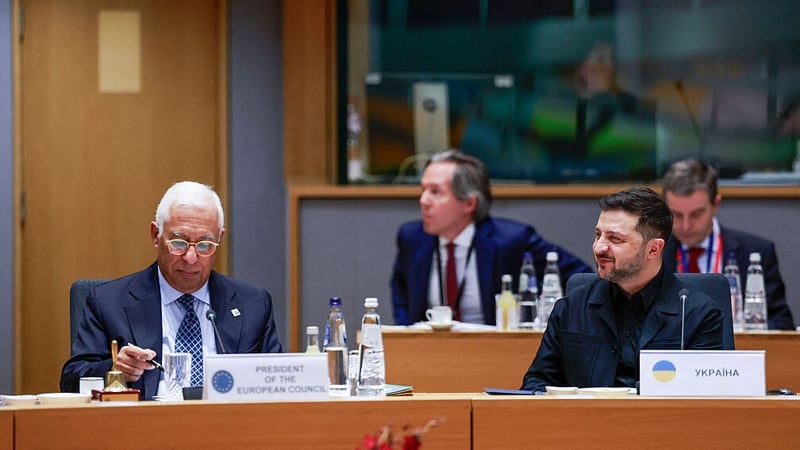
Ukraine will have to significantly cut drone production next year and would not be able to conduct long range strikes on Russian energy facilities, if it does not secure the first loan from Russian assets, Ukrainian President Volodymyr Zelensky has said.
Ukraine is facing a foreign aid shortfall of €45-50 billion next year, Mr Zelensky added.
Speaking in Brussels as EU leaders were set to take a decision on Moscow's seized sovereign wealth, Mr Zelensky said this would mean that Ukraine would have far fewer drones than Russia.
It comes as EU leaders are continuing to debate whether or not to convert hundreds of billions of euro of frozen Russian assets into a long-term loan for Ukraine at a keenly watched summit in Brussels.
Most member states, including Ireland, want to use up to €210bn in frozen Russian assets to underwrite a loan.
However, Belgium continues to resist the plan, despite intense negotiations this week, and there are reservations from a small number of other member states.
Ukraine is due to run out of money early next year.
Arriving at the summit, Poland's Prime Minister Donald Tusk said leaders had a stark choice to make - money today, or blood tomorrow. This was about Europe as well as Ukraine, he said.
As the war approaches its fifth anniversary, and peace talks continue involving US, Ukrainian and Russian officials, the EU is increasingly framing discussions in terms of its own security.
If Russia prevails in Ukraine, then the European Union itself would be at risk.
There are officially two options on the table: borrowing tens of billions of euro against the EU budget, or converting up to €210bn of frozen Russian assets, the bulk of which are currently held in a Belgian securities depository.
But it's the latter option which most member states, including Ireland, prefer.
Watch: Taoiseach says Ireland is in favour of using frozen Russian assets to support Ukraine
Taoiseach Micheál Martin said Ireland is "very much in favour" of using the immobilised Russian assets to support Ukraine financially and militarily in the coming years.
"There has to be a deterrence against countries violating the UN Charter, undermining the sovereignty of other nations, and then destroying those countries their civilian infrastructure, their energy infrastructure, without any need then to rebuild," he told RTÉ News.
"There is an important deterrence issue here that countries cannot simply destroy another country and expect others to pay for all of the reconstruction of that country."
Read More:
How does the EU want to use Russia's frozen assets for Ukraine?
Latest Ukraine stories
But Belgium remains fearful that a successful Russian legal claim could leave the country on the hook. It wants legally binding and enforceable guarantees that other capitals will share the risk especially those which also hold immobilised Russian assets.
There have been intense discussions between Belgium and the European Commission on what guarantees will look like and how open ended they might be.
Mr Zelensky said that any failure by EU leaders to agree on a plan would be a serious challenge for his country.
"I will speak with all the leaders, present our arguments, and I very much hope we can obtain a positive decision. Without it, there will be a big problem for Ukraine," Mr Zelensky told reporters, ahead of his visit to Brussels.
In October, EU leaders - with the exception of Hungary - pledged to find ways to fund the country for the next two years, both for its own survival and to show Russia that Europe continues to support the country.
However, since the vast bulk of Russia's frozen those assets are held in a Belgian company called Euroclear, the Belgian government has objected, fearing a potential legal claim by Russia.
The European Commission has insisted that no Russian or international arbitration court can hold Belgium liable so long as the assets are subject to EU sanctions.
Last week, the EU used emergency powers to ensure those sanctions are locked in until Russia starts to pay reparations, so that Hungary cannot veto them.
Belgium says it wants full mutualisation of the risk. Prime Minister Bart de Wever has also said leaders should consider using so-called headroom in the EU budget against which joint debt could be raised.
However, that appears to be a non-starter, as it would require unanimity, and Hungary would almost certainly block such a move.
Mr De Wever told Belgian MPs this morning that guarantees offered by the EU are so far "insufficient".
"Belgium will not accept a solution where we are the only one bearing both the risks and the responsibility," Mr De Wever said.
"I have not seen a text that could persuade me to give Belgium's agreement. I haven't seen it yet; I hope to see it today, but I haven't seen it yet," he said.
Speaking as he arrived for the summit, Hungarian Prime Minister Viktor Orban said the idea of using Russian frozen assets to finance Ukraine, is "dead" as there is a blocking minority against it.
Officials say agreement on using Russian assets would send a signal to the Trump administration and Russia that Europe is serious about supporting Ukraine in its hour of need.
The European Council will also discuss the Middle East, as well as EU enlargement, security and defence and combatting antisemitism.
The EU's next multi-annual budget (2028-2034), competitiveness and migration are also expected to be discussed.
Ahead of the meeting with EU leaders, Taoiseach Micheál Martin said he looked forward to hearing from Mr Zelensky, who met Mr Martin in Dublin earlier in December.
"I fully support plans to use frozen Russian state assets to support Ukraine, and I hope it will be possible for the meeting to reach an agreement on that," he said.
"I will also be arguing strongly in favour of accelerating Ukraine's EU application. Membership of the EU for Ukraine is also important for its future security.
"Our meeting is an opportunity to send a clear message that EU enlargement will happen, and that the reform efforts by countries aspiring to join our union will be matched by our ambition to advance their path towards EU membership.
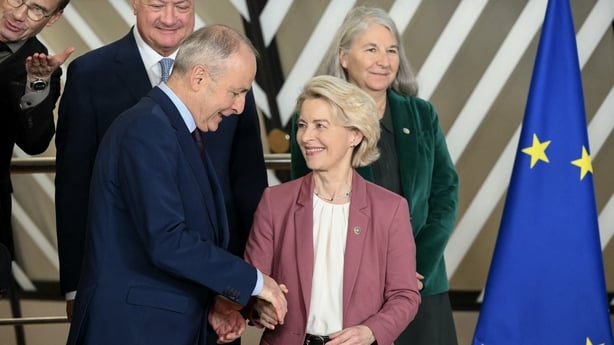
"There are malign actors, including Russia, who are seeking to destabilise the EU and our neighbours, attacking our shared values and posing a real threat to our security."
Referencing sightings of drones near Dublin as Mr Zelensky arrived in Ireland, Mr Martin added, "As recent events have shown, Ireland is not immune to these threats and we must continue to work with our EU partners to combat them."
The Taoiseach also said he would highlight the "critical" humanitarian crisis facing people in Gaza.
"Two months into the ceasefire, aid has still not reached the levels required and as agreed in the peace plan," he said.
"I will be stressing the need for the EU to do all it can to get this much-needed assistance to the people of Gaza, especially as winter closes in, and to contribute to the next phase of the peace plan, which supports a two-state solution," he added.
Addressing Sunday's Bondi Beach attack, he also said he welcomed that the European Council will look to "intensify efforts to rid our societies of the scourge of anti-Semitism".
"We were all deeply shocked and appalled by the terrorist attack on the Jewish community in Sydney," he said.
"There can be no place for anti-Semitism and hatred in our societies," he added.
He said he would argue that the EU should be open to trade and invest in innovation, and said Ireland wanted a "ringfenced and fully funded" CAP and Common Fisheries Policy.
President Zelensky said that Ukrainian and US delegations would hold new talks on Friday and Saturday in the United States aiming to end the Russian invasion.
US President Donald Trump has been pushing for a quick deal to end the fighting, and negotiating teams have proposed draft plans to end the war.
Trump said a deal was closer than ever after Zelensky, US and European officials agreed on a 20-point plan last week.
But Russia has yet to react to the latest proposal and Russian leader Vladimir Putin has repeated that Moscow intends to pursue its maximalist military aims in Ukraine.
"We all know Russia's position. They want to seize the whole of Donbas," Zelensky said, referring to two eastern regions of Ukraine that Putin claimed to have annexed in 2022.
Additional reporting PA and AFP
