Minister of State for Fisheries Timmy Dooley has said that the outcome of an EU fishing quota agreement for next year will present a "very real challenge" for fishermen as fishing organisations say the agreement could impact 2,300 jobs in coastal communities.
EU member states reached an agreement in Brussels on fishing opportunities for 2026 in the early hours of this morning, following the December meeting of the Agri-Fish Council.
Fishing organisations described the outcome for next year as "catastrophic" for the Irish industry.
Seafood Ireland Alliance, a coalition of major fishing and processing bodies, said the industry will have approximately 57,000 tonnes less quota to fish next year.
The alliance said it is facing a quota reduction to the value of €94m and a possible loss of €200m when processing, logistics, and export value are included, that could impact 2,300 jobs in coastal communities.
Speaking this afternoon, Mr Dooley said some of the fish stocks that are important from an Irish perspective were at a very low level and the scientific advice to the European Commission was to reduce the allowable catch for fishermen across Europe.
Mr Dooley said that the stock reduction would have a huge impact on jobs, lives and livelihoods.
He said many small businesses in coastal communities depend on boats going out to fish to provide services to them.
He said he would bring a memo to Cabinet shortly that will set out the approach to appoint an independent chairperson to steer a programme of financial supports to those communities to help them through the difficult days ahead.
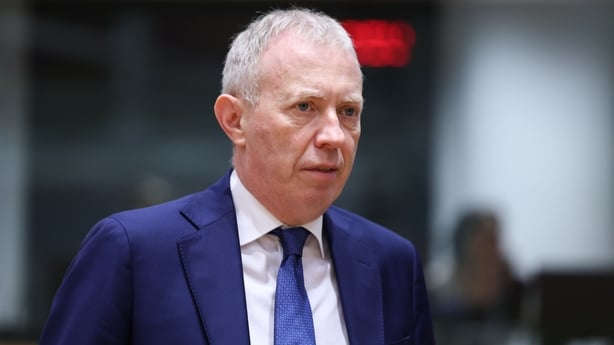
Speaking earlier, Mr Dooley said the scientific advice upon which the decisions were based reflect the impact of overfishing of the mackerel stock by certain third countries.
"They advised 70% drop in the total allowable catch for mackerel is compounded by a 41% reduction in blue whiting and a 22% reduction in boarfish.
"Ireland has consistently called for action against those countries who overfish mackerel.
"Given that Ireland holds the largest share of EU quota for mackerel in the western waters area, the devastating impact of the decline in this stock will be acutely felt," Mr Dooley said.
Mr Dooley said the Government has called for the EU to send a clear message that actions that threaten the sustainability of shared stocks are not acceptable.
Hague preferences blocked
Mr Dooley expressed his "extreme disappointment" at a group of member states who chose to block the implementation of the 'Hague preferences' for next year.
The Hague preference is a longstanding provision within the EU's Common Fisheries Policy that grants Ireland a larger share of certain stocks when total allowable catches fall below a specific level.
It is a protection mechanism for the Irish fishing industry that was introduced in 1976 to account for Ireland’s underdeveloped fleet and to counter the impact of access to Irish waters provided to vessels of other EU nations.
Mr Dooley said: "Regrettably, a group of member states chose to block the invocation of The Hagues this year."
"The consequences will be catastrophic"
The Seafood Ireland Alliance said the deal was "a betrayal of Ireland’s fishing industry".
The alliance accused member states and the European Commission of having reneged on commitments in the Common Fisheries Policy designed to protect Ireland’s reliance on fishing.
Aodh O'Donnell of the Irish Fish Producers Organisation described the blocking of the Hague preferences as "symptomatic of a fundamentally unfair system," where large member states "can dictate what happens to the Irish fishing industry".
Mr O'Donnell said Ireland entered the talks presenting a strong, united front, but was "met with a slap in the face".
"This failure delivers a €94m hit and threatens the survival of many Irish vessels and seafood businesses," said Mr O'Donnell.
"The consequences will be catastrophic," he said.
"Despite the best efforts of Minister Dooley and the Government, the Member States failed to honour the protection mechanism created to support Ireland and failed on the very foundation the European Union was built on."
Mr O’Donnell said the refusal raises serious questions about future cooperation with other European fishing industries.
"If this protection cannot be honoured, why should Ireland continue to offer generous access to our rich fishing waters?" he asked.
2,300 coastal community jobs at risk
The Seafood Ireland Alliance said more than 2,300 jobs in coastal communities are at risk, following the quota cuts.
Brendan Byrne of the Irish Fish Processors and Exporters (IFPEA) said processing plants face a significant threat.
"They cannot survive without supply. Less quota means less fish and less work. Many plants may not survive this blow without raw material."
John Lynch of the Irish South and East Fish Producers Organisations said Ireland's united position was ignored.
"All sectors of our fishing industry backed one position. That unity deserved respect, yet Ireland was dismissed.
"We now have a situation when our fleet of fishing vessels are left with 28 tonnes of sole to catch in 2026 on the south coast of Ireland, when Belgium has 450 tonnes," Mr Lynch said.
Mr Lynch said a longstanding agreement based on access to Irelands Exclusive Economic Zone was broken.
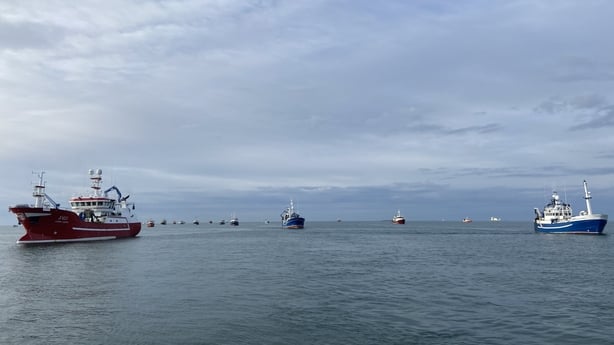
"This is a sad day for the Irish fishing industry, a very sad day for Ireland and a disaster for the dysfunctional fisheries council process."
Patrick Murphy of the Irish South and West Fish Producers Organisation said the Irish industry "was paying for others' reckless behaviour".
"Non-EU states ignored science and inflated their catches. They created this crisis. Ireland fished responsibly, yet we now carry what are proportionately the heaviest losses," he said.
Mr Dooley said the Government intends to establish a working group to develop a framework of support for the sector to address "the substantial challenges in the time ahead".
The political agreement reached over the past few days at the EU Agriculture and Fisheries Council sets catch limits for the most important commercial fish stocks.
It covers the Atlantic, the North Sea, the Mediterranean, the Black Sea and other waters for 2026 and for certain stocks for 2027 and 2028.
The stocks covered are those the EU manages either; on its own, jointly with neighbouring non-EU countries, or through agreements with international organisations set up to manage the conservation of specific fish species.
The European Commission said the agreement drawn up respects the aims of the Common Fisheries Policy.
They said it considers the best available scientific advice from the International Council for the Exploration of the Sea and the Scientific, Technical and Economic Committee for Fisheries.
The Commission said as consultations on mackerel amongst northeast Atlantic coastal states are still ongoing, ministers agreed on provisional catch limits for the first six months of 2026.
The provision catch limit is in accordance with ICES advice, of a reduction of 70%, pending agreement on a total allowable catch.
Given the seasonality of the mackerel fishery, EU ministers set provisional catch limits at 90% of the level advised.
Cuts will be 'devastating for inshore boats'
Chairman of the National Inshore Fishermen's Association, Michael Desmond, said the cuts will be "absolutely devastating for inshore boats".
Mr Desmond said all potting boats involved in crab, lobster and shrimp fisheries rely on fish for bait, particularly pelagic fish as there are "no small whitefish trawlers anymore to supply them".
He said the loss of the blue whiting and mackerel quota will make bait too expensive or not available for inshore fishermen and women.
"There is a maximum of 50 large pelagic boats in Ireland that fish for mackerel and blue whiting; the price of these fish will rise dramatically due to high demand and low supply.
"This will have a knock-on effect in every rural coastal community in the Republic of Ireland," he said.
Mr Desmond said the inshore sector is responsible for most of the direct employment in Ireland's fishing industry.
He added it was imperative that "any forthcoming financial support from Government should mirror the inshore sector's contribution to rural coastal communities".
Vessel owner and chairperson of the Killybegs Fishermen's Organisation Ciarán Doherty said he will have about 14 to 20 days at sea in 2026.
"What happened over the course of the last two days is Brussels is an absolute disaster for the Irish fishing industry.
"The Hague Preferences were a fundamental part of Ireland’s membership, set up as a floor level [quota share] for the Irish industry in 1976 and that has been stripped away.
"This is unprecedented. We will be asking the Government to take a legal case against it," he said.
Mr Doherty said Ireland’s mackerel quota has plunged in the last five years, following Brexit, the latest reductions and the blocking of the Hague Preferences.
"The Government needs to change the dynamic [of its relationship] with Europe going forward, for the betterment of the Irish industry," he added.