
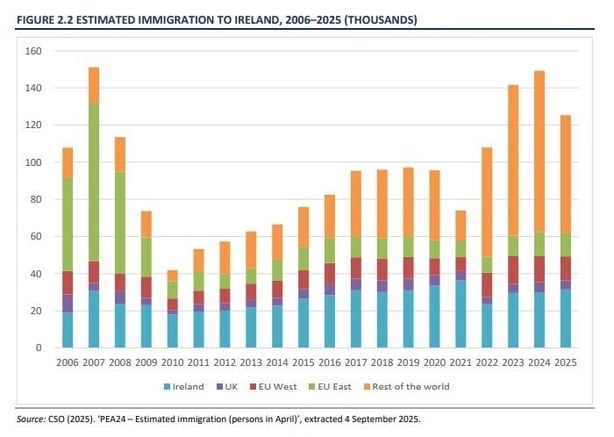
Immigration to Ireland fell sharply last year, with overall arrivals down 16% in the year to April 2025, according to the European Migration Network (EMN) Ireland's annual review.
The review pointed to the decrease being driven primarily by a continued decline in people coming from Ukraine.
A total of 111,480 Personal Public Service numbers were allocated to Ukrainians between February 2022 and December 2024. Of these, 9,558 were allocated in 2024.
Although the number of people coming from Ukraine dropped, those seeking international protection rose by 40% in 2024.
However, the Department of Justice has since announced a 40% reduction in international protection applications in 2025.
Last year, Ireland accounted for 1.86% of the EU total of 997,350 applications, according to the EMN, compared to 1.17% in 2023.
Nigeria, Jordan and Pakistan were the top three countries of origin. The largest increase was from Jordan, and the biggest decrease was in applications from Algeria.
When it came to decision making by the International Protection Office (IPO) last year, the report says the IPO "significantly scaled up decision making".
2024 saw a 56% increase in the number of decisions made compared with the previous year.
Nonetheless, the 2024 median processing time for completed IPO cases was 16 months.
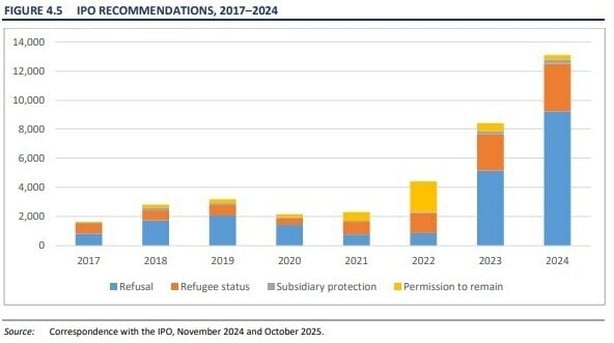
Of the 13,108 decisions made, 70% were refusals. Some of these (35% of final decisions) were overturned on appeal or review.
6,895 third-country nationals were refused entry in 2024, representing a 7% decrease from 2023, and a 25% decrease from 2022.
Refusals to individuals with Albanian nationality more than doubled, from 435 in 2023 to 1,010 in 2024, and Albanians are currently the most common nationality to be refused entry.
The number of South Africans refused entry at the border nearly halved, from 605 in 2023 to 330 in 2024.
There was a significant increase of 345% in the number of voluntary returns between 2023 and 2024.
The figure in 2024, 935 is noted by the EMN as far greater than that for any other year in the last decade.
The inability to accommodate all applicants for asylum is noted as having worsened in 2024, with almost 6,000 applicants not offered accommodation on arrival throughout the year.
Read the report in full here
Turning to legal migration, which accounts for the largest source of arrivals, 2024 saw a 27% increase in the number of employment permits issued, after a drop in 2023.
As in previous years, the two most common sectors were health and social work activities (32%) and information and communication activities (17%).
However, there were increases in permits issued to sectors across the board, with a particular increase in permits issued in the agriculture, forestry and fishing sector.
Residence permit data shows that 24% of first permits issued to non-EEA nationals in 2024 were for employment, while 48% were for education, and just 5% for family and a further 5% for international protection.
The remainder are categorised as 'other' reasons.
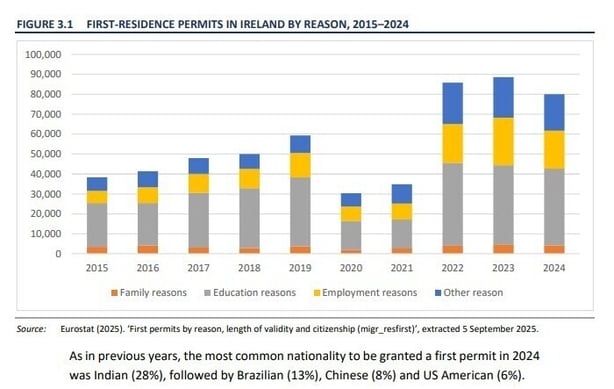
The findings in the EMN report were taken from published first-source material, such as Government or other annual reports, and statistics from the Central Statistics Office and Eurostat.
Report author Keire Murphy described 2024 as one that brought "mixed pressures".
She said the strong uptake of employment permits showed the system responding to Irish labour market gaps.
"However, significant capacity pressures persisted in 2024, especially in the international protection processing and accommodation system," she said.