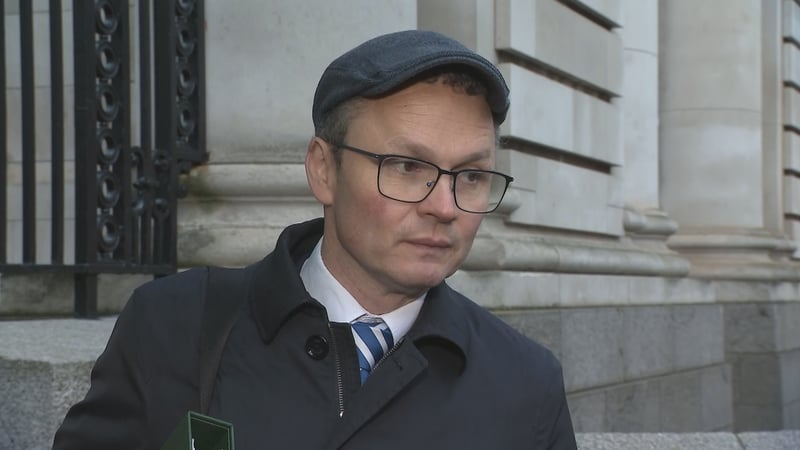

Minister for Communications Patrick O'Donovan has compared allowing children "uncontrolled" access to the internet to giving them a gin and tonic at a bar.
The minister was speaking after an age verification tool as part of the creation of a national digital wallet in a bid to keep children safe online was announced by the Government.
The move comes after Australia became the first country in the world to ban social media platforms for under-16s, with other countries keenly watching developments.
Since midnight in Australia, under-16s can no longer access ten of the most popular social media platforms including TikTok, Snapchat and Instagram, with the firms facing significant fines for breaching the law.
We need your consent to load this rte-player contentWe use rte-player to manage extra content that can set cookies on your device and collect data about your activity. Please review their details and accept them to load the content.Manage Preferences
Minister O'Donovan has said Ireland is watching how that measure takes effect, and is working on age verification systems here.
Mr O'Donovan highlighted recent progress in relation to the development of an age verification mechanism using Ireland’s digital wallet.
While Mr O'Donovan has not yet proposed a minimum age of online consent, it is understood the Government is in favour of 16 as a minimum age.
Listen back: Government move to introduce a digital wallet to verify the age of social media users
We need your consent to load this rte-player contentWe use rte-player to manage extra content that can set cookies on your device and collect data about your activity. Please review their details and accept them to load the content.Manage Preferences
"You wouldn't allow a child in to a bar to sit up at the counter and drink gin and tonic," Mr O'Donovan said at Government Buildings.
"We're allowing children access, in an uncontrolled manner, to some of the most heinous material online.
"As a parent and as a teacher, but more importantly, in this role as minister with responsibility for it, it disappoints me that we're in a situation where we have to act on our own over the last number of years, that we haven't got to consensus in Europe with regard to how we move forward on this.
"I hope to use, as the chair of the European Council of communications ministers next year, the opportunity to push this really to the fore and the theme of our department will be 'protecting the child online,'" he said.
The development of the digital wallet is led by the Office of the Government Chief Information Officer, but the Department of Culture, Communications and Sport is working with the office on providing for an age verification tool in the digital wallet.
Mr O’Donovan said: "Great progress has been made with regard to the implementation of Ireland’s online safety framework, and I commend Coimisiún na Meán for this work.
"Now, we must ensure that the measures that have been put in place are as effective as possible, and the key to this will be the introduction of a robust and secure age verification tool.
"It is a vital part of the picture in terms of providing real assurance that children are the age they claim to be and to ensure they are not exposed to harmful or illegal content."
Read more: Would an Australia-style social media ban for children work here?
Users will have to verify their ages with MyGovID, but individuals' data will not be shared with internet service providers.
A pilot scheme involving around 2,000 participants will be rolled out in the first three months of next year, and Mr O'Donovan said legislative changes would also be required.
Child safety campaigners have long asked the Government to force online platforms to turn off recommender algorithms that are known to push content to children - content that is often harmful to them.
But Coimisiún na Meán rowed back from doing so in implementing the Digital Services Act last year - pushing the issue back to Europe.
Mr O'Donovan said he was frustrated that the European Commission had not yet forced platforms to switch off harmful recommender algorithms for young people, but said it was an EU competency, rather than something that could be done by individual member states.
Campaigners for online safety say that other member states such as France, Italy and Spain have already introduced bans for social media for children.
Technology Ireland, the Ibec group representing the technology industry, welcomed the announcement, saying a "robust, technology-led age verification framework is central to enhancing online protections for young people".
Additional reporting PA