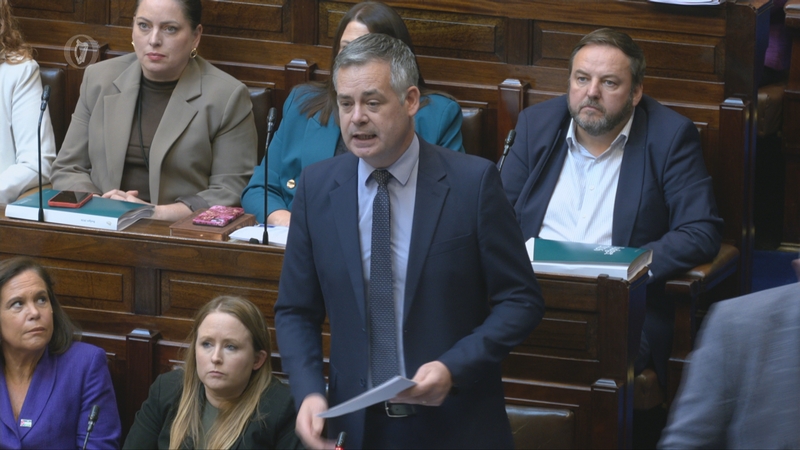

Tánaiste Simon Harris and Sinn Féin's Pearse Doherty accused each other of contradictions in the Dáil as a row broke out about the cost-of-living crisis and college fees.
Mr Doherty accused Mr Harris of repeatedly breaking election promises made to workers and families, before People Before Profit TD Paul Murphy told Mr Harris, who recently became Minister for Finance, "don’t continue to be Scrooge".
Mr Harris responded by defending his Fine Gael party’s handling of the economy and said the Irish economy is "going well".
He rounded on Mr Doherty by pulling out an A4 print-out of a Sinn Féin graphic that compared tuition fees in Northern Ireland with those in England.
The graphic had "£4,855 – student tuition fees in the North" over a picture of First Minister and Sinn Féin Vice-President Michelle O’Neill, and "£9,535 - student tuition fees in England" over a picture of UK Prime Minister Sir Keir Starmer.
Waving the graphic in the Dáil, Mr Harris said that this compared unfavourably with fees in Ireland.
"Your faux-outrage, angry Pearse doesn’t convince anybody," he said amid objections from the Sinn Féin benches.
"We are reducing fees in this jurisdiction now, fees in the north are more than double, and you thought to take to social media and say 'this is great news’. Hypocrites," Mr Harris said.
"People see through it, and that’s why you’re sitting over there giving out rather than actually being in Government, because you have no credibility on this," he said.
"You say one thing here, and you do the exact opposite in Northern Ireland."
Mr Doherty criticised the claim that Mr Harris was "sensible Simon" and said his promise to put money back in people’s pockets was "directly contradicted" by his actions in the first year of Government.
He accused him of breaking promises made during the general election to protect customers and reduce prices.
He said he had promised to cut income tax for workers; to reduce energy bills and instead withdrew energy credits; abolish student fees and instead "hiked" them by €500; to increase the renters’ tax credit; and to bring in a plan to reduce childcare fees to €200 a month in the first 100 days of Government.
Mr Doherty said: "This is not putting money into people’s pockets, Tánaiste. This is about taking money out of their pockets."
"Why should anybody take you seriously when the promises that you made before the general election, one after the other, were broken by you and you did the direct opposite?"
Mr Harris said that they would continue to pursue "sensible economic policies" and they would "continue to be prudent and sensible in the time ahead".
He said the domestic economy was growing, consumer spending was "good" and there was record building and construction.
He said the Government had taken measures to help with the cost-of-living crisis, including the rollout of hot school meal programmes, expanding the Working Family Payment and Fuel Allowance to more families.
He said that the current coalition had only delivered one of five budgets as part of the Programme of Government and that State-led childcare facilities would be delivered.
Garda recruitment and lack of garda stations
Meanwhile, the Labour Party raised garda recruitment and the lack of new garda stations during Leaders' Questions.
TD Duncan Smith said since 2017, only two new stations were delivered in the country, despite one million in population growth.
He said in his area, the garda stations are not fit for purpose, adding that it is not unusual in the country.
"We are screaming out for more resources particularly in rural Ireland," Mr Smith said.
He said he was told by the Minister for Justice that 56 garda stations were unstaffed but not closed, which he said was "absolute nonsense. If the door is not open and there are no opening hours for people to go in and meet and talk with guards then that station is in effect, closed".
He said 129 of 567 stations had a reduction in the number of gardaí assigned to them in the last year.
He accepted that overall numbers have grown but said frontline gardaí have decreased.
Mr Smith asked the Tánaiste if he will increase the training allowance, reform garda pensions and if they will commit to increase the number of garda stations being built around the country.
Responding, Mr Harris said he agreed with the Deputy that there is a need for more gardaí on the streets.
He said the garda budget for next year of €2.59 billion will allow for the recruitment of up to 1,000 new gardaí, 200 more garda staff and doubling the garda reserve to 600.
He said there were 11,000 applications to join in 2025, and that there is a sense of momentum with the numbers going into Templemore and 617 new gardaí have been attested this year.
He said training classes in Templemore are the largest in years and the total number of gardai is now 14,290 compared with 12,816 in 2015.
He said matters of garda training allowances and garda pensions are for discussions through public pay processes and not for him to give commitments to on the floor of the Dáil
On the construction of garda stations, he said the Minister for Justice had approval from Cabinet this week for the garda sectoral investment plan, which he said will see a significant increase in the number of garda stations being constructed.
Money for people with disabilities
People Before Profit's Mr Murphy raised the issue of money for disabled people during Leaders' Questions.
He said these people have been made poorer by €1,400 in the Budget, through cuts the Government introduced. He said inflation has not returned to normal rates as the Government said it would.
"It’s going to be a cold and hard Christmas for a lot of people," Mr Murphy said.
He said the Budget made everyone poorer, unless you were a fast-food giant, a multinational large corporation or a developer.
He said disabled people need an emergency winter payment from the Government.
"Please don’t continue to be Scrooge, don’t continue to be the Grinch, give this little back into people's pockets," he said.
Replying, Mr Harris said inflation in Ireland and the Eurozone is much lower than when the cost-of-living measures were brought in and he said the Government had to get back to an annual budget and that is what they have done.
He said there are measures in place to help with energy poverty, that this week there is a double payment in social welfare rates, an increase in the fuel allowance, while the VAT rate on energy has been retained on the lower rate.
On multinationals, he asked the Deputy if he saw the returns from that sector in November’s tax figures.
"What do you want us to do, send the jobs and money back somewhere else? We're very proud to be a Government that is pro-enterprise and we will continue to pursue policies that keep jobs and revenue in Ireland," Mr Harris said.
He said work is under way on a cost of disability payment and this week organisations representing people with disabilities were in the Department discussing the payments.
Deputy Murphy then urged the Tánaiste to reverse the cuts that made disabled people poorer and he appealed to him to reverse that decision in the days running up to Christmas.
Mr Harris said they will not open the Budget again, adding that the Budget was progressive and that work is under way on a cost of disability payment.
Additional reporting by PA