


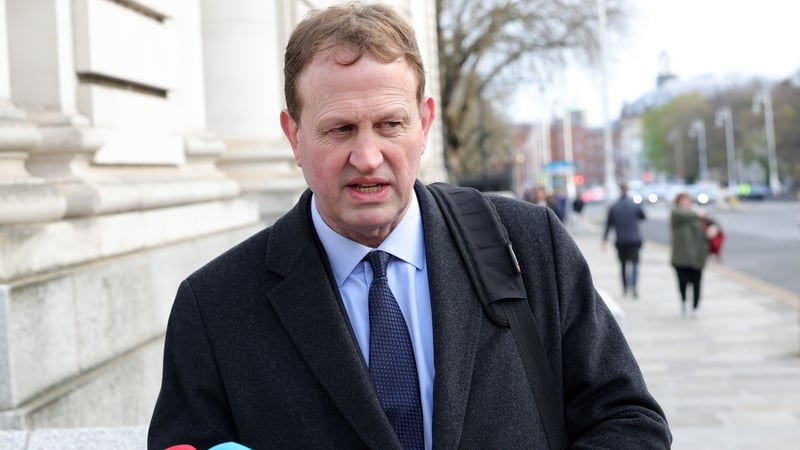
Refugees seeking full citizenship here will be given preferential treatment if they are working, Minister for Justice Jim O'Callaghan has said.
He was speaking after the Cabinet approved a series of changes to the country's migration system.
He confirmed that those who are granted refugee status in Ireland will now have to wait five years before they can apply for citizenship.
Any welfare benefits they have claimed in that period will be examined, and those in work will fare better, the minister said, as he insisted the measures were fair.
Refugee status can also be revoked if someone is a threat to the State.
Under the plan, people will also have to wait longer before other members of their families can join them here.
They will also have to demonstrate that they are financially self-sufficient under revised income rates, plus they will have to pay a fee to apply for family reunification.
Refugees working will be favoured for citizenship, says O'Callaghan
Asylum seekers who are employed will soon have to contribute part of their weekly income towards their State accommodation costs.
Mr O'Callaghan said the population is rising at a rate 1.5% each year, seven times the EU average, and the Government must make decisions on migration that takes account of this extraordinary growth.
Minister accused of 'virtue signalling' on immigration
Ahead of the announcement, Opposition parties on the left were highly critical of the measures.
Labour TD Ged Nash accused Mr O'Callaghan of "virtue signalling" on immigration.
Social Democrats TD Gary Gannon said the proposed changes are "filled with holes" and claimed "there is cruelty built into aspects of it".
People Before Profit-Solidarity TD Ruth Coppinger accused the Coalition of "aping Nigel Farage" and "scapegoating" asylum seekers and refugees.
The plan includes obliging asylum seekers, who are employed, to contribute between 10% and 40% of their weekly income towards their State accommodation costs.
This plan, which was devised in co-operation with Minister of State for Migration Colm Brophy, would mean a person with a weekly income of up to €150 would have a potential contribution of €15; whereas a person earning up to €340 a week would be obliged to contribute around €83.
Taoiseach Micheál Martin has said the proposals are a necessary tightening of procedures.
Mr Martin said the new migration proposals brought to Cabinet are "not a reaction to British policy".
He said they are a modest tightening up, "but an important tightening up nonetheless".
Tánaiste Simon Harris said that migration is a good thing but regarding asylum seekers making a contribution to State accommodation costs, he argued this would assist in social cohesion.
Speaking on his way into Cabinet, Mr Harris said there is a need for a migration system that is "grounded in common sense and is rules based".
He said: "Migration is a good thing, we benefit from migration, but there has to be a balanced approach."
The Minister for Finance said those who are earning an income must pay a contribution and "those who are bringing family here must be able to sustain that family economically themselves".
He said these are "common sense" measures that bring Ireland in line with many other countries.
IHREC 'very concerned' by new immigration measures
The Irish Human Rights and Equality Commission (IHREC) has said it "very concerned" by the new measures.
Chief Commissioner Liam Herrick said they are seeing proposals to restrict rights in a number of key areas such as family reunification and "restricting citizenship".
Mr Herrick said these have been a "cornerstone" of Ireland's integration policy for many years.
He said it is not "clear" that "the potential impact on people's rights" was "adequately considered".
IHREC is concerned "that we are going to follow the United Kingdom," he said.
Mr Herrick said the UK is "clearly going in a direction which is counter to fundamental rights".
"That is surely not a direction that Ireland wants to follow," he said.
"We need to recognise the reality here," said Mr Herrick, adding that people living in IPAS accommodation "don't want to be living there".
"They very often can't access private rental accommodation," he said.
"It is not clear that this has been thought out," Mr Herrick said.
"It's hard to see what impact it's likely to have."
