


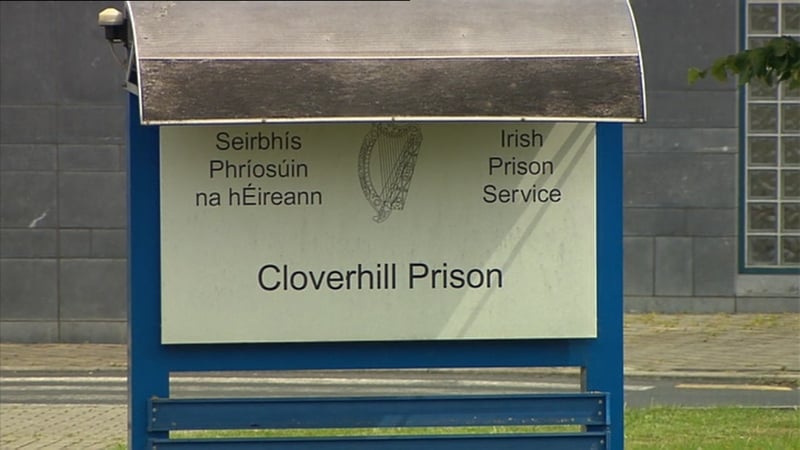
An inquest into the death of a vulnerable prisoner has been unable to establish how exactly he suffered a fatal head injury while being detained in Cloverhill Prison in Dublin.
Christopher Doherty, aged 38, a music manager of Mitchel House, Appian Way, Ranelagh died at Tallaght University Hospital (TUH) on 16 December 2019.
The prisoner had been brought to the hospital after sustaining a head injury in his cell at Cloverhill in the early hours of 4 November 2019 amid concern that he might have suffered an assault or a fall from his bed.
It was noted that he had also been disoriented and lethargic on the previous day.
A jury of four women and three men returned an open verdict on Mr Doherty's death.
It also made several recommendations including asking the Irish Prison Service (IPS) to consider having more nursing staff on duty at night across all prisons.
No reference was made at the inquest to a report into Mr Doherty’s death by the Inspector of Prisons (IoP) which recorded that prison staff had noted that he displayed "unusual behaviour" such as hitting his head off the wall while in Cloverhill.
The IoP said it could not comment on healthcare interventions relating to the prisoner as it was unable to obtain consent from Mr Doherty’s next-of-kin - his mother - to access her son’s medical records.
The deceased, a chronic alcoholic who was also diagnosed with schizophrenia, had been remanded in custody since 16 October 2019 after allegedly assaulting his mother in their family home.
Prison officer, Eoin Minchin, told a sitting of Dublin District Coroner’s Court that he had responded to a call bell at 1.30am when another prisoner threatened that he would "scald or beat" Mr Doherty if he was not relocated to a different cell as the deceased had tried to get into bed with him.
Mr Minchin said Prisoner A was removed from the cell after which Mr Doherty got into a top bunk bed.
He said the deceased had no sign of any injury and made no complaint about being assaulted.
When he checked the cell at 3am Mr Minchin said he found Mr Doherty standing up with blood on his head and clothes.
He recalled that the prisoner seemed confused but provided no explanation how he had received his injury.
Another prison officer, Paul Mongovan, said he thought he heard the injured inmate mumble something about "the bed".
The inquest heard a nursing officer, Jill McRedmond, examined the prisoner and found a small wound had stopped bleeding.
However, Mr Doherty refused to tell her what had happened after which she recommended he be reviewed by a doctor later that day.
A prison doctor, Mohsin Moola, who examined the prisoner at 11.30am, said he was informed that Mr Doherty had been seen eating his own faeces.
'Completely disoriented' condition'
Dr Moola said he arranged an urgent referral for the prisoner to the emergency department of TUH given his "completely disoriented" condition.
He told the coroner he believed the case was "an absolute emergency".
A nursing officer at Cloverhill, Deirdre Betson, gave evidence of calling an ambulance at 12.30pm after she found the prisoner shaking and with a vomit stain on his clothes while he was waiting in the prison’s reception area for an escort to hospital.
The inquest heard an ambulance arrived at Cloverhill at 12.55pm but was not authorised to leave the prison with Mr Doherty until 1.10pm.
Ms Betson explained that approval had to be received from the headquarters of the Irish Prison Service in Longford.
Delay due to 'protocol'
"There was definitely a delay because of the protocol," she added.
Ms Betson said there was a shortage of nursing staff in Cloverhill with one nurse looking after 400 prisoners at night time.
The inquest heard a CT scan on the prisoner in TUH highlighted bleeding and bruising on the patient’s brain and a decision was taken to transfer him to Beaumont Hospital on 5 November 2019.
He was transferred back to Tallaght on 13 November 2019 after his condition stabilised but it subsequently deteriorated and he died on 16 December 2019 after his life support was turned off.
Consultant Pathologist, Heidi Okker, said the results of a post-mortem showed Mr Doherty had died from a traumatic brain injury with chronic liver disease as a contributory factor.
Dr Okkers said the fatal injury was consistent with the victim falling backwards and hitting a flat surface.
The pathologist said there were no signs of any third-party involvement or any defensive injuries on the deceased.
In reply to questions from Dr Cullinane, she said it was possible that several rib fractures and blood-stained fluid on the lungs found during the post-mortem could have occurred at the same time as the head injury.
Dr Okker said she could not say "either way" if Mr Doherty had suffered the fatal injury from a fall or a push.
The inquest heard the DPP recommended no prosecution after examining a file on a garda investigation into the case.
Inspector Brian Hanly said Prisoner A had not cooperated with their investigation but gardaí were satisfied that no assault had taken place.
Governor of Cloverhill, Kevin O’Connell, told the coroner that the urgent transfer of prisoners to hospital still had to be authorised by the IPS headquarters.
However, Mr O’Connell said the decision-maker was now called in such cases rather than the request just being made through an online system.
The jury issued several recommendations including urging the IPS to authorise the person in charge of individual prisons to sanction the discharge of prisoners to hospital in urgent cases and the storing of CCTV footage when any incident occurs.
