

A group representing families that must leave the Ward of Court system due to the introduction of legislation last year have described it as grossly unfair.
The Assisted Decision Making (Capacity) Act commenced in April 2023 and included a provision requiring that wardship be abolished.
The Discharge of Wards Support Group has criticised the Government, the Decision Support Service and the Courts Service over the new system and the pressure they are facing.
The Courts Service recently wrote to those who have not yet sent a Discharge Application for the wards they represent.
Wards of Court are required to be discharged by April 2026, but the letter advised that a solicitor be contacted "as soon as possible" to start the process.
While the correspondence acknowledged that it was "a stressful and uncertain time" for wards and their committees (representatives), it noted that the number of applications received to date was "quite low and given there is now less than two years remaining to discharge all adult wardship cases, it is very important that an Application for Discharge be made as soon as possible".
The Courts Service has said the communication was to remind people that "this provision exists, and action needs to be taken sooner rather than later".
In a statement, it said: "It is imperative we encourage the majority who have not done so already, to begin the process so as there will not be an organisational or court-based logjam as the date approaches in 2026."
The Discharge of Wards Support Group, which represents over 100 families, has described the system as cold, exclusionary and unequal.
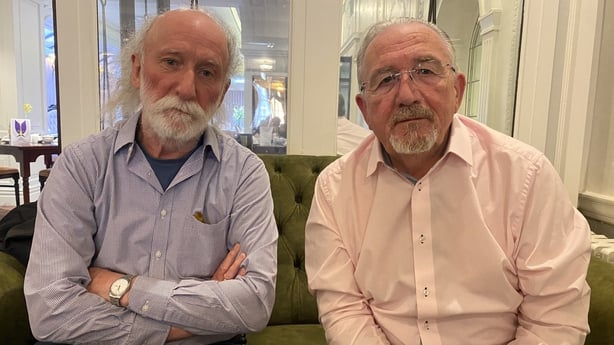
One of the spokespeople for the group, Antóin Ó Lochraigh, said there should have been wider consultation with families before the Decision Support Service was established.
"The final date for discharge is April 2026, the letters going are out, it's putting pressure on people, and they are frightened."
The Courts Service pointed out that the discharge process for a case is lengthy (six months in some cases), that it is taking longer than anticipated, and is complex.
"Time is required to deal with issues that arise and the Wards of Court office needs to manage the discharge process proactively and carefully, as it would not be practicable to deal with a flood of applications in the last year."
It added that were this to happen, "the discharge process would become unworkable."
The letter, it said, was a reminder to committees that "we are halfway into the discharge period and that they need to give serious consideration to commencing discharge applications as the time for filing of discharge applications is progressing".
The Courts Service has said if there are delays, there may not be enough Medical Visitors to carry out assessments.
It said that clarification is often sought from Medical Visitors (Consultant Psychiatrists carrying out functional capacity assessments on behalf of the Court) on the findings of their reports.
The Courts Service added that committees are "finding it difficult to obtain independent financial advice".
It said complex issues arise between family members when deciding if they want to be appointed to assist the ward in making decisions, and the Court "often adjourns cases in order that the parties can clarify matters that arise during the discharge hearing."
Under the Assisted Decision Making (Capacity) Act, wards who have no capacity to make decisions will have a decision-making representative appointed by the Circuit Court.
However, Lisa Marie Murphy who is a representative for her son Finn, said families don’t know who the people are on the panel of Decision-Making Representatives and Decision-Making Assistants, nor do they know "how they’re formed or what qualifications they have to have".
Ms Murphy and another member of the group Ray Whelan, who is a representative for his brother, are also concerned over the assessment of capacity.
"They only have to sign an X. How is it proven that the person understands everything?" Mr Whelan questioned.

At present, there is over €2 billion in assets held for wards of court.
The families say they have been left to "pick up the bill" of solicitors and assessments without any support from the Government.
A letter from the President of the High Court seen by RTÉ News said wards with funds below €100,000 do not have to pay any contribution towards the cost of the application.
"Wards with substantial funds can avail of legal aid (subject to clawback) as the contribution payable towards their legal costs is capped," the letter said.
However, the group believes free legal aid should be available to everyone.
"There is, we believe, a gross unfairness in the system whereby wards having had to pay to enter wardship now have to pay to exit same.
"People have been left in some incidences with life-changing injuries for the rest of their lives. This is one indignity being placed on yet another," they said.
Representatives have called for a meeting to be convened of all the relevant actors involved in the process "which must include at its core wards and their families".
Despite meeting a representative of Sage Advocacy, those concerned believe all representative bodies involved in the process should sit down together.
"When we sat down with the Wards of Courts service in April last year, one of the things that came out was that this had been kicked around for a number of years. I said, if it’s being kicked about why did someone not think of speaking to the families?" Ms Murphy said.
The debacle has left her questioning her son’s future.
"How will he navigate it when I’m not around anymore. Someone could be imposed on us. It’s cold and clinical."
In July, it emerged that the Minister of State Anne Rabbitte had to intervene in a disagreement between the Law Society and the Decision Support Service (DSS) over the structures put in place to establish Enduring Powers of Attorney under the new Act.
The Discharge of Wards Support Group has said that if a leading exponent of the legal profession (the Chair of the Law Society) is expressing grave reservations about the "dysfunctional situation" pertaining to the Decision Support Service ( DSS ).
"The situation has now reached a critical crossroads and nothing less than a complete suspension of the operation of the new departure will suffice," it said.
The Decision Support Service only deals with people once they come out of wardship.
Therefore, it said issues relating to wardship rested with the Wards of Courts office.
The Discharge of Wards Support Group has estimated that €2bn is linked with Wards of Court.
It has called for a complete analysis of the current costs of all charges that are currently in place for wards when it comes to the discharge of financial transactions and it wants a breakdown of all costs accruing for those exiting wardship.
"There is a very strict structure," according to Antóin O’ Lochraigh, "There’s no certainty. People want certainty and the structures are too rigid."
There are just under 2,000 adult Wards of Court.
To date, the Courts Service has received discharge applications for 230 of these wards and has made 72 discharge orders.
Therefore, the anticipated number of discharge applications has not yet materialised.
The Courts Service has warned that if not managed over the timeframe remaining, both the Wards of Court office and the General Solicitor’s office "would require additional staffing resources" and "additional Judicial resources would also be required."