



Minister for Integration Roderic O'Gorman has said he does not accept that the new accommodation strategy for international protection applicants is direct provision under another name.
Mr O'Gorman yesterday announced a new comprehensive accommodation strategy for international protection applicants, which seeks to address the current shortfall in beds while reforming the system over the longer term.
The reforms will see a move away from full reliance on private providers and towards a core of State-owned accommodation, aiming to deliver 14,000 State-owned beds by 2028.
He said it was important to recognise the situation is much different to when the white paper on direct provision was published in February 2021.
We need your consent to load this rte-player contentWe use rte-player to manage extra content that can set cookies on your device and collect data about your activity. Please review their details and accept them to load the content.Manage Preferences
He added: "It's an entirely changed situation and the policy has to change to recognise that."
He said that the new policy meant the accommodation provided will be to national standards.
He said: "These are a set of agreed standards that include access to cooking facilities, and that was one of the key elements that was always identified, and with direct provision, that was a particular difficulty I suppose to people in the system."
He said that Minister for Justice Helen McEntee has been working to speed up processing time for people in direct provision.

Mr O'Gorman said: "She has put very significant resources into the international protection office over the last number of years.
"Yesterday she announced Ireland signing up to the asylum and migration pact which sets out those clear timelines.
"We've put extensive resources into supporting people who have got status who are living in our accommodation to move out into the community."
He said that in 2022, over 700 people moved out of direct provision and that rose to 2,000 last year, while this year 830 people have so far exited the system.
"We've recogised there's a challenge there. We've put in the extra resources and we're seeing the outcomes of that now," he added.
He said that the new policy announced yesterday "is radical" because its scale is far greater than the white paper, and because of its commitment to State-owned accommodation.
He said that in the white paper it was 3,500 beds compared with 14,000 beds now.
The white paper hoped to create a phase one before moving into phase two community accommodation, but this cannot be achieved given the scale of people arriving in Ireland now, he added.
Mr O'Gorman said that what needed to be achieved was people being accommodated in accordance with national standards and that people have dignity, but also to ensure their application is processed quickly so they will not need to be in accommodation for long periods as was previously the case.
On the number of homeless male asylum seekers, he said that this will "grow before it decreases".
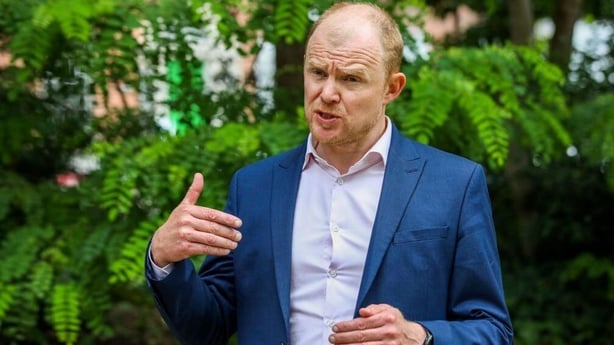
CEO of the Irish Refugee Council Nick Henderson expressed concern over the accommodation strategy.
He said that while there are several positive elements that can be taken from the announcement, the plans did not give insight into ending the issue of homelessness.
"The plan is extremely light on detail, dependent on funding that is not yet confirmed and crucially, does not demonstrate a sufficiently urgent way to end the current homelessness crisis," Mr Henderson said.
Mr Henderson said the council was "very concerned that the plan will not be fulfilled for another four years, until 2028".
He added that the council required clarity over funding for the project.
"We note that Minister (Paschal) Donohoe announced additional funding of €2.25 billion for public capital projects out to 2026 on the 27 March. It does not appear that this accommodation plan is one of the items approved. Clarification should be urgently provided," he said.
Criticism of EU migration pact
Separately, the new EU migration pact, which the Government has decided to opt in to, has been criticised by Medecins Sans Frontiers (MSF).
Ms McEntee yesterday confirmed Ireland would be joining the EU asylum and migration pact, describing it as "hugely beneficial" for the country in responding to the "massive challenge of migration".
However, Medecins Sans Frontieres (MSF) has raised concerns over the agreement for its impact on people arriving in Ireland seeking protection and assistance.
MSF's humanitarian advisor Chloe Marshall-Denton told RTÉ's Morning Ireland: "There are many aspects of the pact that make it increasingly difficult to ensure protection and assistance for those who are most in need."
Ms Marshall-Denton said her main objection to the pact was that it "consolidates many of the most harmful policies and practices" that they had seen on the ground.
She said one of her main concerns was that the pact "enshrines the notion" that EU member states could provide financial support to non-EU countries "with extremely harmful and devastating consequences for people on the move".
We need your consent to load this rte-player contentWe use rte-player to manage extra content that can set cookies on your device and collect data about your activity. Please review their details and accept them to load the content.Manage Preferences
She said there are also concerns around border procedures which will process people who are particularly unlikely to be granted protection more quickly.
There will also be new dedicated accommodation for those being processed in the border procedure.
"The idea that once people arrive at EU borders, they will be subjected to a form of containment that could amount to defacto detention," she said, adding that this had been imposed in places like Italy and Greece "with devastating consequences on people".
Ms Marshall-Denton said those who are in the most difficult situation are trapped in non-EU countries and it is becoming increasingly difficult to move towards the EU.
She said people are then forced to take increasingly dangerous routes to do so, forcing them into greater danger and vulnerability.
