

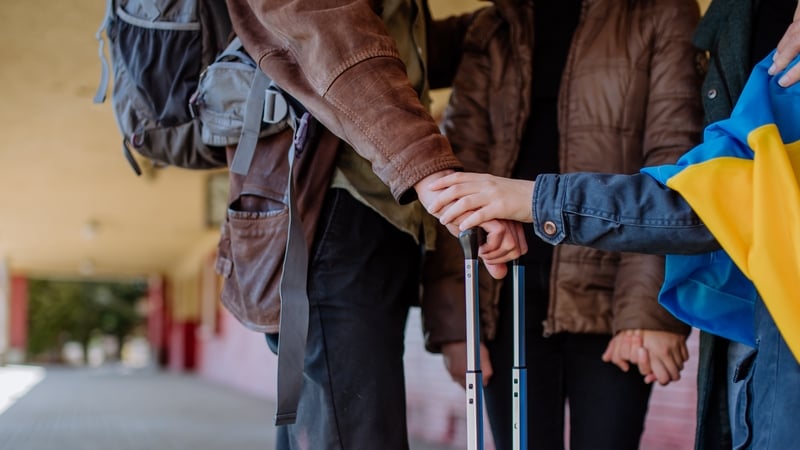
New measures for people arriving to Ireland from Ukraine have left refugees feeling subdued and stressed, according to the national co-ordinator of the Ukraine Civil Society Forum, Emma Lane-Spollen.
Minister for Integration Roderic O'Gorman predicted yesterday that the number of people arriving into Ireland from Ukraine will fall as a result of Cabinet-agreed measures to reduce welfare rates from €220 a week to €38.80 for these refugees.
The Government has also agreed to limit State accommodation for new arrivals from Ukraine to 90 days.
Speaking on RTÉ's Morning Ireland, Ms Lane-Spollen said that these new rules will only come into effect from next year and will not change the country's accommodation problems.
"We have to recognise the war is going on and it's a physical war and it's a psychological war. And these changes have a huge psychological impact on people."
She said it is important to note that these policies will not affect anyone who is already in Ireland.
"I think that's really important. If they do come in and when they come in, it will be in 2024 and there is no impact on the accommodation recognition payment that hosts receive. I think it's really important that people know that because there's huge fear that everything is changing overnight."
She added that if she were a Ukrainian in Ireland she would be doing "everything" she could to get her family in Ukraine here before the rules come into effect.
"It's the natural inclination," she said.
She said she does not know if there will be a surge in people arriving.
"While the Government has put these draconian changes through because they feel that they will act as a deterrent, if you think about direct provision, we've had people living on €38 a week since 2015, living in awful accommodation with no agency. That has not deterred people.
"So what drives people is war and why they come to Ireland is it's far from Russia, English language, there's lots of employment opportunities and friends, they have friends here and family. And I think that needs to be remembered because these solutions are not solutions."
She added that there is "absolutely no evidence behind the policy that this will work. Neither is there any evidence to suggest that it won't create a surge. We just don't know."
She said that people who come to Ireland under the new rules face street homelessness "because the homeless services in Ireland have no responsibility and local authorities have no responsibility to house refugees when they become homeless.
"So, there is no plan after 90 days and that is why it is entirely unworkable. It's not a humanitarian solution. It is all about deterrence," Ms Lane-Spollen added.
She rejected the idea that Ireland currently offers more support to refugees than other European countries and said other countries such as Belgium, Germany and Spain offer childcare and other supports which enable people to access the workplace.
"That's a real problem for us here," she said,... "accommodation, childcare and helping people do intensive language courses".
"So, there isn't one answer and that's part of the problem with temporary protection is that there's huge variety across [the EU] and you're comparing apples and pears a lot of the time."
Read more:
Ukrainians in Ireland concerned over welfare changes
Arrivals from Ukraine will fall following welfare changes - Minister
'The community really accepted us'
We need your consent to load this rte-player contentWe use rte-player to manage extra content that can set cookies on your device and collect data about your activity. Please review their details and accept them to load the content.Manage Preferences
When Russia invaded Ukraine in the spring of 2022, Olha fled her home in Odessa as a refugee of war.
She first went to Romania but once she realised she wouldn't be able to go home soon, she decided to come to Ireland because she could speak English. She already knew that Ireland was experiencing an accommodation crisis.
Arriving in this county in April 2022, she says she was lucky to be among the first refugees to arrive here.
Olha’s first three weeks in Ireland were spent at a sports centre. "It was like a bedroom with 65 people in there," she said.
For a while she didn’t know when she would be able to leave the sports centre but she said, "it was a safe place … we were taken care of".
By May, Olha already had a job.
"The community really accepted us," she said.
"We were one of the first waves of people coming here. We had lots of help … I have tears in my eyes because of the gratitude and support that we got."
Olha says that if she hadn’t received accommodation from the State, she’s not sure she would have stayed in Ireland. She said she has tried, unsuccessfully, to find a place to rent here.
"It would be really hard [to find a place to rent] in the first months when we got here because you do not understand anything."
She added if she hadn’t been provided with accommodation, she would have considered moving to another EU country, possibly Romania, where it is cheaper to live. However, there she’d have found it harder to get a job because she doesn’t speak the language.
For Olha, what really concerns her is what will happen once the EU lifts its temporary protection directive for Ukrainians. This directive provides Ukrainians fleeing the war automatic asylum protections and will remain in place until at least March 2025.
"Myself as a displaced person in Ireland, the only thing that I’m waiting for is a long-term plan from the Government, from the EU … any long-term perspective that we might have an understanding of how things will go."
*Olha's surname withheld on request
Additional reporting: Eithne Dodd
