
A new report to pave the way for the expansion of district heating to Irish homes and businesses was launched today by Minister for Environment, Climate Action, and Communications Eamon Ryan.
District heating is a tried and tested technology for redistributing decarbonised energy to a group of connect buildings and sites.
It uses a network of highly insulated pipes to deliver heat from a central energy source to provide space heating, and hot water, to the buildings connected to the piping network.
This allows for flexibility in terms of the energy used for the central heating systems and is suited to widescale, rapid decarbonisation of central heating systems.
It also allows for alternate combinations of energy resources to be used, at different times, over the lifetime of the district heating network.
Ireland has the lowest share of renewable energy use for heating and cooling in Europe and decarbonising the country's existing stock of residential and commercial buildings is a huge challenge.
Earlier this year Ireland's first district heating programme started operating in Tallaght in South County Dublin where waste heat from a local Amazon Data Centre is carried by hot water through a network of insulated pipes to heat South Dublin County Council offices and the local library.
An extension to the scheme is also planned to channel the heat to 133 affordable apartments to be built on public land as well as a very large innovation centre for start-up tech firms.
In this instance in Tallaght, it is expected that 1,500 tonnes of carbon emissions will be saved simply by capturing and reusing the heat that would be wasted by the Amazon Data Centre.
Waste heat could also be captured from other data centres, power stations and industrial facilities elsewhere and used in a similar fashion.
Codema, the energy agency for Dublin, said that, potentially, almost 80% of the heat demand in Dublin, and 50% nationwide could met by district heating.
Another district heating scheme, the Dublin District Heating Project, is being led by Dublin City Council in Ringsend.
Their, the aim is to heat as many as 80,000 homes in using the heat generated by the burning of rubbish in the Ringsend waste incinerator.
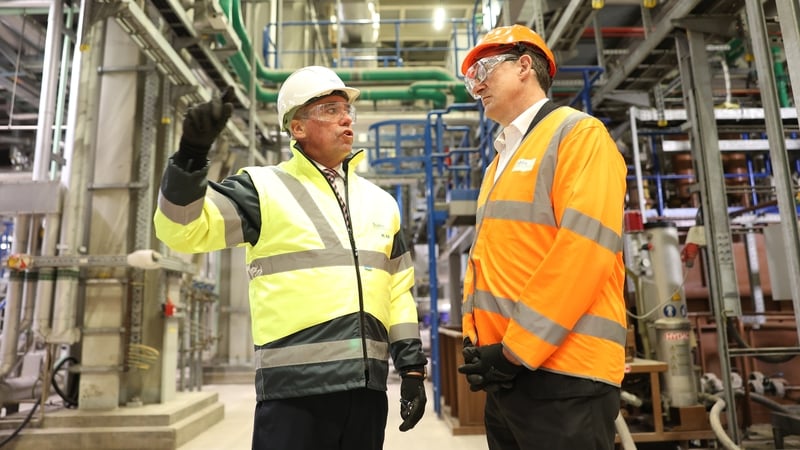
Speaking in Ringsend this morning, where he launched the report of the District Heating Steering Group, Minister Ryan said: "We must radically reduce our reliance on fossil fuels and transition to more sustainable, low-carbon alternatives, particularly for heating our buildings, and district heating has a key role to play in that".
The minister said that the recommendations made in the report of the Steering Group will enable the example of the Tallaght District Heating Project to be replicated throughout the country.
The Steering Group report puts forward eleven overarching recommendations including the need to:
- enable public, private, and utility actors to realise district heating development in Ireland.
- develop a regulatory system for district heating that ensures consumer protection and a vibrant district heating sector.
- enable and mandate public bodies to connect to district heating networks.
- establish a Centre of Excellence for district heating in the SEAI which would support all providers in the development of district heating.
- financially support the roll out of district heating in Ireland.