Minister for Tourism Catherine Martin is considering new supports to help traditional tourism areas cope with potential lost earnings, after a leaked Government memo claimed Ireland's tourism sector could lose more than €1bn this year due to hotel shortages.
Ms Martin was speaking as the Irish Tourism Industry Confederation called on Government to draw up a two-year plan to house refugees and asylum seekers which does not rely on the tourism sector - and said a "mitigation fund" is needed to help tourism businesses this summer.
A leaked memo from the Cabinet's sub-committee on Ukraine today said Ireland's tourism sector could lose as much as €1.1bn this year as an indirect result of the lack of hotel beds available for tourists.
The "Discussion Paper on Displaced Tourism Accommodation" memo said this figure includes potential the food and drink industry falling €581m short of expected income; traditional tourist attractions €94m short; transport €207m short; and retail €198m short.
The memo said the situation has been exacerbated by the fact Ireland's current humanitarian support policy means just over one in every three hotel beds in Ireland have been contracted to the State.
In some counties, almost half of all potentially available hotel accommodation has been contracted to the State.
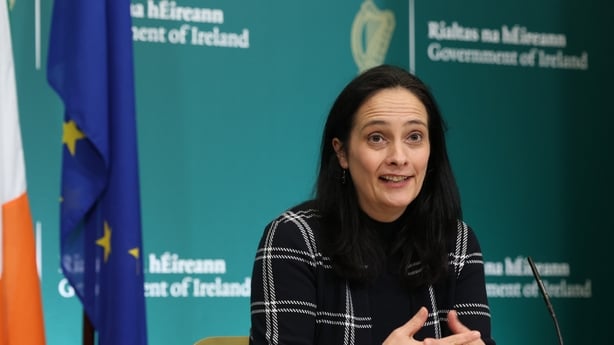
In a statement to RTÉ News responding to the leaked memo, a spokesperson for Minister Martin said she is aware of the impact the lack of available hotel accommodation is having on the sector.
As a result, the spokesperson said Minister Martin has asked Fáilte Ireland to "assess what mitigation measures could be considered" to help businesses in need.
"The minister continues to raise with Government colleagues her concerns about the potential possible impacts on tourism businesses of a significant portion of national hotel stock no longer being available to tourism due to humanitarian accommodation needs.
"She has asked her officials and Fáilte Ireland to do further research on trends in the 2023 season, with particular focus on those parts of the country that are most affected by loss of tourism accommodation, and to assess what mitigation measures could be considered.
"The State has invested heavily over the decades in building the tourism sector to become the key employer in large parts of the country and in ensuring a strong pool of tourism attractions, activity providers and related tourism businesses.
"The minister recognises the importance of ensuring that such businesses are able to cope with and trade through the loss of business that tourism accommodation displacement may cause and she will continue to engage with Government colleagues on this matter," her spokesperson said.
The comments came as Irish Tourism Industry Confederation chief executive, Eoghan O Mara Walsh, told RTÉ's News At One programme supports are needed.
We need your consent to load this rte-player contentWe use rte-player to manage extra content that can set cookies on your device and collect data about your activity. Please review their details and accept them to load the content.Manage Preferences
"Figures we have from the Department of Integration shows that almost one in three tourism bedrooms in regional Ireland is contracted to the Government now for humanitarian reasons. So, they are unavailable to the tourism economy," Mr O'Mara Wlash said.
"And that's going to have a significant knock-on economic impact on downstream tourism businesses. You'll have tourism towns up and down the length and breath of the country without adequate tourism beds and therefore with very little tourism activity."
He said that he thinks the Government need to do two things.
"First of all is to take this very seriously and publish a proper comprehensive two-year plan led by the Department of the Taoiseach as to how refugees and asylum seekers are to be housed on an ongoing basis, because there's an over-reliance on the tourism sector," Mr O'Mara Walsh said.
"And the second point is this summer we will need a mitigation fund to support those downstream tourism businesses that are impacted negatively by Government contracts with accommodation providers," he added.
Speaking to RTÉ News in Dublin's Temple Bar on Monday, many tourists raised concerns over the price and availability of hotels.
One group from the midlands in England said that they "normally stay at the top of O’Connell Street but we've chosen to go towards an AirBnB, mostly through costs and availability".
Another couple from Belgium said: "We want to stay here for three nights, but we've saw it's €550 for three nights in a hotel. And we're told that's not so expensive. We found a BnB and that's now €100 for one night."
A third tourist from California in the USA added that "accommodation was easy to get, but it was rather expensive".
"I'm from San Francisco and it was as expensive or even maybe a little bit more expensive than San Francisco."