


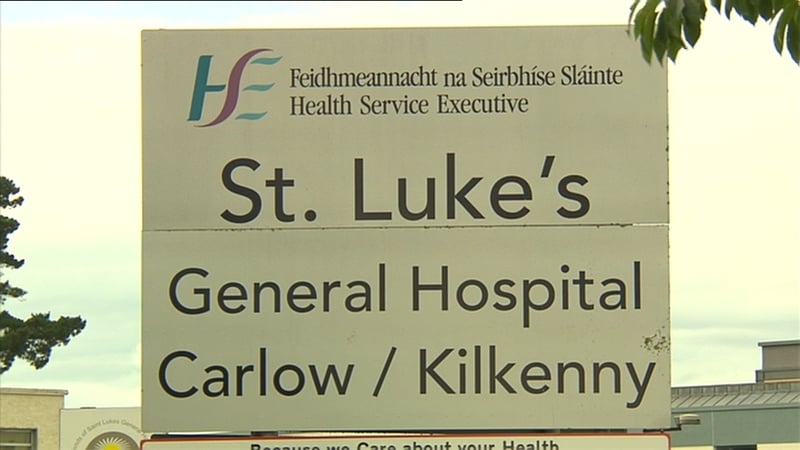
An inquest is under way to ascertain the cause of a woman's death at a Kilkenny hospital 13 years ago.
Olive McGuire was aged 32 when she was admitted to St Luke's Hospital with abdominal pain, vomiting and constipation on Saturday 13 June 2009.
Ms McGuire, from Ballickmoyler in Co Carlow, had also been admitted the previous day, but was discharged as her condition was deemed satisfactory by medical professionals, the Coroner's Court in Kilkenny heard.
While at the hospital, the mother of two was placed into intensive care on a ventilator, having suffered a blood clot and stroke. She died on 24 June 2009, 11 days after she was admitted.
Ten days prior to her admission in mid-June 2009, she had undergone abdominal surgery at St Luke's.
Addressing the court, coroner Tim Kiely said the inquest is "confined to looking at circumstances [of death] and not stray into adequacies of diagnosis".
Two post-mortems were carried out on Ms McGuire, which the court will hear details of at a later stage.
During cross-examination by Raymond Bradley SC, representing the McGuire family, a consultant surgeon who was jointly in charge of Ms McGuire's care was asked whether medical notes taken in 2009 recorded that Ms McGuire's right carotid artery, located in the neck, was "punctured" during an operation after being admitted at St Luke's.
Responding, retired doctor George Nassim said he could not "remember if it was mentioned" when he spoke to doctors regarding Ms McGuire's care, adding that his "concern was about the progress of the patient," who he said was no longer responding neurologically and was paralysed.
He said the right artery was "punctured accidentally" and that a note at the time inadvertently recorded it as a vein that was cut.
Junior counsel for the HSE, Caoimhe Daly, said such a puncture was a "complication that arises in procedures".
Mr Bradley said Mr Nassim was a highly experienced surgeon, but wanted to ask whether, in this instance, following a second surgical intervention during the 11-day stay, a perforation of Ms McGuire's bowel was "never diagnosed".
"The patient was completely paralysed so it adds to the difficulty for diagnosis," Mr Nassim said.
"It was extremely difficult to diagnose and it wasn't diagnosed beforehand," he said.
Mr Nassim disagreed that he did not carry out examinations to check on Ms McGuire's bowel.
"I'm sorry, I don't want to say this, but I had 40 years’ experience in general surgery," he said, adding that a referral letter for doctors in Waterford Regional Hospital outlined examinations on Ms McGuire ahead of a transferal.
"I knew exactly what I was doing," Mr Nassim said.
Mr Nassim earlier said Ms McGuire had a small bowel obstruction after admission. A brain scan was recommended after "very high" blood pressure among other levels were observed.
This was delayed because the CT machine at St Luke's had temporarily broken down and needed to be fixed and, in its place, Waterford Regional Hospital was contacted.
However, he said there were delays to getting Ms McGuire seen in Waterford.
He said it was "not an easy task" to have a patient sent for scans in another hospital and he recalled "shouting over the phone" to ensure Ms McGuire could be seen in Waterford.
When carried out, scans found there was damage to the patient's middle cerebral artery.
Asked by the coroner whether any delays would have had an impact connected to Ms McGuire's death, Mr Naseem said no.
Mr Kiely later summarised his evidence to the jury as the doctor believing it was a "fait accompli" at that point.
The inquest heard additional evidence from other medical professionals, including nurse Genevieve Corrigan, who said she witnessed one consultant having difficulty carrying out an intravenous insertion on Ms McGuire in theatre, but that there was nothing unusual to give her cause for concern.
The inquest is listed to continue for the rest of the week before a jury of three women and three men.
