


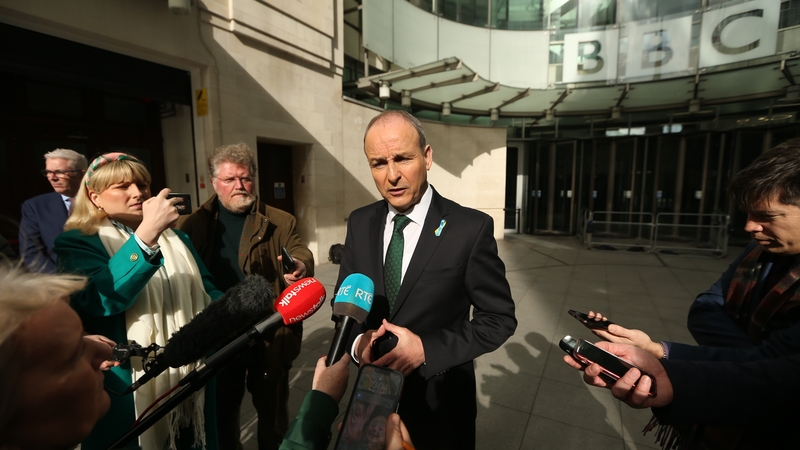
Ireland's humanitarian response trumps security checks on arriving Ukrainians, the Taoiseach has said.
Micheál Martin said Ireland has so far accepted 5,500 people fleeing the Russian invasion.
He said Ireland's priority is the humanitarian response to what he termed "the worst displacement of people since World War II".
"Our primary impulse is to assist those fleeing war," he said.
"The Irish people are very seized by a series of atrocities that are going on. What we're witnessing on our screens every evening is really shocking people and there is huge human empathy there to help the women and the children."
Speaking on the BBC's Sunday Morning programme during a two-day visit to London, the Taoiseach said that of the first wave of those arriving, around two-thirds have family connections in Ireland, but as time goes on fewer have local connections.
Asked about security checks for those arriving, he said: "There is always a balancing of issues, we keep channels open with our UK counterparts - the Home Secretary (Priti Patel) and our Minister for Justice Helen McEntee have been in regular contact.
"I met with the Prime Minister (Boris Johnson) yesterday, he paid tribute to what Ireland is doing on the humanitarian front."
The Taoiseach said the humanitarian response "trumps anything as far as we're concerned", adding that security teams will "keep on monitoring the situation".
"We can all see the humanitarian crisis, we do know that that can be exploited by certain bad actors," he said.
"But our security personnel will keep an eye on that in a more general way."
Mr Martin said the view within the EU is that all borders should be open to Ukrainians.
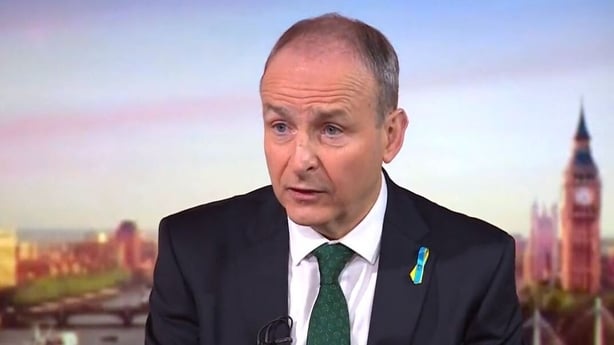
Mr Martin also said that in the longer term, Ireland will reflect on its position of military neutrality. But he said the current time, in the middle of a crisis, is not the time to do that.
He also said Ireland is not politically or morally neutral.
"One cannot, in the middle of a crisis, change a long-held policy overnight," he said. "There will be a debate in Ireland but we don't have time for it right now."
Read more:
Latest Ukraine stories
'We need to recognise the individual lives of Ukrainian refugees'
Mr Martin insisted the Irish Government is "not going to take unilateral action" in respect of sanctions on Russia, despite what he described as "a brutal and immoral war on the Ukrainian people."
He said Ireland is "working in unison with the European Union" and that that is "a fundamental principal that is governing our response to the Ukrainian crisis".
He said Ireland is working with the EU in terms of sanctions, which he said have been "the most severe ever" imposed by the EU on Russia, in particular on Russian finance.
Speaking to reporters in London following his BBC interview, he said: "There will be a further round of sanctions that the European Union will consider and we will be part of that."
However, when asked about imposing sanctions on any oligarchs with assets in Ireland or expelling Russian diplomats, he said "we are not going to take unilateral action."
The Taoiseach has said that the EU will consider a further round of sanctions against Russia, and that Ireland will be part of that. Micheál
— RTÉ News (@rtenews) March 13, 2022
Martin said that unilateral action will not be taken in relation to sanctions | Follow live blog: https://t.co/mJHaCZJhGb pic.twitter.com/dw62WQhEIj
Mr Martin said Ireland will approach the crisis by "working collectively with European colleagues and colleagues in the United States", adding that Ireland does not have oligarchs.
He said that while oligarchs have been very prevalent in the UK and other jurisdictions, "we don't have them resident in Ireland, they haven't bought and football clubs and stuff like that".
However, Mr Martin said the sanctions that Ireland has agreed with the EU "do go after oligarchs across Europe and do go after their finances".
"That's good and that's important in terms of keeping pressure on the Russian system and the system of power and privilege within the Russian Federation," he added.
Asked whether he would accommodate Ukrainians fleeing war in any property he owns, the Taoiseach said: "We would all play our part in that, I think these are personal decisions that every family has to take and we will respond in relation to that as a family. We'll discuss that.
"We're obviously reflecting on this, of course, like everybody else."
