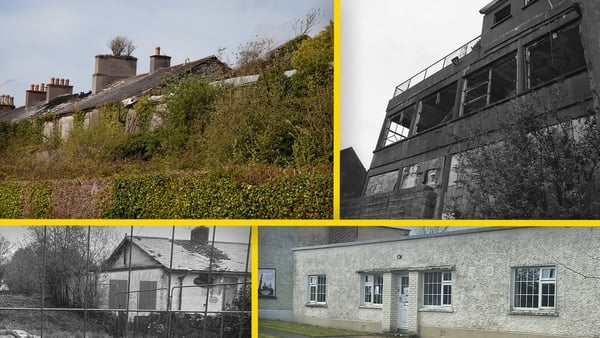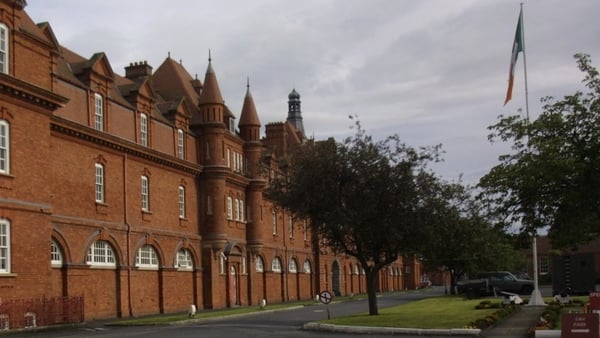

There is no official national measure of dereliction in Ireland.
But the data that does exist suggests something striking: the majority of derelict properties are not subject to any enforcement.
RTÉ Investigates has been analysing national and local authority data, alongside on-the ground reporting to understand the true scale of dereliction and how it is being managed.
Nadia Ramoutar beams as she talks about her adopted hometown of Arklow, Co Wicklow.
Originally from South Dublin, she moved here around eight years ago after a stint in the US.
But there's one thing that particularly irks her about the town - the sight of its derelict buildings.
"One of the reasons I live in Arklow is that I love nature," she said.
"I'm an artist, and I'm raising an autistic son. I love the small-town community feel. And these buildings just completely violate that. They say, 'Nobody cares, it doesn't matter, aesthetics aren't important.' I think it says a lot, and it says all the wrong things."
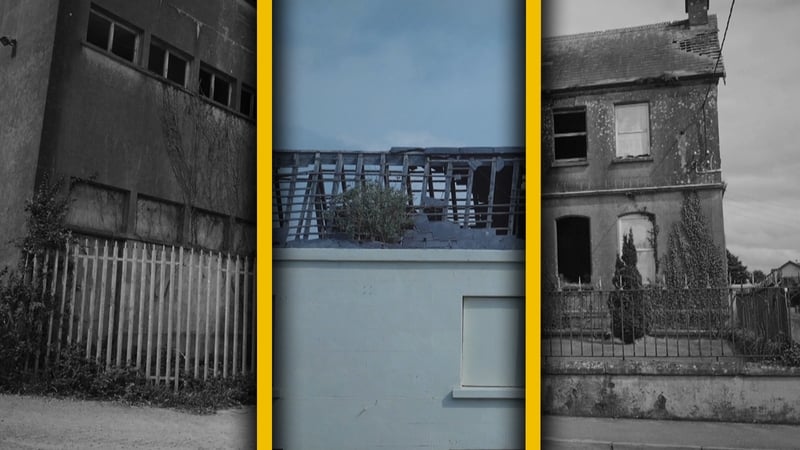
RTÉ Investigates met with Nadia outside 56 Main Street, a former pub that hasn't been used in years and has a partially collapsed roof.
Despite complaints from elected representatives, the property has not been placed on Wicklow County Council's derelict sites register.
The register has just two entries, the lowest number of any local authority in the country.
Being included on the register allows councils to take enforcement action against owners.
Yet, officially, this property is not considered derelict.
It is an example of what appears to be a much broader pattern, where most dereliction in Ireland is not captured on the official registers.
What counts as 'derelict'?
Dr Lorcan Sirr, a housing policy lecturer at TU Dublin, notes that there is no settled definition of what constitutes dereliction.
"Does it mean no roof, no windows?" he said. "Derelict to one person isn't necessarily derelict to another. So, defining what constitutes dereliction is a really tricky one."
The definition contained in the Derelict Sites Act, the legislation which enables local authorities to tackle this issue, is very broad, Dr Sirr says.
"Different councils take a different approach to what constitutes dereliction," he said.
He also points out that while the Central Statistics Office publishes data on housing vacancy, where a housing unit has been unoccupied for a period, it does not do the same for dereliction.
That leaves a significant gap in understanding the scale of the issue.
GeoDirectory
In the absence of official figures, we do have some national data on dereliction.
A company called GeoDirectory, which is owned by An Post and Tailte Éireann, publishes reports on residential housing that include county-level figures on dereliction.
GeoDirectory says the figures are compiled using information gathered through the An Post network.
The data allows county-by-county comparisons.
The GeoDirectory dereliction data, however, relates to housing only and doesn't include derelict commercial buildings, which can be included on derelict sites registers.
There are additional differences between the GeoDirectory data and data collated from the derelict sites registers.
For example, a registered derelict site may contain more than one property if those properties share the same owner and are co-located.
GeoDirectory classifies a building "as derelict when structural work/reconstruction is needed before it can be re-occupied, usually leaving the building dormant for several years."
That differs from the definition in the Derelict Sites Act, which is broader, and which refers to land that detracts from the amenity, character or appearance of the surrounding area due to ruinous or dangerous structures, neglected or unsightly conditions, or the presence of litter, rubbish, debris or waste.
Dereliction rates
With those caveats in mind, however, one thing is clear: the GeoDirectory data indicates that most dereliction in Ireland is not captured in the council registers.
As of Q2 2025, GeoDirectory found that there were close to 20,000 derelict housing units in the country. By comparison, local authority registers contained only around 2,300 entries at this time.
We need your consent to load this flourish contentWe use flourish to manage extra content that can set cookies on your device and collect data about your activity. Please review their details and accept them to load the content.Manage Preferences
In the map above, to enable valid comparisons, we have calculated the GeoDirectory housing dereliction data against CSO housing stock to provide an approximate housing dereliction rate.
The map shows that housing dereliction is generally more pronounced along the western seaboard and less so in the more urban east, in counties such as Dublin and Wicklow.
Enforcement
It should follow that counties with higher rates of housing dereliction would also have higher rates of registered derelict sites.
But as the map shows, this isn't always the case.
Again, to compare counties by the number of registered derelict sites, we can calculate a rate per 10,000 population.
For this analysis, we have combined derelict sites figures for local authorities in Galway, Cork, and Dublin, each of which has city and county councils, so that the data aligns with the GeoDirectory data, which is at a county level.
We need your consent to load this flourish contentWe use flourish to manage extra content that can set cookies on your device and collect data about your activity. Please review their details and accept them to load the content.Manage Preferences
In 2025, our analysis shows that the most active county in this area was Mayo, with 21 registered derelict sites per 10,000 people, followed by Limerick at 20. They were well ahead of the next most active county, Monaghan, at 10.
While the GeoDirectory data shows that housing dereliction was relatively high in Donegal, this county also had one of the lowest rates of registered derelict sites in the country, as the map above indicates.
Donegal County Council told RTÉ Investigates that it was actively taking steps to increase enforcement levels.
In contrast, Waterford has a comparatively lower rate of housing dereliction, according to GeoDirectory, yet is one of the more active counties in registering derelict sites.
Housing need
There is an additional data point which is highly relevant in this discussion: unmet housing need.
One measure of this is provided by Housing Agency figures on social housing waiting lists. The latest national data available is for November 2025.
For comparison purposes, we calculated these figures in per capita terms (per 10,000 people).
We need your consent to load this flourish contentWe use flourish to manage extra content that can set cookies on your device and collect data about your activity. Please review their details and accept them to load the content.Manage Preferences
In broad terms, unmet housing need is relatively greater in parts of the more urban east especially in Dublin, Louth, Kildare and Wicklow than in western counties. Those eastern counties generally also have lower housing dereliction rates.
That said, there is clearly an unmet housing need in every county in Ireland, including in the west.
RTÉ Investigates recently spoke with a young woman who is on the council housing list in Westmeath, a county with a particularly high housing need, as the map above shows.
Katie Touhey (22) has been on the Westmeath County Council housing list for around two years.
She has two young children and lives with her mother, stepfather and younger sister in a three-bedroom house in Athlone. Katie and her children stay in the sitting room.
Katie says the council offered her Housing Assistance Payment (HAP), but even with this, she cannot afford private accommodation, and, in any event, many landlords will not accept HAP.
Her situation has placed an enormous stress on the entire family.
"It brings you down a lot," she said. "Thinking about it all the time, and the waiting and all. It's just not fair. I'm not the only one in this situation in Athlone, either. There are so many houses boarded up."
In Athlone, a housing estate called Sarsfield Square has attracted local media and political attention in recent years because it contains four derelict houses, which are not currently registered.
The approved housing body, Respond, owns the houses.
"People could be living in those houses," Katie said. "They could be in use."
The council recently told RTÉ Investigates that the "process to include these properties on the derelict sites register is currently underway".
Respond said that renovating the houses would involve significant costs and that there were no "viable funding mechanisms available" to do so. It also said it was "engaged with Westmeath County Council to explore all possible options".
Levies
Councils also differ sharply in whether they penalise owners once a property is registered.
Under the Derelict Sites Act, local authorities can impose an annual levy of 7% of a site's market value, which is intended to encourage owners to bring properties back into use or put them up for sale. But applying the levy is optional.
Department of Housing data for 2021 to 2024 shows that while most councils used the levy as an enforcement tool, six including Cavan, Donegal, Fingal, Leitrim, Longford and Monaghan did not levy any registered properties during that period.
The same data also highlights difficulties in collecting the levy once it is imposed. Across the State, local authorities imposed around €25m in derelict sites levies between 2021 and 2024, yet recovered just over €3m, around 13% of the total owed.
In recent years, the Local Government Auditor has repeatedly highlighted problems with levy collection.
Councils, however, have argued that the levy is intended to reduce dereliction rather than generate income, and have described the process as resource-intensive and legally cumbersome, particularly where distressed assets are involved.
Last year, the Government announced plans to replace the levy with a new Derelict Property Tax, to be administered by the Revenue Commissioners.
Local authorities will still be responsible for identifying and registering derelict properties, but the Revenue Commissioners will handle tax collection.
As part of the new plan, preliminary registers of derelict sites are to be published by local authorities in 2027.
The Department of Finance told RTÉ Investigates that "the tax will come into effect as soon as possible thereafter," but declined to be more specific about a timeframe.
Dr Neil Maddox, law lecturer at Maynooth University, welcomed the move.
"Absolutely give it to the Revenue to do it. They'll do it efficiently, and there will be enforcement," he said.
According to Dr Maddox, the Revenue's experience of dealing with people in significant debt means it is better suited to this type of work than local authorities.
"They're used to doing that kind of difficult insolvency work that maybe local authorities haven't got the stomach for," he added.
Compulsory Purchase Orders
Finally, an additional metric that indicates dereliction enforcement is the use of Compulsory Purchase Orders (CPOs).
When a property is registered as derelict, the local authority can initiate a process to compulsorily acquire it. The council can then sell or develop the property.
Department of Housing data for 2021 to 2024 show that some councils frequently use this tool; others, by contrast, practically never do.
The chart below shows CPO activity, expressed as the number of CPOs per 10,000 people. (The total numbers are also included in the chart, which excludes councils that did not CPO any derelict sites.)
We need your consent to load this flourish contentWe use flourish to manage extra content that can set cookies on your device and collect data about your activity. Please review their details and accept them to load the content.Manage Preferences
Limerick was by far the most enthusiastic user of CPOs, in both absolute and relative terms, with a total of 159 properties CPO'ed from 2021 to 2024, close to the combined total for all other local authorities. This works out at 7.7 CPOs per 10,000 people. As the chart shows, Carlow and Sligo were the next highest on a per-capita basis.
The data for 2021 to 2024 shows that during this period, 10 local authorities did not CPO any derelict properties. Those were Donegal, Dún Laoghaire-Rathdown, Fingal, Galway City, Galway County, Kerry, Leitrim, Louth, Tipperary and Wicklow.
We asked those councils why they did not CPO properties during this time. In some cases, councils said their preferred approach was to work with property owners to bring derelict buildings back into use, with compulsory purchase orders generally viewed as a last resort.
Several councils also pointed to increased CPO activity in 2025, while others highlighted resource constraints.
'This wouldn't be tolerated elsewhere'
Back on Main Street, Arklow, Nadia Ramoutar says similar levels of dereliction do not exist elsewhere in Wicklow.
"There are parts of Wicklow, like North Wicklow in particular, where something like this in the centre of the main street would just not be tolerated," she says. "They wouldn't get away with it."
Meanwhile, a spokesperson for the owner of 56 Main Street told RTÉ Investigates that they had wanted to develop the site for some time and had held several pre-planning meetings with the council.
The spokesperson cited issues with the town's sewage treatment system as the cause of the delay.
The council said it had engaged with the owner, who indicated that a planning application was forthcoming.
It said that if an application is not submitted within a short period, Wicklow County Council will review the site for inclusion on its derelict sites register.
__________________________________________________________________________
Watch RTÉ Investigates: Left to Rot – tonight at 9:35 on RTÉ One and RTÉ Player.
Report produced/directed by Janet Traynor.