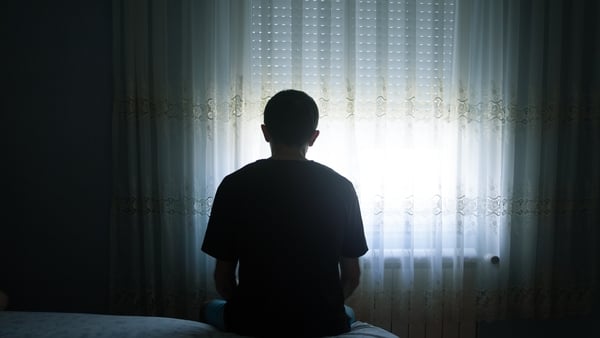
In early January 2026, during one of the wettest winters in years, RTÉ filmed with 18-year-old Max as he was slipping in at night to sleep in the underground car park of the Child and Family Agency, Tusla in Naas, Co Kildare.
"It’s got power, I can charge my phone, and it’s dry," Max told RTÉ Investigates. "But it is not the best place to sleep." A victim of abuse in care, Max was cold, homeless and struggling to cope from years of trauma.
Max left the care system last October after spending almost his entire life in the care of Tusla. Now he was sleeping in one of its underground car parks. So how did he end up here?
RTÉ Investigates first became aware of Max a year ago as part of its documentary, which broadcast last night, documenting cases before the family law courts - specifically cases where Tusla had no beds available and was outsourcing the placements of children to private companies, under what is known as Special Emergency Arrangements or SEAs.
Such arrangements mean that children are accommodated in care facilities provided by private operators, including rented apartments or houses, B&Bs and hotels.
Read more: Children in care: one year following a system in crisis
Despite being known as unregulated care facilities, not open to independent inspection, they are dealing with some of the most challenging children in the care system. Children like Max.
"This was before I went into care," said Max, who is transgender, showing a picture of a little girl, looking out a window on a train, smiling.
"And that's my mum and me, when I was younger, before I went into care," he said. His mum has been in addiction services for many years.
Max was taken into care in 2010, aged three. "So, I've been through a lot of different parts of the system of Tusla," he said.
"I got good memories and obviously some very bad memories."
Max later opened up about these bad memories.
"I was sexually abused [in care]," he said, before trailing off, evidently upset. "I'll just take a break for a second."
So how does he feel now, some years later?
"Does it make me angry? It used to, very much. I was very, very angry at Tusla and the people who work for them. Purely for the fact that I was let down so many times."
Max later found it difficult to settle in mainstream residential services, and he ended up being moved into an SEA, operating out of hotel rooms.
One evening Max went missing from care. Out on the street, Max says he was approached by an adult and led away to a location where he suffered further abuse.
"I ended up being hurt by this person … I was hysterical."
Read more: Fake references used for staff at children's care home company
Max had been missing from the hotel room for two-and-a-half hours before care workers in the SEA discovered what had happened and reported him missing.
Family law solicitor Gareth Noble described the incident as "a series of tragic situations".
"It was so difficult to watch that, and so difficult even for that young person to share that story."
SEAs have appeared in the vacuum of governed residential placements for children.
At the time of his placement in an SEA, Max should instead have been placed in a secure care facility called Special Care, under orders from the High Court. This is a type of lock down facility which has therapeutic support and staff who can de-escalate situations when challenged by traumatised and often very angry young people.
But Tusla had no beds available in Special Care, so - in contempt of an order from the High Court - Max was living in a hotel room under an unregulated SEA, which is not required to comply with HIQA standards.
Watch: RTÉ Investigates: 'Inside the Care System' - Experts react
Within a matter of months of this incident, RTÉ Investigates learned Max had experienced troubles in another hotel under an SEA arrangement. Max caused significant damage to his hotel room. He was said to be deeply disturbed, yet the damage to the hotel room was reported as a crime. He was later remanded to Oberstown Youth Detention Centre.
After a brief period in Oberstown, Max went on to spend almost two-and-a-half years in a secure care unit - one of the longest periods any child has spent in secure care. But his stay went on for several months longer than planned, simply because Tusla could not provide a place for him in a step-down facility.
In late 2024, a place was eventually found for Max. But this placement broke down after Max allegedly set fires.
Max, who was suicidal at the time, was then moved by Tusla back into an unregulated special emergency care arrangement.
While in the SEA, Max tried to take his own life and was found unconscious in a wardrobe. He was only discovered after staff were alerted by one of his friends.
The court also heard that staff in the SEA did not have ligature training or even a first aid kit.
The courts were told that this was an inappropriate setting for a child with his complex needs including dealing with extremely challenging behaviours and a history of suicide attempts.
"So, when I was in SEAs it was just really bad for me. I just hated it. I was sectioned twice, for my mental health," said Max. "It was hell on earth."
Family law solicitor Sarah Molloy told RTÉ Investigates: "It is extraordinary that the State has chosen to place children with the most complex needs in residential units where the staff have perhaps the least qualifications and the least skills to deal with those needs."
Ms Molloy added that staff in SEAs often have limited training in social care, leaving many understandably struggling to cope.
"To protect themselves," she said, "they leave the children in the bedrooms because they don't know how to deal with such dysregulated children. They themselves are often afraid, and rightly so, they are afraid that they will be assaulted, and they have been assaulted on many occasions. So that is a very genuine fear."
It also emerged in the courts that Max had not had a home cooked meal in six months while he was in the SEA.
"I was being fed takeaways every single day of the week. So, I literally ordered the same thing from McDonald's every single day for about six months. It was the only thing I would eat. I'd get six nuggets, double cheeseburger, Coke Zero, and then the sweet and sour sauce from the nuggets, and obviously chips."
Max’s weight increased dramatically.
"When I went into the SEA, I was about 65 kg. And the last time I was weighed, I was about 85kg."
In February 2025, Max’s lawyers were granted an order from Dublin’s District Court directing Tusla to have him placed in a registered residential service which would be regulated and open to inspection. In other words, not an SEA.
However, Tusla did not comply with the order - and Max remained in the SEA.
In late summer, the courts were told that Max’s troubles were escalating. He was increasingly suicidal, taking drugs and allegedly assaulting staff. He was also, once again, setting fires in the SEA.
"It's going to sound like a sick thing to say, but it was genuinely a big, 'f**k you [to Tusla]," Max told RTÉ Investigates.
"The other times were genuinely just me looking for attention and looking for somebody to care about me. It wasn't like I was angry or I wanted to hurt anybody... but I think, obviously, I can't keep blaming everybody else for my mistakes and my decisions."
In spite of Max's situation, an application by social workers to place him back in secure care was again turned down by Tusla, which concluded that "community-based care options had not been sufficiently explored."
In September last, Max continued to set fires. This had a direct impact on his aftercare plan.
A month later, he turned 18 years old, but due to his fire setting, the plan to place him in an aftercare apartment was withdrawn.
After leaving care, Max was admitted briefly to a psychiatric unit. He then found himself on the homeless waiting list with Kildare County Council (KCC).
Newbridge Social Democrat Councillor Chris Pender took up his case.
"I have made representations to KCC and while I get that there has been that back and forth in terms of who is responsible, Tusla or KCC, I don't see Tusla stepping up. It shows me the State doesn't care and regardless of who is responsible, provide emergency accommodation for a young person who needs it."
Struggling with his mental health, Max found therapy to be helpful. However, RTÉ Investigates learned that in spite of an undertaking given in court by Tusla to continue funding his therapy, the funding was stopped for a period.
"I haven't seen my psychologist since after Christmas, the funding got pulled. Then I only got told today [February 2026] that the funding is after being put back in."
Max, who was moved around approximately 20 care settings, believes his life to date has toughened him up for whatever lies ahead.
"The way I think of it is - I have to keep going. Like, I struggled with my mental health for years obviously, and since becoming homeless, it’s almost like, I was shown the worst of it, and I realise that even though I’m at the worst, I’m still living, I can still keep going."
Five weeks after this interview, Max was committed to prison. He is now facing a sentence for setting fire to one of his care facilities last year.
"What was supposed to be the saving of this child, has turned out to be a nightmare," Dr Niall Muldoon, the Children’s Ombudsman, told RTÉ Investigates.
"Every way he turned it seemed to be poor service, poor support... The State promises when we bring you into care, we’re going to do a better job... and we’ll help you reach your potential. So, it’s just a constant river of rights breaches."
"We can't allow this to go on anymore," Dr Muldoon said.
The stories of Max and other young people who have been through care system featured in RTÉ Investigates: Inside the Care System. It is available to view on the RTÉ Player