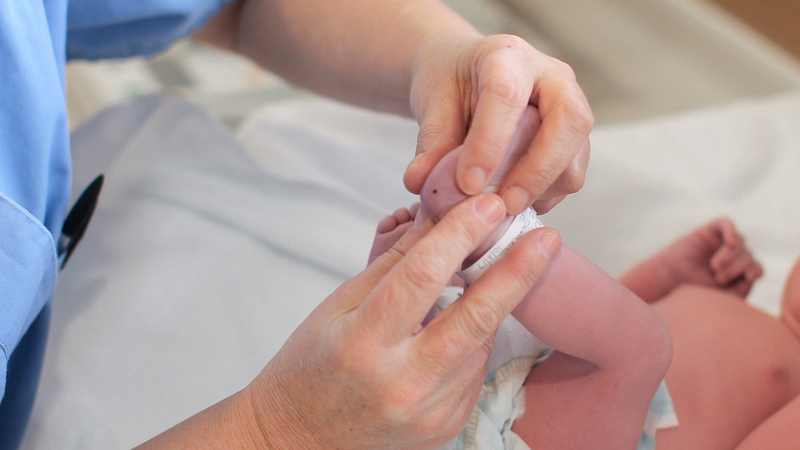

A mother whose four-year-old son is tube fed and in a wheelchair has hailed news that the heel prick test will now screen for two more rare conditions from today as "monumental".
However, she said had her son's rare condition been detected earlier, he would not have had to have spinal surgery and would be "meeting all his milestones" in life.
The inclusion of Severe Combined Immunodeficiency (SCID) and Spinal Muscular Atrophy (SMA) - brings the total number of conditions tested through the National Newborn Bloodspot Screening, known as the heel pick test, to eleven.
This will help to ensure earlier diagnosis and better outcomes for children. Around 130 babies are identified as having one of the conditions each year.
SCID is a group of disorders that cause major abnormalities of the immune system, while SMA is a condition that causes progressive muscle wasting.
Bróna Noonan has been campaigning for SMA to be included in the heel prick test since the birth of her son Donnacha, four years ago.
We need your consent to load this rte-player contentWe use rte-player to manage extra content that can set cookies on your device and collect data about your activity. Please review their details and accept them to load the content.Manage Preferences
Ms Noonan said her son was born "perfectly healthy" but in the weeks that followed, they started to notice signs that he was losing muscle tone and having issues with feeding.
At first it was thought to be a number of possible issues, including colic and reflux.
However, it was not until he reached 12 weeks old that Donnacha was diagnosed with SMA.
The four-year-old is now tube fed, in a wheelchair and requires 24/7 around the clock care.
Donnacha was hospitalised eight or nine times last year due to his condition.
Ms Noonan described the incorporation of SMA into the heel prick test as marking a "monumental day".
However, she said if her son’s SMA had been detected early, the chances are he would not have been admitted to hospital as much and would not have had spinal surgery.
She added that he would more than likely not need to be tube fed.
She said from the research she has seen, Donnacha would also not be in a wheelchair - he would be walking, running, crawling and "meeting all his milestones".
Speaking on RTÉ’s News At One, Ms Noonan said: "It’s a bit bittersweet, but when Donnacha was diagnosed and we went through all the treatment, we said we would adopt a positive attitude for him.
"To be even a small part of making this change for future families - future babies - I feel like that's the most important thing to come out of this," she added.
Addition of SCID and SMA a 'significant milestone’ - minister
In a statement, Minister for Health Jennifer Carroll MacNeill said: "The addition of SCID and SMA to the National Newborn Bloodspot Screening Programme is a significant milestone.
"I know it will be very welcome news for families all over Ireland."
She added that the programme allows for the detection of "rare but serious conditions which benefit from early intervention and lead to vastly improved outcomes for children".
The screening will help identify around six babies born with SMA and two born with SCID each year, the HSE said.
"This early detection allows for earlier treatment, leading to better outcomes for babies with these conditions," the HSE National Clinical Lead for the Child Health Public Health, Dr Abigail Collins, said.
SMA Ireland also welcomed the announcement.
SMA Ireland Director Jonathan O'Grady said it is a "truly historic day for all the families who have campaigned so tirelessly for the screening of babies born in Ireland for Spinal Muscular Atrophy".
"Early detection is critical with SMA and including it in the heel prick test provides the opportunity of timely intervention, offering a more hopeful outlook for babies and their families," he added.