


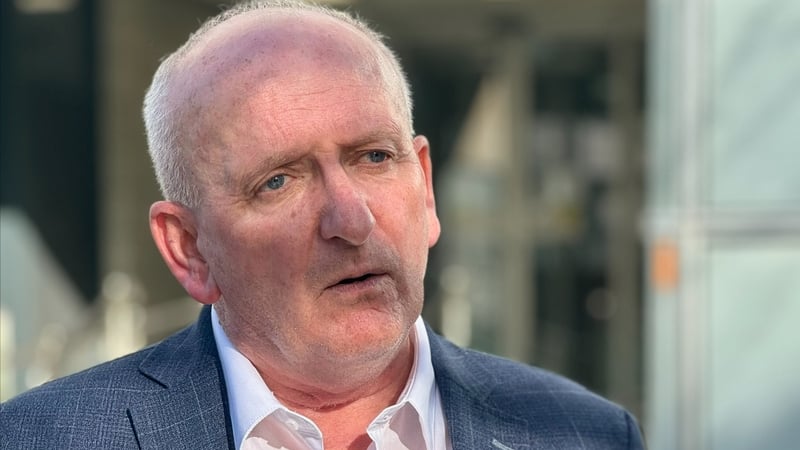
The Chief Executive of the HSE, Bernard Gloster, has "unequivocally" apologised after reviews into Child and Adolescent Mental Health Services (CAMHS) in north and south Kerry identified risks of potential harm in how young people were treated.
The 2022 Maskey report into south Kerry CAMHS found the care of hundreds of young people did not meet standards it should have, including unreliable diagnoses, inappropriate prescriptions and poor monitoring of treatment.
That prompted a review into services in north Kerry, published yesterday, which found a risk of potential for harm in more than half of files it reviewed - citing similar concerns.
It found that resources for the CAMHS team were significantly below what is recommended in national mental health policy.
Dr Colette Halpin's report said that Co Kerry should have a minimum of four full-resourced dedicated CAMHS teams, including four consultant child and adolescent psychiatrists and full multi-disciplinary teams.
In a statement, HSE chief Bernard Gloster said he is "truly sorry for the harm caused" and it "will continue to work to improve, reform and invest in mental health services for young people in Kerry, and indeed throughout the country".
"I am conscious that for the people of Kerry and indeed CAMHS service users across the country that their confidence has been eroded.
"While all of our improvements are good and welcome, there is no doubt but that our services in Kerry were so far below the acceptable standards as to cause risk of harm.
"That is unacceptable, it is not good enough and for that I am sincerely sorry. I have also clarified that the HSE has made a referral to the Medical Council in this case, and it is important that their assessment is allowed to progress," Mr Gloster said.
Speaking on RTÉ's Six One this evening, Mr Gloster said what happened is a "combination of the prescribing practices and individual clinical practitioner".
He said it was an absence of clear clinical governance and corporate governance on how services are overseen and developed.
He said there was further isolation in Kerry and that the doctor in Kerry would not have been exposed to the same number of peers as other across the country, adding that this is a "significant safety valve" in healthcare.
On the delay in publishing the review, Mr Gloster said reviewing 374 cases was a "very complex" process, which he said takes a lot of time.
He said they did not wait until the end of the review to start making improvements.
The HSE chief said it was not acceptable that one woman, given the name Mary, has been unable to access compensation because of the length of time the review took.
"In this particular instance… there was a particular scheme brought in by Minister Butler at the time in respect of south Kerry," he said, adding that the Minister for Health Jennifer Carroll MacNeill and Ms Butler have agreed following consultation with the Attorney General that similar would apply to North Kerry.
He said the state claims agency have "managed that well in a very non-adversarial way".
However, Mr Gloster, empathising with Mary's case, said these processes are "exceptionally difficult".
He said further cases going back to 2014 will be reviewed, in particular 310 who "fit into particular categories of risk".
When asked if he would go back to 2010, he said he has to look at what is the most effective and best review possible, adding that the clinical evidence available to him says to go back to 2014.
However, he said depending on what those tell "we are always open to broadening the scope of that".
Earlier, a senior HSE representative said that despite the recommendation to have a minimum of four full-time child psychiatrists working in Co Kerry, there are currently none.
Speaking on RTÉ's Morning Ireland, Dr Amanda Burke said: "They don't have them at the moment. Recruitment and retention continues to be a challenge and we are reaching out ... nationally and internationally, to get this.
"But as I said, we're not an outlier. This is happening internationally. Recruitment of consultant child and adolescent psychiatrists is an international problem."
Asked how many consultants were working in the county, she said: "They have a number of consultants inputting.
"There are more than four consultants inputting but they are not full-time consultants and there are a number of arrangements in place."
Pressed on how many consultants were working full-time, she said: "There is no full-time consultant at this moment in time, as I understand."
Dr Burke did not provide information on how many whole-time equivalents were working in the county and the HSE has been contacted for clarification.
She said there was "widespread acknowledgement" of workforce challenges in CAMHS both nationally and internationally, adding that it is a particular issue in rural areas.
"We have a plan to remediate that but it's something that takes consistent year-on-year funding and a clear recruitment strategy," she added.
'Absolutely heartbroken', says Butler after meeting affected families in Tralee
Minister of State with Responsibility for Mental Health Mary Butler met with families of young people affected by the review in Tralee.
She told them the Government plans to put in place a non-adversarial compensation scheme similar to the one put in place after the Maskey Report.
She said she was "absolutely heartbroken" after hearing the "emotional" stories from the families affected.
"It is deeply, deeply troubling to me and I am absolutely devastated for the children, young people and families, and their lived experience," she told RTÉ's Drivetime.
Minister Butler said she met with four individual families, speaking about several different children.
She said they spoke about the strain on families, the relationship strains as a result of their "children being harmed" as well as the interaction with siblings and the personality changes they saw because of medication.
Ms Bulter said the families also spoke of how their children became socially isolated or missed school and "not being able to function".
She described it as "really, really difficult" and said it was one of the lowest days in her career as minister for mental health.
Ms Butler also met with the CAMHS team in the town "because I think it's important that we support the CAMHS team that's in place who deliver a really good service".
Ms Butler also said she will have further details on the compensation scheme in the coming weeks.
She said she brought a memo to Cabinet colleagues and subsequently received approval yesterday afternoon. She said she hopes to expand the scheme that is already in place.
She also said the terms of reference of the review will be extended to include "some people who have fallen outside the terms of reference of this particular review and especially those who have mental health with intellectual disabilities and those that have an ADHD diagnosis and those that would have received multiple medications".
"It will only apply to the children who were harmed in this particular report, however, I am going to keep it under review because I am very conscious that there are some children, young people and adolescents who have fallen outside of the scope of the two schemes, both the Maskey and this particular scheme," she said.
Ms Butler said a further look back is planned for "anyone who fell outside the review that has happened already, who has an intellectual disability or where a child was prescribed anti-psychotic medication or children who received high dosage psychotropic medication during their care and treatment will be considered".
Ms Butler said they want to make a more specific target as she felt these were areas where harm may have occurred.
She added that she has asked that anyone who has concerns be able to ask for their child's chart to be reviewed and for a specific pathway to be set up for that for people living in Kerry.
She said she expects the new look back to be conducted much quicker and that a team is going through the scope of what they expect the look back to look like.
Ms Butler said she will have information on this in the next two to three weeks.
However, she said her expectation is that the new look back could take up to 12 months but "nothing like the timeframes we have seen over the last years," she added.
CAMHS report demonstrates challenges within mental health system
Policy and Research Manager for Mental Health Reform, Dr Louise Rooney, said yesterday's CAMHS report was "really shocking" and "demonstrates the challenges" within the mental health system at the moment.
Also speaking on Morning Ireland, Dr Rooney said it is "quite clear" that a number of things need to happen to instill people's confidence back into the system.
"People are going to be taking their children today to CAMHS appointments. They deserve to feel confident in the services that they're accessing and that sense of trust is something that is going to have to be built back up," she said.
Dr Rooney said they are calling for the reinstatement of a lead for mental health in the HSE to "strengthen oversight and increase accountability".
She said a statutory right to independent advocacy is also needed.
"Parents talk about that they were unaware of the side effects and potential consequences of some of the psychotropics that their children were put on. The children also said that they felt that they weren't listened to," Dr Rooney said, adding that they were also calling for an independent complaints mechanism.
"The HSE has a complaints service called 'Your Service, Your Say', but it's not independent. You're essentially complaining about the HSE to the HSE," she explained.
"In order to really have independent complaints investigated in a robust and fair manner, that is something that we're calling for," added Dr Rooney.
