


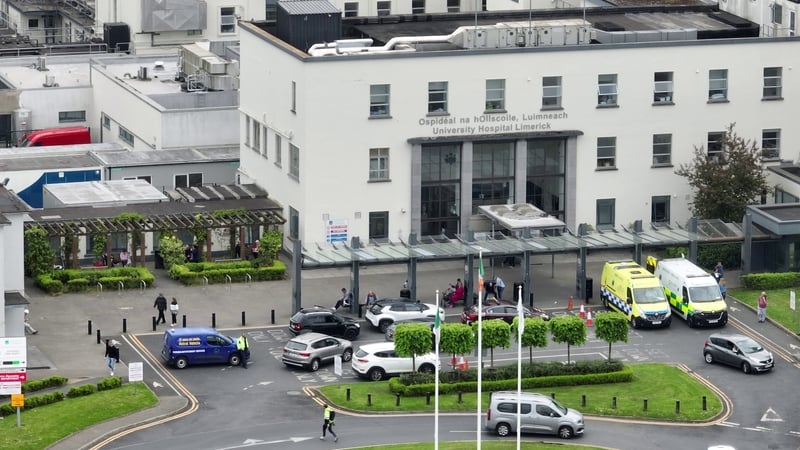
The suspension of some medical services in the midwest is part of short-term interventions to improve care in the longer term, according to the Chief Executive of the Health Service Executive.
Speaking on RTÉ's News at One, Bernard Gloster said a decision was made in April and May to deploy an expert team to the UHL Group to get an insight into the situation there.
Mr Gloster said that as part of that review it was decided that at some time during the summer, services would concentrate on urgent care or those patients currently in the system.
He said that essentially the hospital is "completely overheated".
A significant number of planned services in the University Limerick Hospitals Group were suspended yesterday, to allow the main hospital deal with emergency department overcrowding.
Inpatient, day surgery, outpatient appointments and some other scheduled services have been deferred at UHL, Ennis, Nenagh, St John's and Croom Orthopaedic Hospital, until further notice.
Exceptions to the deferrals in care include cancer services, time-critical surgery, dialysis, cardiology and other care.
"There's a backlog of unscheduled care that has to be dealt with and it has now got into such a circular space that all of the normal options that are available to assist are being essentially occupied by patients who require care," he said.
The plan would be for this to be in place "certainly for the shortest period of time possible".
"I would like to think it's in the category of weeks," Mr Gloster said.
We need your consent to load this rte-player contentWe use rte-player to manage extra content that can set cookies on your device and collect data about your activity. Please review their details and accept them to load the content.Manage Preferences
Earlier, the President of the Irish Hospital Consultants Association said that it was "not acceptable" that many essential medical services are being "switched off" in the midwest.
Professor Gabrielle Colleran said staff were shocked when they were informed that key services were suspended.
"The first reaction we had was one of shock and that was very much the reaction of our members on the ground when they got this cold e-mail yesterday morning informing them that so many key services were about to be switched off.
"It's really important that we're very honest and transparent with the public about what this actually means.
"Some of the language in the release around just talking about de-escalation, if I'm being straight that is really a corporate sanitisation of what's happening.
"Because what it amounts to is the switching off of many essential services in the Midwest and that just isn't acceptable."
Prof Colleran said there are more than 400,000 people dependent on the hospitals in these regions.
There were more than 240,000 outpatient appointments in the UHL region last year, she said.
"So, switching off those appointments, switching off that crucial access, that's just not acceptable."
Speaking on the HSE national support team that was set up to devise actions designed to ease overcrowding and pressures in the emergency department at UHL, Prof Colleran said the origins of the issues in Limerick go back to 2008, when the review of acute hospital services in the Midwest was published.
It was recommended that UHL would have 642 inpatient beds, she said, but with the associated closures in Ennis and Nenagh there would be increased capacity in Limerick.
"Now unfortunately that hasn't happened."
She said the reality is that Limerick has a shortfall of 158 beds, or 25% of that target.
The Regional Executive Officer of the HSE Mid-West said the decision to defer elective, day surgery and outpatient appointments was taken due to "significant overcrowding" across hospitals in the region.
Sandra Broderick said an expert review team had put forward "a de-escalation plan" aimed at reducing waiting times and improving patient flow, which included a "hard reset".
"We have instituted, based on the level of overcrowding seen here, a hard reset which means that we have rescheduled people for their appointments, for their outpatients, and for their admissions to this hospital."
Speaking to RTÉ News, Ms Broderick said the measures will continue "until such time as this hospital is de-escalated fully down, where I have confidence that we can run scheduled care with unscheduled care".
Ms Broderick said the level of overcrowding for staff, for patients and for service users was "entirely unacceptable".
"It is unacceptable and we need to bring this back down to a level where we can manage scheduled and unscheduled care together in a safe way," added Ms Broderick.
Decision to postpone scheduled care 'detrimental to patients'

Melanie Cleary (above) from the Mid-West Hospital Campaign group described the decision to postpone scheduled care as "detrimental to patients".
She said she knows there are people in the region who are "devastated" because they waited so long for their appointments.
"We know the state of our waiting lists in this country. This decision was the stark opposite of what we need in the Mid-West."
Ms Cleary said more bed capacity is needed and more community care options "to free up more beds" in hospitals.
"This is not good enough for us. We have been forgotten about and left behind, so many times," she said.
Slight monthly increase in hospital waiting lists
There has been a small rise in national public hospital waiting lists, which now stand at a total of 848,428 patients.
The figures for July published today represent an increase of 1,668 patients on the June figures from the National Treatment Purchase Fund.
The total figures exclude 64,568 patients classified as "suspended" . This group covers patients who are temporarily unfit, or unable to attend due to clinical or personal reasons.
This suspended category also includes patients who are being treated through outsourcing measures.
The number of patients waiting to be seen by a consultant at an outpatient clinic for the first time is 599,458.
There are also 88,063 patients waiting for an appointment for their inpatient or day case treatment.
Another 24,670 patients are waiting for an appointment for a gastrointestinal check.
Additional reporting Fergal Bowers
