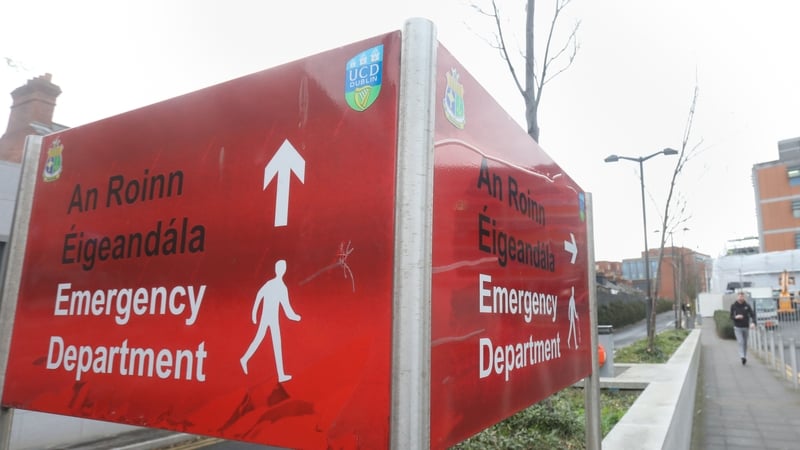

The Health Service Executive will ask private hospitals to help the public system cope with emergency department overcrowding as part of a tender expected to be published in the coming days.
RTÉ News understands the plan was outlined at the latest meeting of the HSE's Emergency Department Taskforce today.
The meeting, at the executive's headquarters in Dublin, lasted for almost three hours.
It was attended by senior HSE officials, Minister for Health Stephen Donnelly, Irish Nurses and Midwives Organisation General Secretary Phil Ní Sheaghdha, Irish Patients Association co-founder Stephen McMahon and other health groups.
The meeting was called due to ongoing concerns over emergency department overcrowding amid criticism that while HSE guidelines published in July say a maximum of 320 people should be on trolleys per day, INMO figures show 385 people were on trolleys today.
The meeting is understood to have been told the HSE will tender in the coming days for private hospitals to help the public system during any overcrowding surge this winter.
This support is, as in previous years, likely to include private hospitals helping with waiting lists for elective and non-emergency services in order to reduce pressures in public hospitals.
During the meeting, Minister Donnelly is also understood to have told taskforce members that he wants to see a roster change in hospitals.
This would potentially result in weekend on-call emergency rosters being replaced with seven-day working rosters in hospitals - previously been suggested by HSE Chief Executive Bernard Gloster.
The taskforce, which until today had only met twice this year, has also agreed to meet again within six weeks, at which point it will further address the emergency department overcrowding situation.
Over 960,000 emergency department attendances in 2023
Figures prepared for the meeting by the HSE show that emergency departments have seen over 960,000 attendances this year.
It represents around 3,800 more patients than the same period last year.
Overcrowding figures from the Irish Nurses and Midwives Organisation (INMO) show there are 385 patients waiting for admission to a bed today.
The hospital worst affected is University Hospital Limerick (UHL) with 87 patients waiting.
According to the HSE, its average 8am trolley count this year is 301 patients, down slightly on last year.
The hospitals with the largest number of attendances this year are the Mater Hospital in Dublin with over 65,400 patients, UHL with over 53,000 patients and Cork University Hospital (CUH) with over 51,100.
The hospitals with the largest number of patients waiting over 24 hours for admission were Tallaght University Hospital with 4,341 patients, CUH with 4,051 patients and UHL where 3,776 patients have waited over 24 hours.
Under its recently published emergency care plan, the HSE set an average monthly target that no more than 320 patients can be waiting for admission at 8am each day.
It has also said that no patient over 75 will wait more than 24 hours in an emergency department.
The latest HSE figures show that so far this year, over 1,600 patients aged 75 or older waited more than 24 hours for admission at St Vincent's Hospital in Dublin, 1,678 waited over 24 hours at CUH and 1,482 waited more than 24 hours for admission at UHL.
The HSE figures show there are around 500 patients in hospitals with a delayed transfer of care.
These are patients whose acute care has ended but they cannot be discharged mainly because there is currently no place suitable or available to send them to.
Nurses face 'impossible' winter - INMO
The INMO warned that staff are facing another winter "in impossible and often dangerous conditions".
"We know all of the research tells us that when you are on a trolley for longer than six hours actually that fact alone affects your outcome. In fact, it means that you are not going to do as well, and some people, unfortunately, research tells us die as a result," said General Secretary Phil Ní Sheaghdha.
"These are statistics, but behind each one of them, is a person who is having a really bad experience."
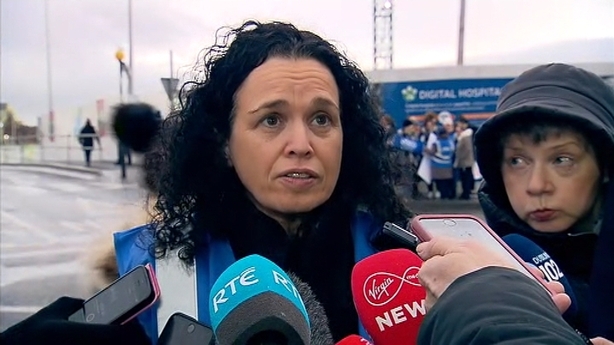
Speaking on RTÉ's Morning Ireland, Ms Ní Sheaghdha said there have been improvements in some hospitals, but not all.
"HIQA have recently issued a report which clearly indicates that what they are doing in Waterford is working, and we know that for example, they concentrate entirely on ensuring patients are not on trolleys.
"Wherever the trolley is it does not matter, it must be the aim of the hospital to get people into a hospital bed which is fully staffed and where care can be delivered safely."
She said that numbers were up this August on the previous year, which pointed to a difficult winter ahead.
"Again, think about the pressure that puts on staff, the people we represent nurses and midwives. They work very hard. They never get reprieve; the levels of burnout are getting increasingly high, and that all leads to people deciding to leave their jobs. We do not want to be in that situation."