


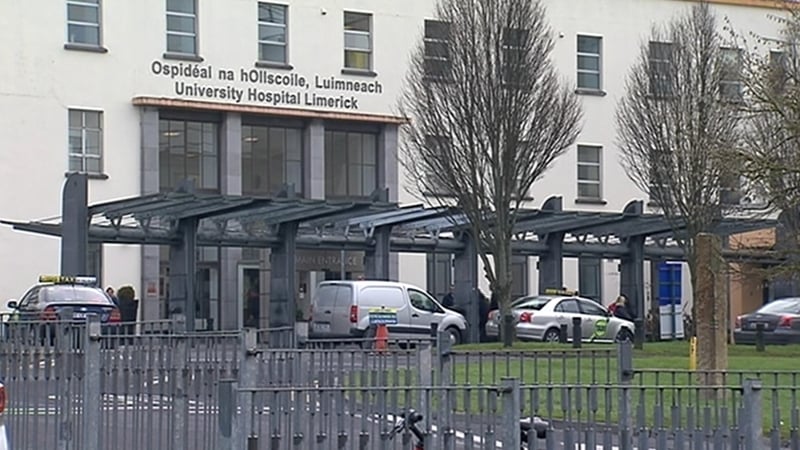
A Medical Council inquiry has found a surgeon guilty of professional misconduct in relation to two allegations that he worked at University Hospital Limerick without being registered in Ireland as a medical practitioner with the council, which is required by law.
It was alleged that Dr Motaz Kabadaya worked between February and June 2011 at University Hospital Limerick and that he performed dental surgery on Breda Flannery there around 23 May 2011.
The Council's report, including any proposed sanctions and recommendations, will go before the full Medical Council for decision at a later stage.
The inquiry heard that, under the Medical Practitioners Act, it is a criminal offence to practise as a doctor in Ireland without being registered with the Medical Council.
Dr Kabadaya did not attend the inquiry and was not legally represented.
The inquiry heard he failed to pay his registration fee to the council from July 2010 to June 2011.
He worked at UHL between 25 May 2011 and 9 June 2011.
In correspondence from Dr Kabadaya to the council, which was read out at the inquiry, he indicated that he had made a mistake in not paying his annual fee to the council to stay on the register.
He said he had been in financial difficulties at the time and is married to a dentist and has two sons he has to support.
He also indicated that he wished to defend himself at the inquiry.
Dr Kabadaya later said he could not attend today's inquiry, as his brother had passed away.
He did not object to the inquiry proceeding and accepted that he had practised unlawfully.
The inquiry has heard that Dr Kabadaya has a registered address in Rathfarnham in Dublin, and is an Irish and Egyptian citizen and qualified at Trinity College Dublin.
He is also a member of the Royal College of Surgeons of Ireland and is currently on the Medical Register in Ireland.
He worked previously in Galway, Limerick, St James's Hospital, St Michael’s Hospital Dun Laoghaire, the Royal Victoria Eye and Ear Hospital, Our Lady of Lourdes Hospital Drogheda and Cavan General Hospital.
In correspondence, Dr Kabadaya said most of his work was in the UK and Ireland and this was the first complaint against him in 35 years.
Dr Kabadaya said he was one of the top ten oral-maxillofacial surgeons in the two countries.
He said he left Ireland in the summer of 2011 to work in Saudi Arabia, where he is currently employed.
The complaint against Dr Kabadaya, that he was not registered, was made by Ms Flannery.
The inquiry has also heard evidence that Dr Kabadaya was not registered with the Dental Council at the time of the surgery or during his time at Limerick in 2011.
His last registration with the Dental Council was up to January 2011.
Majella Hogan, from the administration department at University Hospital Limerick, told the inquiry that Dr Kabadaya was employed there from 1 July 2009 to 12 August 2011, as a registrar in oral and maxillofacial surgery.
She said she was not involved in the recruitment process in this case.
Ms Hogan said the hospital file on Dr Kabadaya dated 20 January 2010 shows there are documents outstanding.
It did contain a copy of his Medical Council registration for 2007-2008.
Ms Hogan said the hospital checks whether doctors are registered with the Medical Council, as part of the employment process.
It also receives a list of those removed from the medical register, from the Heath Service Executive, or the Council.
She said the HSE at national HR level keeps a record of all doctors and their Medical Council registration number.
The inquiry was told that the Medical Council sends an alert to the HSE medical manpower managers, when a doctor is removed from its register.
In this case, they would have been notified within weeks of 2 February 2011 that Dr Kabadaya had been taken off the medical register.
Expert witness, Professor Stephen Lane, respiratory consultant at Tallaght Hospital, told the inquiry that if a doctor is practising and not registered, prescriptions, medical certificates and medical insurance cover could be deemed null and void.
He said in Dr Kabadaya's case it was a serious falling short.
However, he said there were many mitigating factors; Dr Kabadaya had not fraudulently misrepresented himself, there were difficult personal circumstances and his career up to this had been exemplary.
