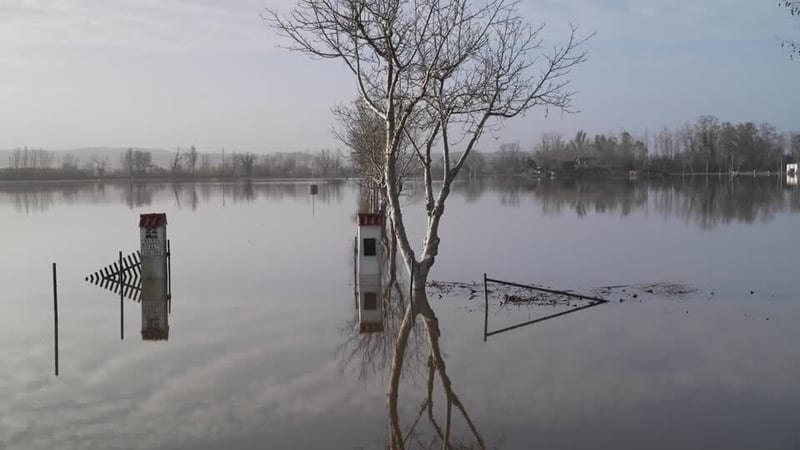
Parts of Spain and Portugal are on high alert as heavy rain and strong winds batter the two countries, felling trees, disrupting transport and forcing the closure of schools.
A viaduct on a motorway in Portugal, between the capital Lisbon and the city of Porto, partially collapsed near the city of Coimbra.
"The speed and force of the water ... it's an absolutely abnormal situation," said infrastructure minister Miguel Pinto Luz, who visited the scene.
No injuries were reported, he added, but it could take "weeks for this infrastructure to be operational again".
The section of the A1 motorway where the viaduct was located had been closed to traffic in both directions after the partial breach of a dyke. The collapse occurred a few hours later.
About 15 trucks, loaded with loose stone and rubble to protect against erosion, were brought in to reinforce the breach.
Watch: Flooding hits parts of Portugal
The collapse comes after deadly storms battered Portugal in recent weeks, badly damaging infrastructure.
A train derailed near the central city of Abrantes, after hitting debris that had fallen onto the tracks.
No one was injured, but several railway lines remain suspended in Portugal.
Following the passage of storms Kristin, Leonardo and Marta - extra-tropical cyclones that dealt significant damage - Portugal is on alert again due to the risk of flash floods caused by heavy rainfall.
A weather phenomenon known as an "atmospheric river" - a wide corridor of concentrated water vapour carrying massive amounts of moisture from the tropics - brought new downpours, affecting the north of the country to a greater extent.
The Portuguese Institute of the Sea and the Atmosphere (IPMA) said that Storm Oriana - a separate Atlantic depression - would not directly affect the country's mainland, but would cause heavy rainfall and wind in most areas today and tomorrow.
The Iberian Peninsula is on the front line of climate change in Europe and is experiencing increasingly long heatwaves and more frequent and intense episodes of heavy rain.
"In just these two days, the rainfall has been equivalent to 20% of Portugal's average annual rainfall," environment minister Maria da Graca Carvalho said.
Under fire from critics, Maria Lucia Amaral resigned as interior minister earlier this week and was replaced by Mr Pinto Luz.
The government, still facing public pressure, will face questioning in parliament tomorrow over its handling of the crisis.
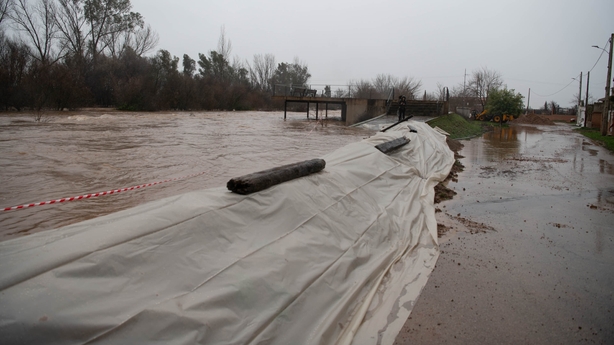
In Spain, a red alert - the highest level - was issued for the northern regions of Galicia, Cantabria and the Basque Country after the arrival of Storm Nils, the eighth storm to hit the country this year.
Weather agency AEMET warned of waves up to 9m.
At least five people were injured - one seriously - in Catalonia, head of the northeastern region's interior department Nuria Parlon told radio station RAC1.
Authorities closed schools, suspended sporting events and restricted non-essential healthcare services as wind gusts of over 105km/h felled trees, disrupting road and rail traffic across the region.
Civil protection services in Catalonia sent a mobile emergency alert warning people to stay indoors and avoid unnecessary travel.