


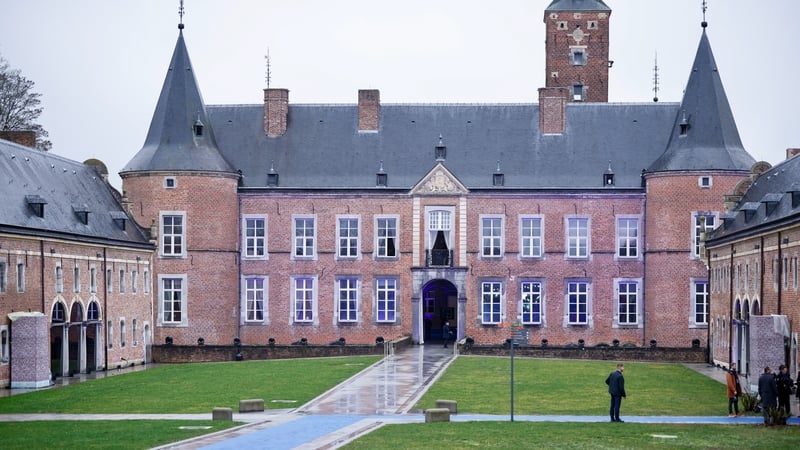
EU leaders have said it is urgent they find ways to cut energy costs and improve how Europe's border-free internal market works so businesses can be competitive and survive threats from the United States and China.
While few concrete decisions are expected from a summit in a Belgian castle, the talks will provide clues on whether the bloc's 27 member states can overcome self-interest and agree a joint plan of action.
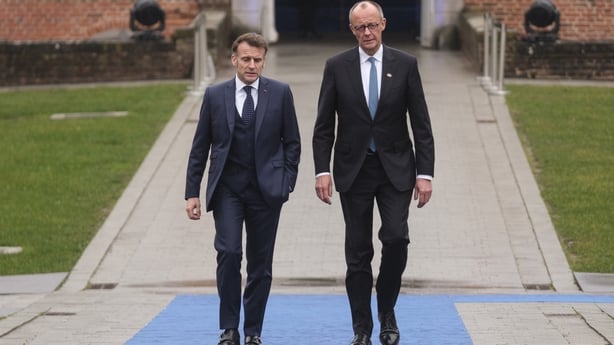
"We share a sense of urgency that our Europe needs to act," said French President Emmanuel Macron, standing next to German Chancellor Friedrich Merz.
The two - who disagree on many of the possible solutions - arrived together for the meeting at Alden Biesen Castle in the province of Limburg.
Many of the leaders shared the same sense of urgency, and of frustration at the lack of progress, much of which they are themselves responsible for, in further unifying member states' economies.
"There's so much talk and so little action, and this is a chance to at least reverse that trend," Swedish Prime Minister Ulf Kristersson said.
Czech Prime Minister Andrej Babis was even more blunt, saying: "Only words, conferences and no action".
Discussions span a number of themes, including how to deepen the EU's single market, push ahead with a union of financial markets to allow the bloc to invest at scale and reduce Europe's high energy costs.
These issues will test the member states' readiness to compromise on their individual interests and act on pro-growth rhetoric.
"We have to have a unified energy market, that is the only solution," Mr Babis said, echoed by many of the other leaders.
Industries in Europe face power costs that are more than double those in the US and China, according to EU data.
"The main issue for European industry right now is energy costs," Belgian Prime Minister Bart De Wever said, a day after business leaders urged the EU to act on that.
"We are not competitive and we risk losing the petrochemical industry, the steel industry, metals, and of course, this is the base of all prosperity."
While all EU countries want a more competitive bloc, they disagree on how to get there, and have done so for years.
President Macron renewed his call earlier this week for the EU to embark on more common borrowing to invest at scale and challenge the dominance of the US dollar.
France is also pushing a "Made in Europe" strategy that would set minimum requirements for European content in goods bought with public money.
Germany disagrees with both ideas and says the key is to boost productivity rather than build new debt.
It also stresses the need for trade deals, such as with South American bloc Mercosur, which France rejects.
"We have been discussing so long time and I think this is a time to take the decisions, because ... time is running out," Lithuanian President Gitanas Nauseda said.
President Macron suggested that an EU summit in June should be the deadline for decisions to be taken.
"We need to act fast and we need concrete decisions by June. If, in certain areas, we are not advancing as 27 we have the right to opt for reinforced cooperation (among fewer EU members) to go faster."
Former Italian prime ministers Mario Draghi and Enrico Letta, authors of two influential reports in 2024 on the EU's competitiveness challenge and its single market, were invited to share their views at the summit.
Mr Draghi warned that the EU faced "slow agony" if it did not carry out urgent reforms on multiple fronts.
We need your consent to load this rte-player contentWe use rte-player to manage extra content that can set cookies on your device and collect data about your activity. Please review their details and accept them to load the content.Manage Preferences
