


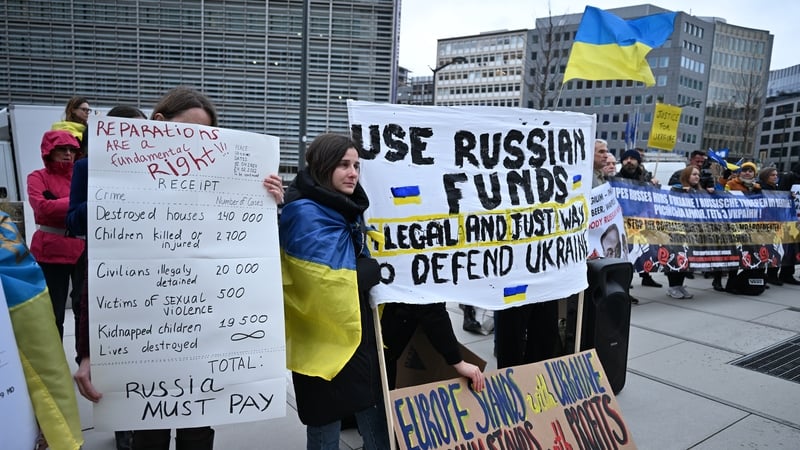
The European Union has agreed to indefinitely freeze Russian central bank assets held in Europe, removing a big obstacle to using the cash to help Ukraine defend itself against Russia's invasion.
The EU wants to keep Ukraine financed and fighting as its sees Russia's invasion as a threat to its own security.
To do so, EU states aim to put to work some of the Russian sovereign assets they immobilised after Moscow's 2022 invasion of Ukraine.
A first big step, which EU governments have now agreed, is to immobilise €210 billion worth of Russian sovereign assets.
The new freeze, which would stay in place "until there is no longer an immediate threat to the economic interests of the Union", will replace the current system which requires a roll-over of the freeze every six months by unanimity.
This removes the risk that Hungary and Slovakia, which have better relations with Moscow than other EU states, could refuse to roll over the freeze at some point forcing the EU to return the money to Russia.
Speaking from Brussels, Tánaiste Simon Harris said the immobilisation of Russian assets on a longer-term basis is a "really important step to take".
"We must always understand the aggressor has to pay," said Mr Harris.
He also said he hopes that Europe can fulfil its commitment to Ukraine in delivering a "loan system that works" to bring "much needed support" to Ukrainians.
Russian central bank suing Euroclear
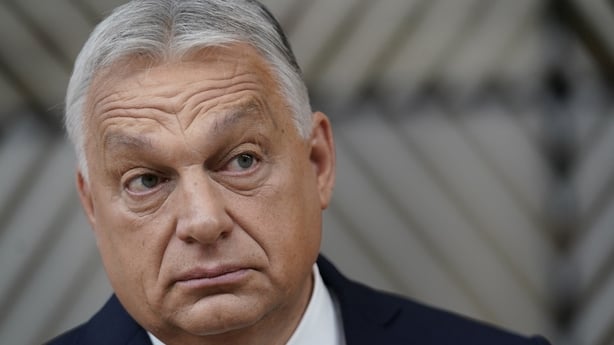
Hungarian Prime Minister Viktor Orban said in a post on Facebook he believed the EU move would "cause irreparable damage to the Union".
"Hungary protests against this decision and will do everything it can to restore a lawful state of affairs," Mr Orban wrote.
Russia's central bank said that EU plans to use its assets were illegal and that it reserved the right to employ all available means to protect its interests.
In a separate statement, the bank said it was suing the Brussels-based central securities depository Euroclear - which holds €185bn of the total assets frozen in Europe - in a Moscow court over what it said were damaging actions, affecting its ability to dispose of its funds and securities.
Belgium's Euroclear has been subject to Russian lawsuits in Moscow courts since the EU froze the assets in 2022 following Russia's invasion of Ukraine.
EU seeks support for planned loan to Ukraine
The indefinite asset freeze is meant to help convince Belgium to support the EU's plan to use the frozen Russian cash to extend a loan of up to €165bn to Ukraine to cover its military and civilian budget needs in 2026 and 2027.
The loan would be paid back by Ukraine only when Russia pays Kyiv war damages, making the loan effectively a grant that advances future Russian reparations payments.
"We think that the reparations proposal is by far the best option also because it doesn't stress countries, public finances, public debt levels," Danish Finance Minister Stephanie Lose, whose country holds the rotating EU presidency, said.
"There's still some worries that need to be addressed. There are still of course countries that have concerns. It's natural that there's a discussion, but we'll continue to work to clarify all the elements and hopefully we'll be able to pave the way towards a decision at the European Council next week," she told reporters on entering a meeting of EU finance ministers.
The European Council is to meet on 18 December to finalise the details of the reparations loan to Ukraine, hammering out the remaining problems which include guarantees from all EU governments for Belgium that it would not be left alone to foot the bill should a potential Moscow lawsuit prove successful.
Additional reporting Róisín Cullen
