


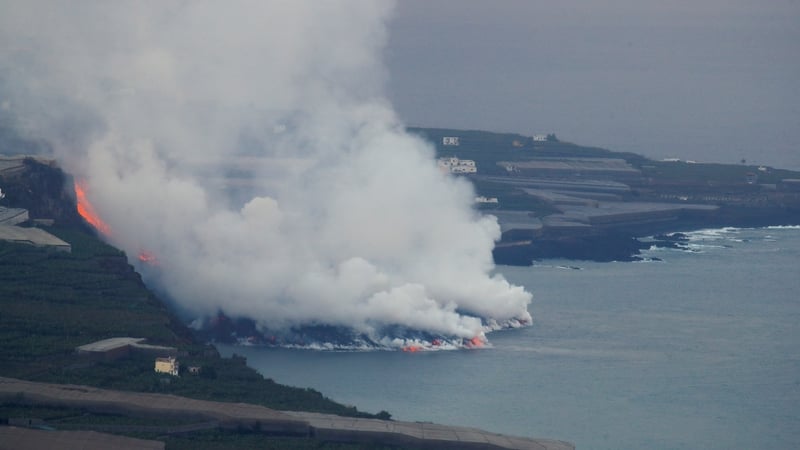
Toxic gases produced by lava entering the sea from an erupting volcano in the Canary Islands present only a "low" risk to the local population, a member of the Canary Island's Pevolca volcanic emergency committee said.
The Cumbre Vieja volcano, which straddles a southern ridge in La Palma, an island with 85,000 inhabitants, erupted on 19 September.
It has spewed out rivers of lava that have slowly crept towards the sea, entering the water last night just after 11pm local time.
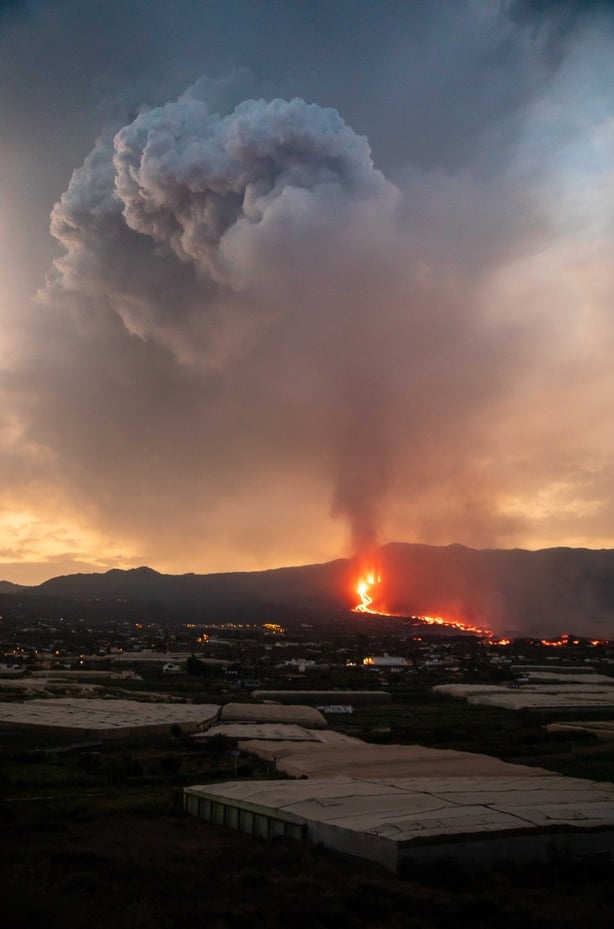
Television images showed a stream of glowing lava cascading off a cliff into the water, creating a large cloud of smoke.
Experts had warned that the entry of the white-hot magma into the sea was likely to release clouds of acidic gas into the air, which could irritate the skin, eyes and respiratory tracts, possibly causing breathing difficulties.
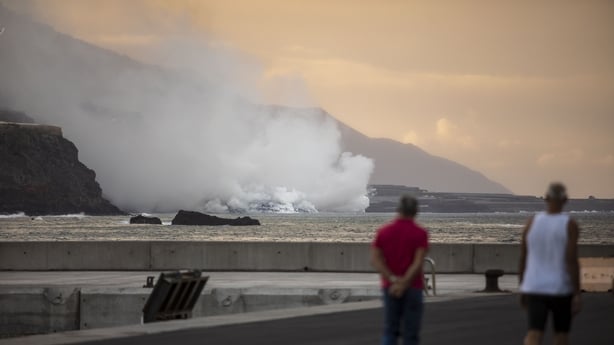
But windy conditions overnight blew the gas towards the sea, reducing the risk, said Rubén Fernández, head of the emergency committee.
"We have a strong wind in the area which is blowing the cloud of gases towards the sea, so the risk for the local population is much lower" than initially feared, he told Spain's public radio.
Images on public television showed a glowing stream of lava pouring into the sea, churning up huge clouds of vapour and gas.
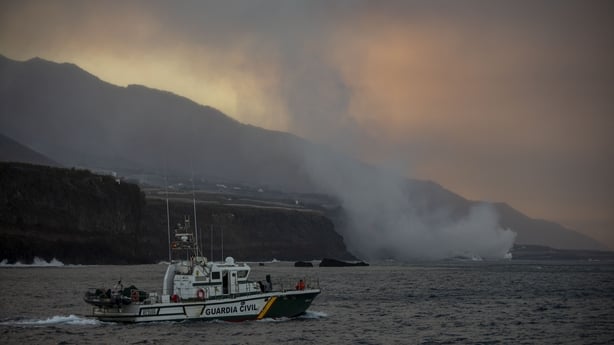
Some 300 residents of the town of Tazacorte and the area where the lava was expected to enter the sea were ordered to stay at home from Monday, as a precautionary measure to avoid harm from the emissions.
"Right now we have no indication that makes us think there is any danger for those who are confined in their homes, nor for the emergency teams which are observing a safety distance," Mr Fernández said.
The islands' government had set up a 3.5km no-go zone on land and a two nautical mile perimeter at sea to keep people safe.
A state of natural disaster has been declared on the island, where the molten rock has so far scorched its way across more than 268 hectares of land and destroyed 656 buildings, according to the European Union's Copernicus Earth Observation Programme.
We need your consent to load this rte-player contentWe use rte-player to manage extra content that can set cookies on your device and collect data about your activity. Please review their details and accept them to load the content.Manage Preferences
Lava from the Cumbre Vieja volcano on La Palma in the Canary Islands has begun to reach the sea.
— RTÉ News (@rtenews) September 29, 2021
However local officials say toxic gases produced as the lava enters the water present only a 'low' risk to the local population | Read more: https://t.co/XCIl9YT31g pic.twitter.com/ferHjiJvmm
The government yesterday released €10.5m in aid for victims of the eruption, notably for housing for those whose homes were engulfed in lava.
The eruption has forced the evacuation of more than 6,000 people from their homes, but has not killed or injured anyone.
The two last eruptions on La Palma, in 1949 and 1971, killed a total of three people, two of them from gas inhalation.
The lava flow has destroyed several roads, with the Canaries regional head Angel Victor Torres estimating last week that the damage to land and property would exceed €400m.
Since it erupted, the volcano has been spewing huge columns of smoke and ash reaching several hundred metres high, disrupting air traffic.
Domestic flights were cancelled on Friday and the airport was closed the following day.
However, the airport reopened on Sunday, but it was only today that a commercial plane landed on the island.
The plane, operated by the carrier Binter, landed in the early afternoon, said a spokesman for state-owned airport operator.
Binter said the flight was made possible by "improved security conditions" on La Palma.
Experts estimate the eruption could last for several weeks, or even months.
Like other islands in the archipelago off the northwest coast of Africa, La Palma relies mainly on the cultivation of bananas and tourism.
