


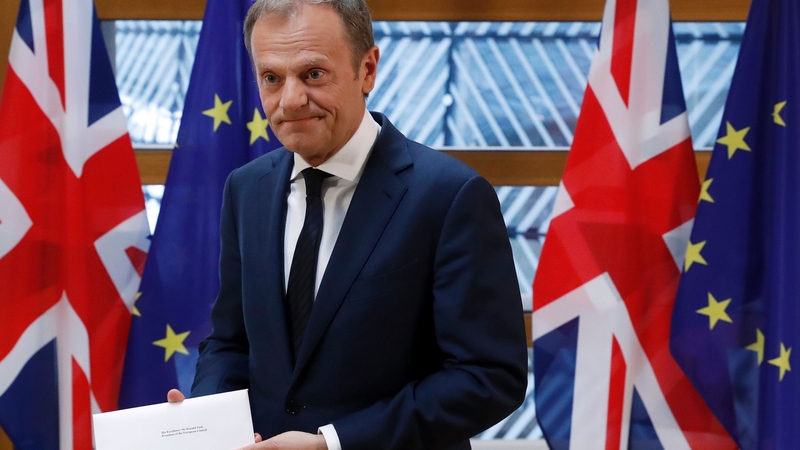
European Council President Donald Tusk has said there is no reason to pretend that this is a happy day, either in Brussels or London.
He was speaking after receiving the letter from British Prime Minister Theresa May triggering Article 50 of the Lisbon Treaty, officially starting divorce proceedings from the EU.
In the letter, Mrs May said Britain and the EU must "work hard" to avoid a failure in Brexit negotiations, calling it a "momentous" challenge.
Mrs May also called for negotiations on the exit and on future trade ties to be worked out "alongside" each other, although the EU has said the new trading relationship should only be discussed after Brexit is agreed.
Donald Tusk: 'There is no reason to pretend that this is a happy day, either in Brussels or in London' pic.twitter.com/DT3Km9myKl
— RTÉ News (@rtenews) March 29, 2017
Mr Tusk made a short statement to reporters after receiving Britain's letter, saying: "We already miss you".
"There is no reason to pretend this is a happy day," he added.
Just before 10am local time, Sir Tim Barrow, Britain's permanent representative to the EU left the British Embassy and drove the short distance to the European Council building.
He was to attend a routine meeting of EU ambassadors before formally delivering a letter to Mr Tusk, the President of Council, signed by Mrs May last night in Downing Street.
In a day replete with symbolism and significance, the actual triggering of Article 50 was a relatively mundane act.
At around 12.25pm Irish time, President Tusk tweeted a photograph of Sir Tim handing him the letter, which he had received five minutes earlier.
The Article 50 letter. #Brexit pic.twitter.com/SO5R5BTvhw
— Donald Tusk (@eucopresident) March 29, 2017
Within 24 hours President Tusk is expected to draw up draft negotiating guidelines for the talks process to begin.
Today Mr Tusk promised to begin arrangements for an "orderly withdrawal" for the UK, but said there was nothing for either side to gain from the two years of negotiations to come, which would be no more than an effort at "damage control".
Member states including Ireland will have four weeks to shape those guidelines before an extraordinary summit meeting at the end of April and the negotiations proper will begin probably in late May, early June.
The divorce proceedings are supposed to be completed within two years, but Britain wants to have a parallel process during which the future trading relationship with the EU, and by extension, Ireland, is opened up.
There is real doubt over how far the EU will go to facilitate that.
Much will depend on the tone and progress of the divorce negotiations, and capitals will be looking closely at Mrs May's letter for hints as to how Britain will approach those issues.
Meanwhile, a spokesman for the German Foreign Ministry said the two-year period for Britain and the EU to settle the terms of their split is very tight.
"The time-frame is damn narrow," Martin Schaefer said at a regular government news conference.
The remaining 27 EU states issued a statement saying the bloc "act as one" and defend its interests in Brexit negotiations.
"In these negotiations the Union will act as one and preserve its interests," they said, adding that they would prioritise arrangements for an "orderly" divorce.
