


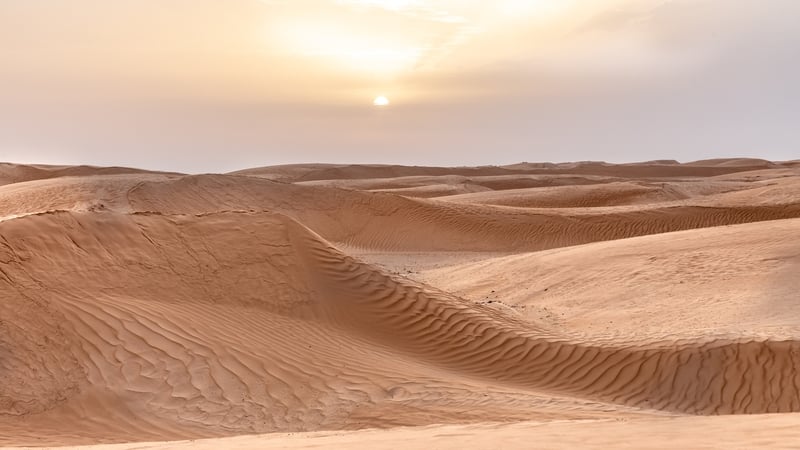
A large plume of Saharan dust travelling across Europe has resulted in hazy skies and vivid sunsets over parts of the country as meteorologists track the atmospheric event moving north from the Sahara Desert.
Early data from the Copernicus Atmosphere Monitoring Service (CAMS) indicates it may be more intense in some regions, especially along the east coast of Ireland.
However, the service said there are no concerns for air quality in Ireland due to the dust, but in other parts of southern Europe it may be different.
Speaking on RTÉ's Morning Ireland, Dr Mark Parrington, a Senior Scientist with CAMS, said the dust plume is air mass originating from the Sahara.
He said the weather there has allowed dust, mineral dust particles to get into the atmosphere and this then travelled across the Mediterranean, and across Europe in this case, as far as Ireland, the UK and the North Sea.
He said that people can expect to see a more colourful sunrise while the plume is travelling along the east coast of Ireland.
"Most of this dust is going to be higher altitude in the atmosphere and so it's not really getting down to ground level, but it should be noticeable if it's clear enough to actually see the sunrise and there may be a more orange colour to that," Dr Parrington said.
He said the dust it should not cause issues for people's breathing.
"We're not seeing any evidence that it's reaching to the surface in any noticeable amount. The only way it might reach the surface is if there's some element of rain in this air mass, and that would then leave a deposit of dust on, say, the car or the window if anyone's left their washing out."
Dr Parrington said that this dust is as a result of Storm Regina, which struck off the southwest coast of Portugal a few days ago.
"This sets up these so-called anticyclonic systems, or this low pressure system, which means you get very strong easterly, southeasterly winds, which then brings this air mass directly from the Sahara to the western Mediterranean, Spain, Portugal, southern France," he said.
