
A new initiative aimed at protecting Ireland's most spectacular marine wildlife will be trialled by tour operators in Cork and Kerry over the coming months.
It aims to help avoid harmful disturbance to sensitive wildlife, and support and encourage sustainable and responsible tourism operations in the marine areas off the southwest coast.
Activities which can cause disturbance to marine wildlife include noise, presence of vessels and personal watercraft, the irresponsible use of drones, and visitor pressure.
The new Code of Practice sets out best practice for approaching marine species including whales, dolphins, seals, seabirds, basking sharks and turtles.
It was launched by Minister of State for Nature, Heritage and Biodiversity Christopher O'Sullivan in Daingean Uí Chúis in Co Kerry, where he met a group of boat tour operators who helped to develop it.
"Simple actions can have a huge impact on the safety and future of these species."
Animals like the fin whale, the second biggest animal that has ever lived, and the iconic humpback whale are regularly seen in the waters off Cork and Kerry.
"These species use sound for hunting and if there is significant sound disturbance from a loud engine on a boat it will have an impact", the minister said.
"Some of the most remarkable wildlife can be seen along our Cork and Kerry coastline, from bottlenose dolphins to grey seals, minke whales and even basking sharks.
"Hearing the call of an oystercatcher off the Great Blasket, or seeing a puffin dive for food are unique experiences which make this place so special.
"Many of these species are protected and they are vulnerable to disturbance. It is in all our interests to ensure that they continue to breed and feed around our coasts.
"Simple actions can have a huge impact on the safety and future of these species - such as keeping our distance, especially during breeding season and being vigilant for signs of disturbance," he added.
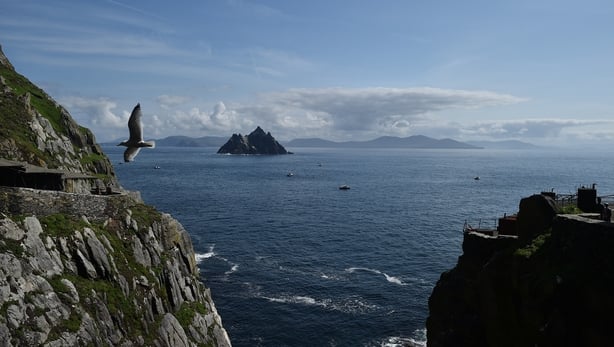
The southwest coast has some of the most spectacular breeding colonies of sea birds in Europe including puffins and gannets on Na Scealga.
If operators get too close and cause disturbance, many of these birds may abandon their nest or their eggs, which could be disastrous and the nest will eventually fail.
The waters off the southwest of Ireland are highly productive. Marine animals come to feed on that productivity; sea birds come to breed.
There are grey seal colonies and harbour seals. Also, sea birds like gannets, that plunge dive at speeds of up to 100km/h to catch mackerel and other pelagic fish. In addition to humpback whales, charismatic rizos dolphins are also present.
"With the increasing number of boats, you have to start putting a few rules and regulations in place so that everybody respects the animals."
District Conservation Officer of the National Parks and Wildlife Service William Hunt describes the birds that come to these waters as "true" sea birds.
"They spend all their lives at sea, except for when they come ashore. We have 10% of the global population of European storm petrels.
"They come here because they have shelter and good feeding opportunities. They can raise their young for the six to eight weeks that they spend on the cliffs and islands off the southwest and then head back offshore again.
"It's vitally important that we protect them and respect them and give them the space they need, while also respecting local communities’ ability to bring people out to share in that wildlife spectacle," he said.
Mick Sheeran operates Blasket Islands Eco Marine Tours from Ventry, a few kilometres west of Daingean Uí Chúis.
He said when he started out about 20 years ago, he was the only marine safari operator doing trips around the islands.
Then, marine tour operators in Daingean Uí Chúis were concentrating on boat tours to see Fungie the bottlenose dolphin, that took up residence in the bay and became famous for his friendly interactions with humans.
"When Fungie disappeared the Dingle lads obviously had to do something else. So now they are out here around the bay doing the same thing that I have been doing for a long time," Mr Sheeran said.
He added: "The Code of Practice is a good start, because there's been no real rules or regulations up to this.
"And with the increasing number of boats, you have to start putting a few rules and regulations in place so that everybody respects the animals. It's a good thing all round.
"I have been operating around the Blasket Islands now for about 50 years. I have seen a couple of species disappear in that time.
"But I've also seen new species arrive. It's very dynamic. There used to be a flock of about 200 Greenland White Fronted Geese. They don't come anymore.
"Arctic Terns don't come anymore either. I am worried what could happen if we interfere too much with species like puffins. I wouldn't like to add them to that list," he added
"When I was fishing there years ago, you'd see an odd basking shark, maybe at the start of May. Then for a period of about 12 to 15 years when salmon stocks fell, we never saw a basking shark.
"But gradually they came back. Now in some years, we might see a couple of hundred basking sharks in a day at the start of the season. The same with humpback whales.
"I never saw one back then when I was fishing. Then about the year 2005 or so, when we started doing the tours around the islands and going further out to see wildlife, we started spotting humpback whales. They have become very, very plentiful. There was one year recently when we had humpback whales every day in August," he said.
For now, the new Code of Practice is voluntary and tour operators like Mr Sheeran will operate it on a trial basis over the coming months to see if it needs to be tweaked.
It was developed with input from the Irish Whale and Dolphin Group and is a conservation project of Páirc Náisiúnta na Mara, Ciarraí, Ireland’s first Marine National Park.
We need your consent to load this rte-player contentWe use rte-player to manage extra content that can set cookies on your device and collect data about your activity. Please review their details and accept them to load the content.Manage Preferences