Chair of the Elders Mary Robinson has said she "wasn't surprised" that last month was the warmest January on record.
According to the European Copernicus Climate Change Services, Over the month of January, average surface air temperatures worldwide were 13.14C, which was 0.12C higher than the temperature of the previous warmest January, which was in 2020.
The Copernicus programme also confirmed the last 12 months were more than 1.5 degrees Celsius above the pre-industrial reference period.
Mary Robinson said that earth is getting warmer, but that it was exacerbated by the El Niño weather event.
"I wasn’t surprised because I’ve had a couple of mandates from the UN, and one of them in 2016 was the last El Niño, it was about El Niño and climate, and I learned that climate is anyway affected by our greenhouse gases, especially carbon emissions.
"It’s getting warmer and then El Niño exacerbates that. And so, I was expecting that last year, 2023, would be the hottest year until this year. I’m afraid this year will probably be hotter. So, I wasn’t surprised, but I think we need to really take this seriously."
"With any luck it may be a bit cooler" in January 2025 Mrs Robinson said, "because we will be out of the El Niño".
"It’s a very predictable thing that happens. And La Niña, the sister one, makes things cooler," she added.
The former Irish president said that efforts must still be made on climate change.
"That doesn’t mean that we’re out of the woods. We need to really make the kind of progress that we are making, but we just need to move faster," she said.
New records set every month since June last year
Deputy Director of the Copernicus Climate Change Service Samantha Burgess has said rapid reductions in greenhouse gas emissions are the only way to stop global temperatures increasing.
Ms Burgess made the comments as she launched the latest EU climate report.
The report says new temperature records have been set every month from June last year, meaning records have been broken for the last eight months in a row.
For January, the average temperature was 0.7C higher than the 30 years up to 2020, and 1.66C higher than typical January temperatures in the pre-industrial era.
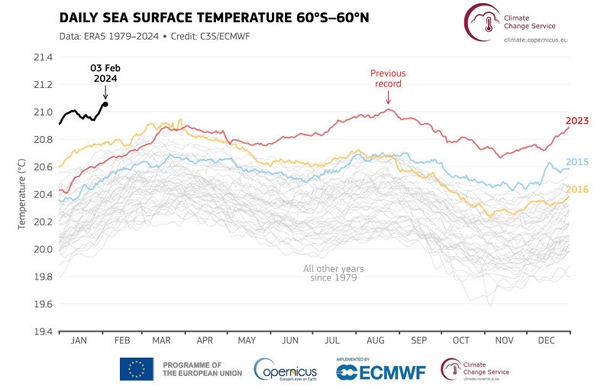
European temperatures varied from much below the 30-year average over the Nordic countries, to much above average over the south of the continent.
The report also noted that January was wetter than average in large parts of Europe, with storms impacting north-and south-western Europe.
However, the first month of the year saw drier-than-average conditions in some parts of the continent, including in Ireland.
'Long streak' in 'worst records' - Director of Copernicus Climate Change Service
"Climate change affects all areas of life ... it is not just temperature, it's the shrinking ice in the polar areas, it’s the change in the precipitation pattern and in the intensity of precipitation and this freak event that we have seen," Director of Copernicus Climate Change Service Carlo Buontempo has said.
Speaking on RTÉ's Morning Ireland, he said: "It is another month that adds to the long streak of months that started back in June 2023 and has been uninterrupted since of months that at that moment in time when they were the worst on record."
The arrival of El Niño, a natural weather system, which increases sea surface temperatures in the tropical eastern Pacific, is, according to Mr Buontempo "one of the drivers on top of climate change of these exceptional year we've just lived through."