
Members of the Teachers' Union of Ireland (TUI) are set to raise fresh concerns about several issues that they have said are making the profession unsustainable and unattractive.
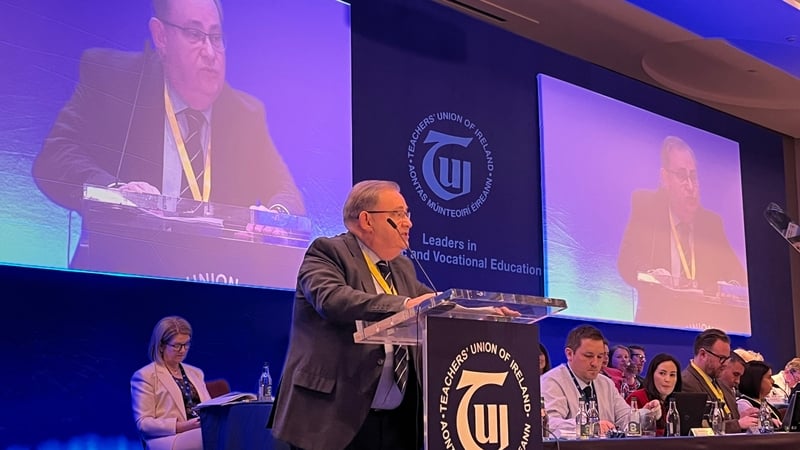
More than 500 delegates and guests will attend the union’s annual congress in Kilkenny over the next three days.
Members of the union will raise concerns about what they have said are the affordability of the profession for new entrants, the excessive workload facing teachers because of bureaucratic demand, and the challenges posed by artificial intelligence.
Minister for Further and Higher Education James Lawless will address the conference today, while Minister for Education Hildegarde Naughton will speak to delegates tomorrow.
The TUI represents 22,000 teachers and lecturers at secondary school level, in further education and training colleges and centres, as well as in technological universities/institutes of technology.
The union has warned that teaching is no longer a viable and sustainable profession for many.
Union officials have said that this is evidenced by what they have described as a worsening recruitment crisis that has seen larger class sizes, and students not being able to access the full range of school subjects.
A recent survey of more than 1,000 of the union’s members found that of those who entered the profession since 2016, just 35% received a contract of full hours in their first year.
The survey also found that 36% of recent entrants do not believe that they will be in the profession in ten years' time.
Of those who responded to the survey, 77% said they do not believe that they could afford to become a teacher today given the "fragments of jobs" being offered at a time when there is a cost-of-living crisis and a shortage of accommodation and housing.
Teaching an expensive profession
TUI General Secretary Michael Gillespie will raise a number of these issues in his address to delegates.
He is expected to say that a new pay deal is not possible unless the local bargaining element of the current one is concluded.
He is also expected to call for a 1% pay increase that must be applied retroactively from 1 September 2025, with this being backdated for the union's co-operation with the redevelopment of the senior cycle and the Leaving Certificate.
Mr Gillespie will also draw attention to what he will say is the imminent fall in pupil numbers expected at second level over the coming years due to changing demographics.
He will say that the union plans to campaign to ensure that this "demographic opportunity" is used to benefit students and school communities by allowing smaller class sizes and wider access to the full range of school subjects.
He is also expected to say that excessive workload, especially that of a bureaucratic nature, is driving many from the profession.
The union is expected to form a position that enhanced staffing ratios and smaller class sizes will be essential as senior cycle redevelopment is integrated into schools.
The union's annual report will also confirm its membership has increased by 8% over the previous year.
Commenting on the findings of the TUI’s recent survey, TUI President, Anthony Quinn said teaching has become too expensive a profession for many in Irish society.
He said: "In terms of solutions, schools need greater teaching allocations to allow them to offer more than fractions of jobs, and the duration of the two-year Professional Master in Education (PME) required to teach at second level must be halved to make the profession more affordable.
"Excessive workload is also a serious issue in terms of teacher retention. It is students who are losing out most, with 77% of respondents believing that the crisis has had a negative effect on the education service to pupils."
Mr Quinn added: "It is concerning that 78% of respondents do not believe that the level of guidance provided by to date by the Department of Education on artificial intelligence (AI) is satisfactory. It is also worrying that 87% agree that it poses a threat to equity and fairness.
"Standing still is not an option here. The nettle must be grasped - we need a coherent and regulated national approach that optimises the potential benefits and protects against the risks that AI presents to the education system."
The online survey of 1,021 TUI members was carried out over two and a half weeks last month.
The annual congress takes place at the at the Lyrath Hotel in Kilkenny until Thursday.