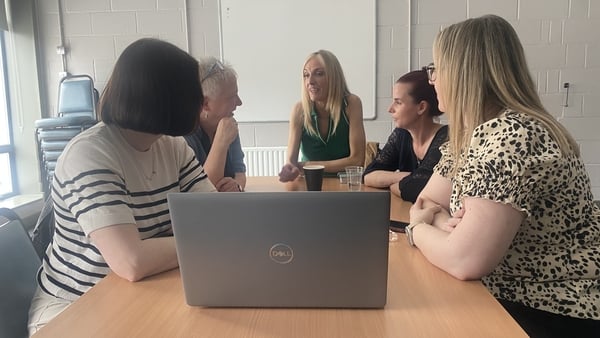

Susan Quirke-Crowley knows all about waiting lists as her Mounthawk Montessori School Group in Co Kerry has a significant demand for places.
Based in Tralee, the service offers pre-school bookings, Montessori education and nursery care in large indoor/outdoor spaces.
Parents are so desperate for children to attend Ms Quirke-Crowley's facilities, waiting lists currently extend to 2028.
Generally, parents expecting a child call the facility to enquire about a placement until recently.
She said: "My colleague was at the front door the other day speaking with a mum who had booked a baby in for 2028 and she asked the mum 'how are you feeling?'
"The mum looked at my colleague quizzically and told her she wasn't expecting a child, but that she would be."

According to Early Childhood Ireland, around 46,000 children under the age of three are now on waiting lists to access places nationwide.
However, in response to that waiting list figure, Minister for Children Norma Foley has previously pointed out that an individual child may be on multiple waiting lists in different services.
The minister said waiting list data should not be used as a measure of overall demand for early learning care and school aged childcare.
But Mounthawk Montessori School Group is experiencing demand, which is largely down to the unique experience provided to children.
Influenced by the Reggio Emilia Approach, there are no pre-set lesson plans and the curriculum is built on projects emerging from children's interests.
Nature, the outdoors and biodiversity feature greatly.
Ms Quirke-Crowley began working in childcare back in 1999 with 10 children.
She is now responsible for 289 families across four services, with 35 staff.
"While it's fantastic that we have free early childhood care, we never had that before, from a practitioner point of view, the capitation isn't enough," Ms Quirke-Crowley pointed out.
"It hasn't grown," she added.
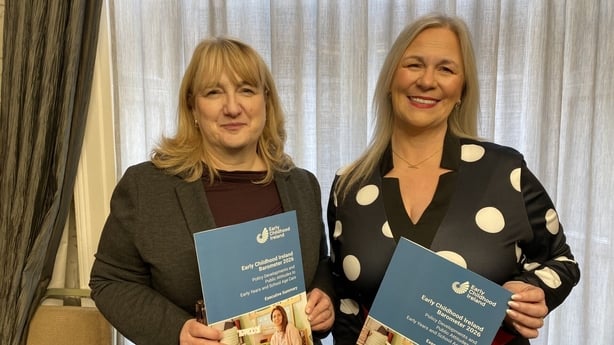
Asked what changes she would like to see in the sector, she said it was simple.
"Support the parents, increase the National Childcare Scheme, increase the core funding, so that we also can increase the payment for our staff," she said.
"I mean, then let us do what we do best and be the voice of the child," she added.
Workforce issues are of major concern to Early Childhood Ireland which has described the current national staff turnover rate of 25% as "unsustainable".
Director of Policy Frances Byrne called on the Government to take "urgent action" to address the underlying issues around pay and conditions.
This morning, she reiterated calls to bring early years graduates under public sector terms and conditions, in line with primary school teachers.
The impact is significant, according to many providers including Ms Quirke-Crowley.
She said: "Three of our excellent teachers with degree qualifications have gone to primary teaching because of lack of pay parity.
"I don't blame them, but wouldn't it be a fantastic thing if core funding could increase, so that the salaries can increase on par and from that perspective, early years education and educators are seen and respected as teachers.
"And it wouldn't take an awful lot to do that."
Director of Policy at ECI Frances Byrne said: "Without better pay and conditions for the workforce, capacity cannot increase, and waiting lists will remain a reality for tens of thousands of children and families."
At a recent Oireachtas committee, she described people on very low wages working with young children as "immoral and unethical".
More than half of Irish adults, or 57%, do not think the Government is doing enough to address the acute shortage of early years places for children nationwide.

The margin for error is +/-3.2%.
Of those polled, 79% agreed that every child should be guaranteed access to early years and school age care in their community.
This is a rise from 76% last year.
Of those polled, 75% thought that - similar to primary education in Ireland - early years education should be free to all children.
The Programme for Government committed to reducing costs of childcare.
An Early Years Action Plan launched by the Minister for Children has committed to actions this year that will make services more affordable, accessible and improve quality.
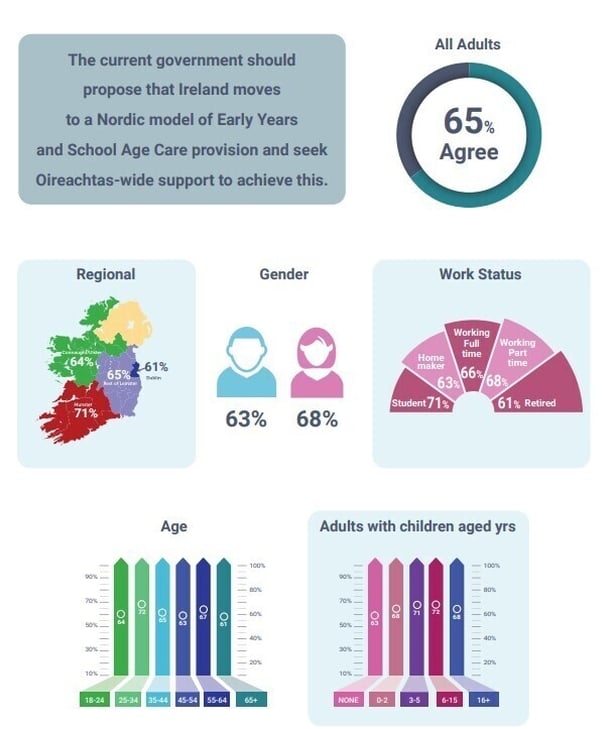
According to the poll, 65% of the public agree the Government should propose that Ireland move to a Nordic model of early years and school age care.
According to the survey, two-thirds of adults believe all parents should be financially supported to stay home with their child for the first 12 months of their child's life.
Support for direct government payment of wages for early years educators has increased, rising from 49% in 2025 to 54% in 2026.