

A new study has found that school absence leads to lower educational qualifications and poorer wellbeing in early adulthood.
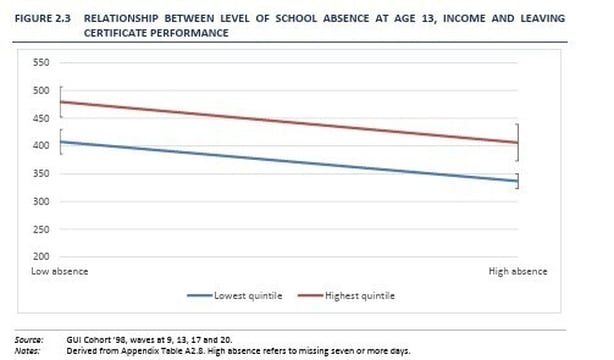
The report from the ESRI shows even short spells of absence of one to two days at age 13 are linked to lower Leaving Certificate grades.
It found that if a child misses 20 days or more of school every year this can lead to a performance gap of over 80 Leaving Certificate points.
It said the performance gap is evident across all social groups and there is no evidence that more advantaged families can successfully counter the negative effects of absenteeism for their children.
The report shows that longer school absence at age 13 is significantly related to lower chances of going on to higher education and of achieving a degree by age 25.
Young people with prolonged absence from school are more negative about the benefits of their schooling to their broader social and personal development.
The study also found that people who attend a school with a higher prevalence of chronic absence achieve lower Leaving Certificate points.
Even young people who have good attendance have poorer outcomes if school-level absence is higher.
Read the report in full here
The report shows that chronic absence at ages nine and 13 is predictive of depressive symptoms and higher stress levels at both 20 and 25 years.
Life satisfaction at 20 and 25 years of age is much lower among those who were persistently absent from school at age 13.
The study shows that those who have higher levels of absence at age 13 report poorer physical health at ages 20 and 25.
Co-author of the report Emer Smyth said: "School absence emerges as an important driver of later inequality, with very significant negative consequences for educational attainment, health, wellbeing and social belonging.
"The findings highlight the urgency of addressing school absence, especially given the higher levels apparent since the pandemic."
Minister for Education Hildegarde Naughton said: ‘Regular school attendance plays a vital role not only in academic achievement but in supporting young people's wellbeing, confidence and future opportunities.
"This important research highlights the lasting impact that even relatively short periods of absence can have on educational outcomes and life chances."
We need your consent to load this rte-player contentWe use rte-player to manage extra content that can set cookies on your device and collect data about your activity. Please review their details and accept them to load the content.Manage Preferences
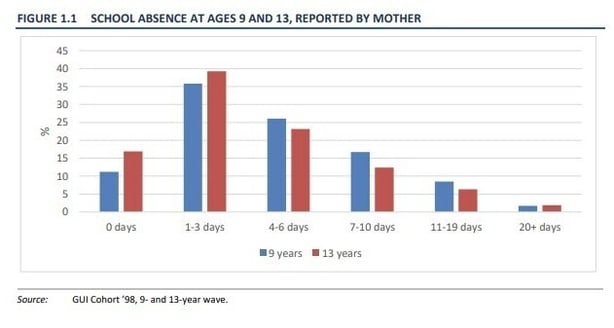
Professor Smyth said about a fifth of the students across primary and secondary fulfil the definition of chronic absence from school, missing 20 days or more.
Speaking on RTÉ's Morning Ireland, she said there has been a massive increase in days missed in the wake of the COVID pandemic, and that more disadvantaged groups are more likely to be absent.
However, she said the effect is the same across all social classes and genders.
Prof Smyth said that between the ages 20 and 25, young people who have been absent a lot from school, have been found to be less satisfied with their lives and more likely to have depressive symptoms and high stress levels.
They also have weaker social ties, less sense of belonging and less sense of general trust in other people, she said.
Prof Smyth said that the relationship between the level of absence and level of underperformance is linear, and missing more than ten days at school means students are 16% less likely to go on and get a degree by the time they are 25.
The research found more experience of unemployment and being out of the workforce for the group who were chronically absent and slightly lower income levels.
Prof Smyth said that school absence impacts wellbeing, education outcomes and life chances.
Read more: Children in Ireland missing more days of school - ESRI