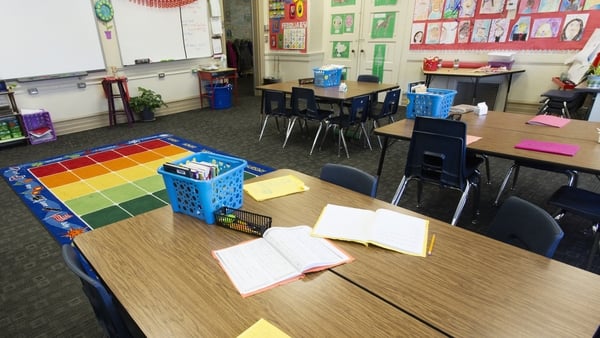
Primary school enrolment has fallen by almost 6,500 over the past year.
It is the largest decline to be seen in recent years and places further pressure on many small rural schools which fear closure or the loss of teachers as a result of declining pupil numbers.
The latest data published by the Department of Education and Youth shows that 6,470 fewer children are attending primary school this year compared to last.
The reduction is due to declining population in the primary school-going age group.
Primary school enrolment fell by almost 4,000 last year and by just over 2,000 two years ago.
Eleven primary schools have closed permanently since last June due to low enrolment making them unviable.
The latest Department of Education and Youth data reveals more tiny schools struggling to survive, especially along the west coast where the national decline in primary school-age children, combined with rural depopulation and changing work patterns in families, have created the perfect storm.
Data based on official returns made to the department by schools at the end of September shows one mainland school had just one pupil enrolled.
That one child attended Leaffoney National School in Co Sligo up until Christmas.
After a number of efforts to secure future enrolment failed, a decision was taken to close the school permanently.
The data shows a second mainland school with just two pupils enrolled.
That school, SN Naomh Antoine near Clifden in Galway, also decided late last year to close.
Four schools, in Tipperary, Donegal, and Cavan, have just four pupils each.
Most of these schools managed to remain open in recent years due to the enrolment of children from Ukrainian or asylum seeker families who were living locally.
When those families were moved to accommodation elsewhere, their children were obliged to leave those schools and their loss resulted in a dramatic fall in enrolment.
Finntra NS in Killybegs in Donegal, now with just four pupils, had 22 children on its roll last year and 47 the year before.
Principal Aisling Meehan says there are fewer young families in the area and a preponderance of holiday homes.
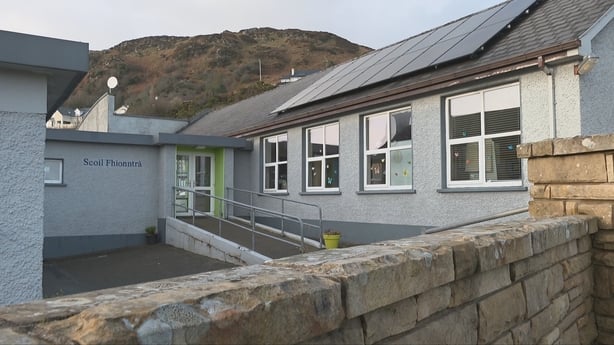
"A school is the backbone of the community and we would love to see it remain open. The community definitely would like to keep the school open," Ms Meehan said.
The principals of some tiny schools spoke to RTÉ News on condition of anonymity.
They do not want to draw attention to their own schools for fear of damaging future enrolment.
"We have fabulous facilities, and an immaculate school. The only thing we are missing is the children," said one principal.
Describing depopulation in the area, the principal said: "You don't see children’s bikes in the gardens, toy tractors, all those things you associate with children. There are no children here."
The principals of other tiny schools also point to changing family routines.
Where families are living in a rural area, both parents are likely to be leaving home early in the morning to work in urban centres that are often far away.
They are more likely to send their children to schools in nearby towns with breakfast clubs and afterschool care.
"It has been heartbreaking for us," said the principal of one such school.
Looking to what appears to be certain closure in the near future they said: "We are all devastated. We adore this school and this community. It has kept us awake at night."
School resources
Although their number is declining, Ireland continues to have a high proportion of very small schools.
Thirty mainland schools across the country have an enrolment of 10 or fewer.
Some of these tiny schools have more staff than pupils, or as many.
This is because core staffing is allocated on the basis of pupil numbers in the previous year.
Leaffoney NS was allocated one teacher, one SNA, a part-time resource teacher and a school secretary for this year even though it had just one pupil.
Drung NS in Cavan and Killusty NS in Co Tipperary with just four pupils both have two class teachers, one special education teacher and one SNA.
All receive the same level of core funding as that of a 60-pupil school.
This is because it costs the same to heat and maintain a school building regardless of whether four or 60 pupils are in attendance.
Some of these tiny schools have had State-funded solar panels installed in recent years.
'It is the decline of rural Ireland’
Killian NS in Inver in Co Donegal closed its doors permanently last September when not a single child enrolled for the new school year.
The school, which has new solar panels on its roof, had just celebrated its 100th anniversary.
Department of Education inspectors who visited the school last April noted that it had six pupils, "the majority" of whom were from Ukraine.
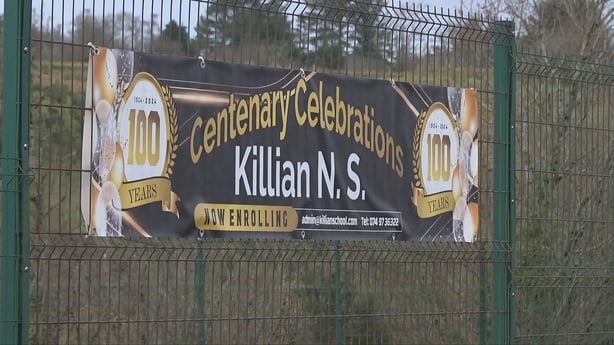
It was the departure of these Ukrainian students that sealed the school’s fate.
"The numbers just went down and down" a former chair of Killian's board Fr James Sweeney said, speaking of recent years.
"It is the decline of rural Ireland."
But while some rural schools are suffering, others, closer to towns, are booming.
Just 10km away from Killian NS, St Peters NS in the village of Mountcharles in south Donegal has seen enrolment rise this year from 107 to 135.
Fr Sweeney says this is because parents prefer to drop their children to schools in towns that are on their commute to work.
"Parents are either heading to Ballybofey or Donegal town [from more remote areas] and they can very easily just drive into [Mountcharles] and drop or collect their child on the way," he said.
The Department of Education and Youth said a decision to close a school is a matter for its patron and subject to the agreement of the department.
It said any proposal to close a school involves consultation with the school community.
Two weeks ago, the patron of Leaffoney National School, the local Church of Ireland bishop, informed the department that they wished to close the school.
Of this now empty school, the department said the request was "currently under review".
A network representing the interests of rural communities has called for an urgent, coordinated response from the Government, including a review of the factors driving population decline in rural areas.
Expressing serious concern over the decline in pupil numbers, Irish Rural Link said rural primary schools were central to community life, supporting not only education but also local employment, social connection and population stability.
It said the trend of falling school enrolments reflects deeper structural challenges that threaten the long-term viability of rural communities.