
Second-level schools are coming under increased pressure to introduce individual electronic devices for students as a result of a new senior cycle curriculum - and while schoolbooks are now free, the cost of paying for a laptop or tablet for their child has taken their place as a significant expense for families.
Schools that had until now resisted requiring parents to pay for laptops or tablets for their children say the new curriculum, which awards at least 40% of final marks for practical or project work, has left them with little option but to change direction.
The growing adoption of one-to-one devices has given rise to a new wave of marketing directed at school leaders by companies competing to secure contracts for the provision of devices and services to students.
While school leaders choose which kind of tech plan to go with, and which provider to give their business to, it is parents who purchase the devices, paying in some cases as much as €1,000 per child.
Because it is parents who pay, public procurement rules do not apply.
School leader conferences
One company, Wriggle, is offering school leaders overnight stays at five-star hotels such as the K Club and Mount Juliet.
"This exclusive retreat includes dinner, drinks, and an overnight stay in a five-star venue, providing you with an excellent opportunity to reflect, recharge and reimagine with school leaders and the extended Wriggle team who will support you on your journey," the company states on Eventbrite.
At a conference for school leaders late last year, companies were keen to persuade school principals of the benefits of their product range.
At the National Association of Principals and Deputy Principals conference, representatives from another tech company were paying for rounds of drinks at the bar.
"I went up to get my order of drinks from the bar and it was already paid for," one principal remarked. "But they are not going to get any money from me because I don't have it," he added.
The largest provider of managed laptops and tablets to schools, Wriggle, is hosting "exclusive retreats" at five-star hotels for school leaders.
This month it has sent out its latest high-tech invitations to school principals, containing a hotel keycard and a video which plays when the lid is lifted and invites school leaders to attend one of four "exclusive retreats at one of Ireland’s finest five-star venues".
Wriggle is holding its free overnight retreats at the K Club in Kildare and the Castlemartyr Resort Hotel in Cork in February, and at Mount Juliet and the Grace Hotel in Westport in March.
The retreats, titled "Leading Senior Cycle Reform with a Student Device Model", all take place during term-time weekdays.
The company told RTÉ News that such events support schools in delivering the Department of Education’s Digital Strategy for Schools Implementation Plan, which recognises collaboration with external partners.
"These events are structured professional development forums that allow school leaders to learn from peers, reflect on digital strategy, and engage with system-wide changes such as senior cycle reform, digital skills and AI, with no sales requirement or obligation attached," a statement from Wriggle said.
New curriculum pressures
"The only reason we went with tech this year is because of the new Leaving Cert," said principal of St Anne’s Secondary School in Tipperary Town Jan Dowling.
"With such an emphasis now on project work [in the new senior cycle curriculum] it is important for students to have their own devices," Ms Dowling said.
Prior to this the school had been unwilling to burden its hard-pressed families with the expense of one-to-one devices.
As of this academic year, the parents of 5th year students are required to purchase a laptop for their child, at a cost of €750. The school is acutely aware of the financial pressures many of its families face.
It deliberately chose laptops with a five-year warranty, so that the devices will see students not just through the senior cycle but also through three years of college or further education.
"Parents are able to pay for the devices over a number of months" Ms Dowling said. "Tipperary is a really really deprived town and you can't turn a blind eye to what is around you."
St Aidan's Community School in Tallaght continues to resist. Principal of this DEIS school Kevin Shortall acknowledges the impact of the new senior cycle curriculum but said turning to parents to ask them to fund a device for their child is simply "a non-runner".
This year the school found another solution. "We have purchased devices with €30,000 in funding that we received from Google.
"We have four trolleys of 24 laptops which are shared between our 600 pupils," Mr Shortall said.
He is concerned by what he sees as a growing digital inequity between richer and poorer schools. He talks about other nearby schools where students are required to purchase their own iPad or other expensive device.
"The inequality among schools is really stark, and the extra money the state gives doesn't even begin to address it," he added.
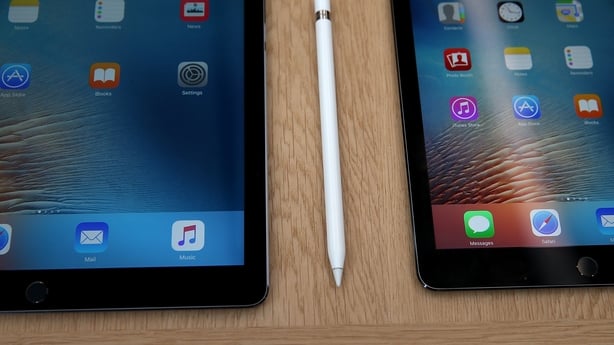
The Department of Education and Youth has said that schools may use money they receive in State funding for Information and Communications Technology (ICT) to set up loan schemes to help parents pay for student devices.
Last May, it issued €35m in ICT funding to schools - distributed across the primary and post-primary sectors.
"The department is aware of the financial pressures faced by families and has instructed schools to work closely with parents to ensure costs are kept reasonable," it said.
But the principal of a DEIS school in Co Laois points to the disparity between State funding for schoolbooks versus funding for ICT.
"We got €260,000 in funding for schoolbooks [this year], but we got only €35,000 for ICT. That €35,000 is to cover PCs, licences, WiFi, projectors, TVs etc.
"You can see the imbalance", he said. This school has introduced tablets with keyboards for students, at a cost to parents of €455.
Schools are supposed to consult with parents before introducing any policy that means parents have to pay for technology.
But in reality parents are left with little if any choice. Enrolling their child in a school means accepting the school's practices, and if that includes paying up to €1,000 for a device for their child then so be it.
Dr Ann Marcus-Quinn, an Associate Professor at University of Limerick, has specialised in the subject of ICT use in schools.
Dr Marcus-Quinn believes there should be a centralised approach, led by the Department of Education and Youth, to both the procurement and the provision of digital devices and necessary ICT systems in schools.
In what is currently an unregulated area she believes this would support well-informed digital school policies and investment.
In the meantime, schools need a recommendation regarding a common minimum standard for both student and teacher devices, Dr Marcus-Quinn said.
"The department needs to acknowledge the necessity of devices, both at junior cycle and at senior cycle. They have never done that, so this has allowed schools to do what they want, and it means they are beholden to the private sector for advice on devices and technical support," she said.
"This is driving up costs for parents" she said. "A device is now part and parcel of going to school in the same way as books once were, especially now with the new AACs (Additional Assessment Components) at Leaving Certificate level, and the Leaving Cert is high stakes for student prospects.
"The department needs to lay down minimum standards for devices to help counter what is currently a mandated brand approach, Dr Marcus-Quinn added.
Mr Shortall agrees with much of this. "There needs to be a State procurement system. They will say one to one devices are not needed, but because of the new specification for senior cycle they are," he said.