


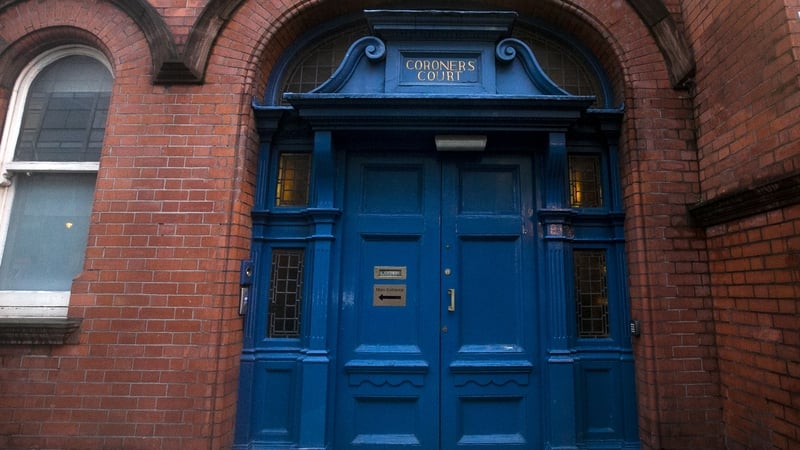
An inquest into a fatal drowning on the River Liffey where rescuers struggled to find life-saving equipment has heard that 15 ring buoys are stolen on average every week in Dublin city.
A sitting of Dublin District Coroner's Court heard two ring buoys - otherwise known as lifebuoys - were missing from their stands on the night that a Tyrone man got into difficulty after falling into the river on 7 June 2021.
Daniel Cullen, 34, a former civil servant of Oaks Road, Dungannon, Co Tyrone drowned after falling into the Liffey at Sir John Rogerson’s Quay shortly before midnight.
Several witnesses gave evidence that attempts to rescue Mr Cullen were hampered by missing ring buoys near the location where the victim entered the water.
Cian Granger Stanley, a youth who was in a car with his mother which stopped when they saw someone in a distressed state on the quays close to the Samuel Beckett Bridge, said a ring buoy was missing from its stand when he went to assist the man who was in the water.
He estimated the stand was just four metres from where Mr Cullen had fallen into the river.
Mr Granger Stanley said he had run around another 300 metres along the river to a second stand but its ring buoy was also missing.
He eventually found a ring buoy which he estimated was located around 500 metres from where Mr Cullen had fallen into the river.
Mr Granger Stanley said he threw the ring buoy to Mr Cullen, who was around five metres from the quayside wall, but he made no attempt to try to grab it.
The driver of another vehicle who stopped after seeing the incident, Nicole Tennison, described how she leaned over the quayside to extend a belt that she was holding to Mr Cullen to try to pull him out of the river.
Ms Tennison said she believed he was not strong enough to recognise that the ring buoy was beside him after someone had found one and thrown it to him.
She estimated the victim had been in the river for around 20 minutes and was getting dragged by the current before a ring buoy was located.
Her friend, Sonia Brown, said she had persuaded one of Mr Cullen’s friends, who wanted to jump into the river, to stay on the quayside for his own safety after hearing they had been drinking all day.
The inquest, which was adjourned from last April, had previously heard that Mr Cullen and two friends had stopped near the Diving Bell on the quays to urinate while on their way home.
A Dublin Fire Brigade crew had launched a boat on the river to try to find the casualty, while the Irish Coast Guard helicopter, Garda Air Support Unit and RNLI lifeboat from Dún Laoghaire were also deployed to the scene.
A search for Mr Cullen was called off at around 4.30am and resumed later that morning when his body was found on the river bed by a member of the Garda Water Unit at 9.57am. He was formally pronounced dead at Poolbeg Yacht and Boat Club where his body was brought ashore
The hearing today was told by Dublin City Council’s water safety officer, Gerard Carty, that the local authority is spending approximately €22,500 each year to replace stolen or damaged ring buoys.
Mr Carty said an average of 15 ring buoys were stolen each week - approximately 600 per annum.
He admitted the problem was particularly acute in some areas including along the Liffey between Heuston Station and the 3 Arena with five reported missing in one week recently.
The council has around 140 ring buoys stands located along rivers, canals, lakes and coastal areas within the city’s administrative area which are inspected twice weekly.
Mr Carty said records showed that the ring buoy at the location where Mr Cullen fell into the river was in its stand when inspected on 4 June 2021 - three days before the fatal incident.
The inquest heard it had been replaced and a lifebuoy was recorded as being present at the location two days later on 9 June 2021.
Mr Carty said a lifebuoy was also recorded as being at the location on 21 April this year - a day after Mr Cullen’s family had visited the scene to hold a short memorial ceremony following a hearing of the inquest and expressed concern that there was no life-saving equipment in the stand.
He said the issue of stolen or damaged ring buoys was an ongoing problem which had become worse in recent years.
In many cases, Mr Carty said it was "senseless, mindless acts of vandalism" which appeared to be caused mostly by groups of teenagers and stag parties "who think it’s fun to interfere with live-saving devices".
He believed that the equipment was also sometimes stolen for the ropes by people who own horses.
The council official said the four local authorities within Dublin city and county had run a successful pilot scheme using GPS technology which would alert the authorities in real time whenever a ring buoy was removed from its stand.
Mr Carty said a tender was out to implement the project across all ring buoy locations in the capital which he hoped would be up and running within four months.
He told the inquest that missing or damaged ring buoys would be replaced by the following day under the proposed new system.
Questioned by solicitor for Mr Cullen’s family, Stephen Woods, Mr Carty said ring buoys were located every 100-200 metres in the most dangerous areas which were based on a risk assessment.
Mr Carty said ring buoys would be no more than 150 metres apart where Mr Cullen had fallen in the Liffey, noting that there was another stand located on the opposite side of the river near the Samuel Beckett Bridge which was "no more than 120 metres away".
Mr Woods said Mr Cullen’s family believed more frequent inspections should be carried out at locations from where ring buoys regularly go missing such as the Liffey’s quays.
The solicitor said they also felt Dublin City Council should work more with gardaí on the issue as well as making use of CCTV to counteract the problem.
"A stolen ring buoy is a stolen life and never was it truer, sadly, than with this case," said Mr Woods.
He said the victim’s mother, Mary felt "a mixture of anger and sadness" about the evidence in the case.
"The anger is that something so simple that should have been there to save her son’s life wasn’t and it is a sadness that will never leave her," said Mr Woods.
Ms Cullen had earlier intervened in the hearing to state: "I don’t want this to happen to another family. It’s just horrendous."
She also expressed thanks to all the individuals and various authorities who had attempted to rescue her son.
The coroner, Clare Keane, said a post-mortem report had confirmed that Mr Cullen had died as a result of drowning.
Dr Keane recorded a narrative verdict based on the extended evidence in the case.
The coroner said she would completely endorse the council’s plans to use GPS technology to allow for the speedier replacement of stolen or damaged ring buoys and would write to Dublin City Council to urge it to implement the project as soon as possible.
"The message needs to get out about doing something so stupid and to realise the consequences," said Dr Keane.
