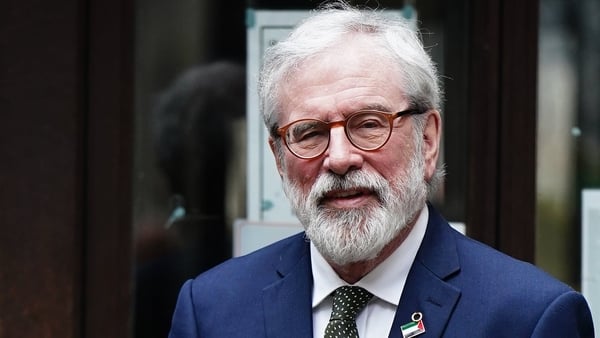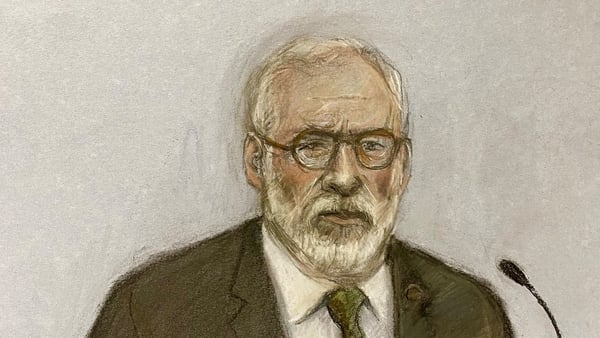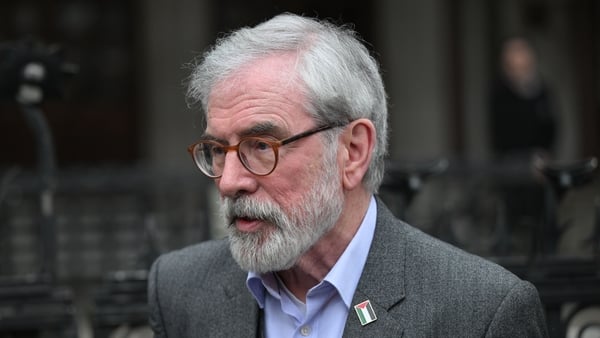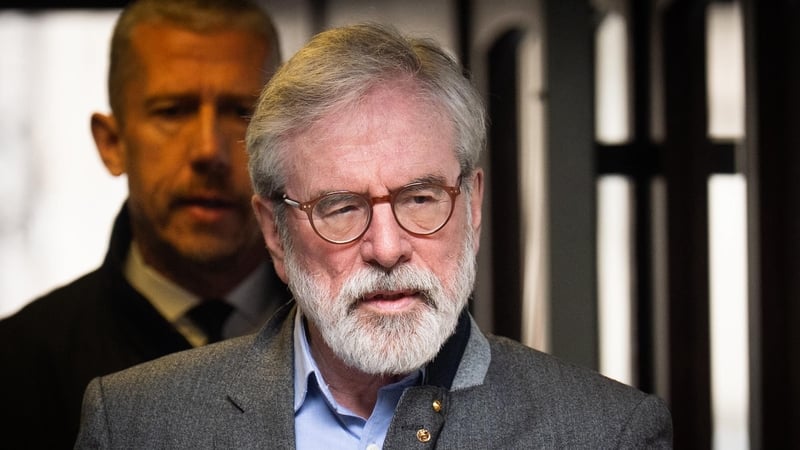

A lawyer for Gerry Adams has questioned why three IRA victims suing him for damages took so long to make their claims.
The claimants allege that the former Sinn Féin leader is personally liable for injuries they sustained in bomb attacks in England in 1973 and 1996 because he allegedly held an IRA leadership role.
Outside the court Mr Adams said that he was "very, very content" that he joined Sinn Féin rather than the IRA.
In closing arguments on the eighth day of the civil trial at the Royal Courts of Justice in London, Edward Craven KC said the delay had prejudiced Mr Adams' ability to challenge the allegations.
Those taking the claim are John Clark, injured in the Old Bailey bombing in 1973, and Jonathan Ganesh and Barry Laycock, who were injured in attacks on London Docklands and in Manchester in 1996.
In the case of John Clark, Mr Craven told Judge Jonathan Swift that the delay of almost half a century is "genuinely unprecedented in magnitude".
"We have not been able to find a case where Section 33 (of the limitation act) has been disapplied after such a long delay, almost half a century," he added.
He referenced the fact that the other two claimants both said they only decided to take action after hearing that Gerry Adams had taken a case in 2020 against the British government over his internment in the 1970s.
Mr Craven cited two other civil cases, including by victims of the Omagh bombing, which were successful, and questioned whether the claimants in this case were not aware of those.
The lawyer said the claimants in this case were not "acting promptly and reasonably".
He also said the delay resulted in the trial hearing claims about Mr Adams by several people who are dead.
Mr Craven said that was prejudicial because Mr Adams "was not able to challenge that evidence robustly in cross examination".
"It is very difficult to defend a case where some of the key allegations come from hearsay evidence," he said.
Mr Craven said the claimants had come "nowhere close" to establishing grounds for the court to set aside the three-year limitation for bringing a civil case.
"There is no legal reason why the claims could not have been brought many years earlier," he said.
The lawyer also said there were concerns that the claim was being used as a way to achieve a much wider examination of Mr Adams’ "alleged role, associations and membership of the IRA".
The judge was also told that the claims should fail on the basis that they are an abuse of legal process.
Mr Craven said the true purpose of the legal action was to try to compel the court to carry out a much wider "public inquiry style examination" of Mr Adams' alleged involvement with the IRA over half a century.
The lawyer said the civil action was not about trying to prove liability for the three bomb attacks, but to try to establish a much wider process which "the court is not intended to perform or is equipped to perform".
"There has been very, very little evidence relating specifically to the three bombings, instead there has been an enormous array of allegations that have no direct connection to those events whatsoever," he added.
We need your consent to load this rte-player contentWe use rte-player to manage extra content that can set cookies on your device and collect data about your activity. Please review their details and accept them to load the content.Manage Preferences
Adams says he is content that he joined Sinn Féin rather than IRA
Speaking outside the court this afternoon, Mr Adams said: "I came here to reject the accusations levelled against me, to assert the legitimacy of the Republican cause and the right of the people of Ireland to be free.
"I'm also here out of respect for the claimants. I'm very mindful of all the victims of the conflict, they all deserve our respect.
"Thankfully, the war is over. I'm glad that I, with many, many others, helped to secure this."
He was asked that as someone who expressed support for the IRA over many decades but insists he was never a member of the organisation, why had he not joined the IRA.
"Because I'd already joined Sinn Féin, an organisation at that time when the IRA was in decline - if it existed at all, it barely existed - and I’m very, very content that I did that," he replied.
"Two roads diverged in a yellow wood and I, I took the one which was less travelled by and that made all the difference."
The case continues.