


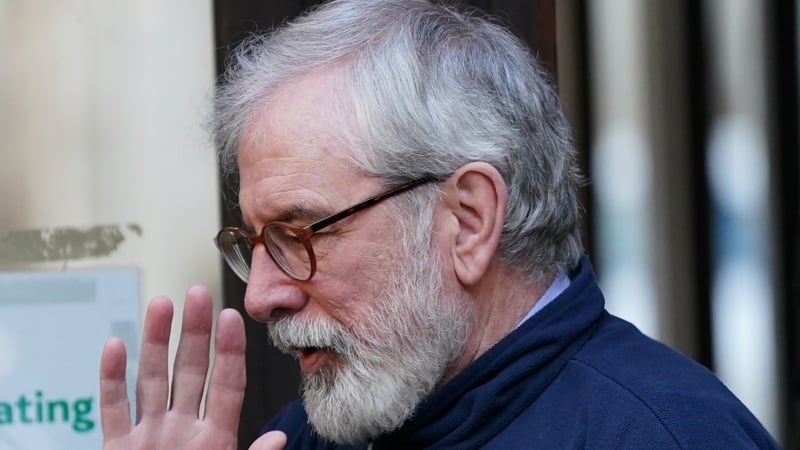
Evidence proving Gerry Adams was behind three IRA bombings in England is "extremely limited" and "bordering on non-existent", the High Court has heard.
Edward Craven KC, for Mr Adams, said the job of the court should not be to rule on a historical truth but to address a dispute between two parties.
John Clark, a victim of the 1973 Old Bailey bombing in London; Jonathan Ganesh, a 1996 London Docklands bombing victim; and Barry Laycock, a victim of the 1996 Arndale shopping centre bombing in Manchester, all allege that Mr Adams was a leading member of the Provisional IRA on those dates, including of its Army Council, and are seeking £1 in damages.
The former Sinn Féin president denies the allegations and is defending the claim.
He told the court that he had "no involvement whatsoever" in the bombings and was never a member of the Provisional IRA.
After Mr Adams finished giving evidence today, Mr Craven said to the judge: "You have actually had very little evidence of how, why and by whom these bombings were authorised.
"That is the central question in this trial. When you actually focus on that, the evidence is extremely limited and we say bordering on non-existent."
"There is not a single page in the 6,000-page bundle that implicates Mr Adams in any of the bombings," Mr Craven said.
About the evidence given by the 13 witnesses, some of which related to intelligence gathered years ago, he said: "All you have is high-level assertions, unsupported by detail, uncorroborated by documents.
"We say that comes absolutely nowhere close to proving allegations of this magnitude."
He added: "The desire to establish for the historical record that Mr Adams was a member of the IRA is the purpose that has driven this claim."
Mr Adams has claimed that while he was a member of Sinn Féin and was the organisation's president from 1983 to 2018, he "was never a member of the IRA or its Army Council, and I never held any role or rank within the IRA".
Last week, the court heard from former intelligence operatives working for the British authorities who said they believed Mr Adams was a "de facto leader" of the IRA and he ran his own "fiefdom" in Belfast.
Sir Max Hill KC, for the three bombing victims, said while cross-examining Mr Adams today that a former volunteer, who had at one point been friends with Mr Adams, understood Mr Adams to be a "major, major player in the war".
He also said that 1,178 people were killed by the Provisional IRA and that Mr Adams has "over a long period of time, chosen to stand by the IRA", to which Mr Adams replied: "I do not stand by everything that they did, but these were my neighbours."
Anne Studd KC, for the bomb victims, previously told the trial that being a member of Sinn Féin and a member of the Provisional IRA was "a distinction without a difference" for some individuals, including Mr Adams.
Ms Studd also told the court that Mr Adams had "a foot in each camp" of the military and political sides of the Irish Republican movement.
The barrister continued that Mr Adams was "directly responsible for and complicit in those decisions made by that organisation to detonate bombs on the British mainland in 1973 and 1996".
The trial before Mr Justice Swift, is due to conclude later in March.
We need your consent to load this rte-player contentWe use rte-player to manage extra content that can set cookies on your device and collect data about your activity. Please review their details and accept them to load the content.Manage Preferences
