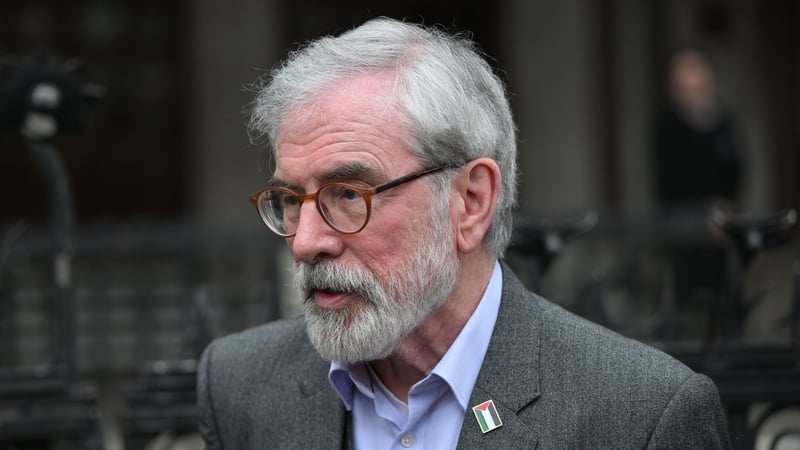

A former British Army intelligence officer has told the Gerry Adams civil trial in London that the former Sinn Féin president pushed for the ending of the IRA ceasefire with bombs in England in 1996.
Retired Brigadier Ian Liles told the court that the bombs were intended to force the British government into political concessions.
Mr Adams is being sued in the High Court in London by three victims of separate IRA bomb attacks in 1973 and 1996 who claim he was directly responsible.
Ian Liles is the last of 11 witnesses to be called by the prosecution team in the case.
He was appointed battalion intelligence officer in 1982 and held the role until his retirement in 1990.
In his witness statement, he said that during that time he was privy to a great deal of "high-grade intelligence" including military and police reports showing that Gerry Adams "was a leader within the Belfast PIRA and held various command and support appointments".
Mr Liles said he saw many intelligence reports at the time of the Docklands and Manchester bombings in 1996 that said Gerry Adams believed it was the best time "to take the war to the Brits".
"Adams wanted the PIRA to cause whatever havoc they could on the mainland, Germany and elsewhere to reap the political benefits and send a message to the British that the PIRA were not spent, and to force the weary British into concessions," his statement adds.
"The hope from the PIRA was that the 1996 bombings would leverage pressure on the British because they knew the government would not tolerate attacks on the mainland at this point in the conflict; it would not have been 'an acceptable level of violence'.
"The targets chosen in London and Manchester were deliberately high-profile targets to put this pressure on the UK government, cause economic pain to the UK and gain maximum publicity."
He added that there was simply no way the bomb attacks in England in 1996 "could have happened without the oversight and approval of Mr Adams".
The witness also alleges that Mr Adams was involved in the Bloody Friday bombings in Belfast city centre in July 1972 in which nine people were killed, and that he authorised the attack on the La Mon hotel in which 12 people were killed in February 1978.
He told the court that the British army and MI5 had recruited agents who were close to Gerry Adams and Martin McGuiness, including Freddie Scappaticci, the former agent known as Stakeknife.
Earlier, the court heard from journalist John Ware.
IRA members were angered by Adams' denials, court hears
A journalist who spent decades reporting on the Troubles told the trial that IRA members he interviewed were angered by his repeated denials that he was a member of the organisation.
John Ware worked for the Sun newspaper, ITV and the BBC, specialising in security issues.
Based on conversations with former IRA members and police sources, he said he believes Gerry Adams was a member of the IRA army council for more than 30 years from the late 1970s and was "one of the single most influential strategists in the Republican movement".
The former Louth TD and West Belfast MP has repeatedly denied ever being a member of the IRA and strenuously denies the allegations against him.
The journalist said the driving force behind IRA members speaking to him for one of his documentaries about Mr Adams was their anger at his "brazen, unequivocal, and unambiguous denial of his role in the PIRA [Provisional IRA]".
His witness statement adds: "It clearly grated with many of them that when Adams said that he strongly supported the armed struggle, his denial of actual PIRA membership allowed him to avoid taking personal responsibility for their actions.
"They believed it was a slippery way of Adams avoiding personal responsibility for the death and destruction caused by the PIRA's violence, which he had either ordered in the operational phase of his PIRA membership, and later in his strategic phase as a member of the PIRA army council."
Questioned by a lawyer representing Mr Adams, the witness confirmed that he had no first-hand personal knowledge of who was responsible for the three bombings cited in this case.
Asked about his reporting which exposed collusion between the security forces and loyalist paramilitaries, Mr Ware agreed that he was on record as saying MI5 and the British army had made statements about the issue that were not true.
Edward Craven KC told the court there had been a pattern of dissemination of false information by the British army, the RUC and MI5.
Mr Ware said he was giving evidence in the trial for public interest reasons, stating that it was his belief that it is "manifestly not the case that Gerry Adams was never a member of the IRA".
He said it would be wrong "for history to record that Mr Adams was never a member of the IRA when it is perfectly clear to me, my colleagues and scores and scores of people" that he was.