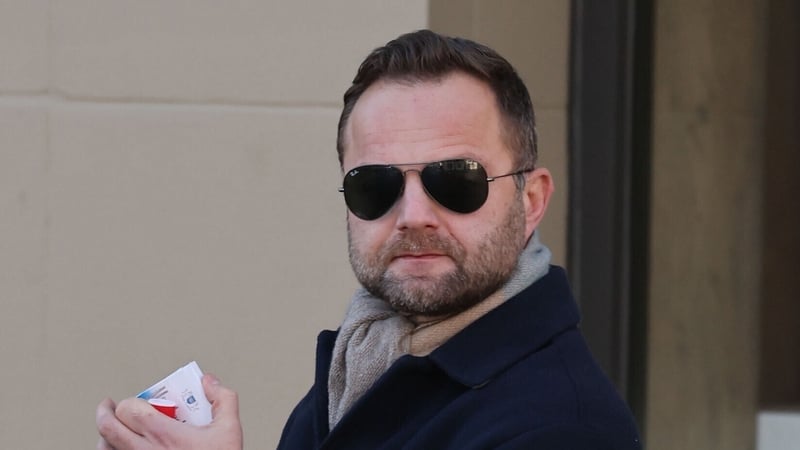

A pilot of a light aircraft convicted last October for his role in the importation of over €8 million worth of cocaine into the midlands three ago has had his sentencing adjourned.
A jury of four women and eight men found Michal Luczak, 44, formerly of Primrose Avenue, Jigginstown, Naas, Co Kildare guilty following a three-week trial at Mullingar Circuit Court last year.
Addressing the court today, Luczak told the court that there had been a breakdown in communication between himself and his legal team and they were no longer representing him.
He asked Judge Roderick Maguire to give him at least two months to try and find a new legal team, adding that he is actively looking for new representation.
Counsel for the State Cathal Ó Braonáin BL, said it was disappointing that the court was only hearing this information on the day of sentencing.
Judge Maguire adjourned the case until 13 April.
Trial Evidence
Luczak, a Polish national and father of two, was the pilot of a Cessna 182, a small four-seater light aircraft.
The court heard the aircraft was part-owned by eight equal shareholders, including Luczak.
The jury heard how the Polish pilot departed from Abbeyshrule Aerodrome in Co Longford, a type two customs airport for passengers and baggage only, on 3 August 2022, in the Cessna 182-S aircraft.
Luczak travelled with his friend Timothy Gilchrist, 57, who told the jury, during the trial, that he had been jailed for 11 years for his role in collecting the drugs.
Evidence was given that the two men flew to Le Touquet, a customs airport in northern France, and stayed overnight in a hotel before flying to Dieppe, a smaller airport.
The jury heard that at Dieppe airport, five large sports bags and one large suitcase were loaded on the plane.
The trial heard the plane then returned directly to Abbeyshrule Aerodrome in Co Longford landing in the early evening of 4 August.
Garda surveillance
On that day, garda surveillance was put in place, and the Garda National Drugs and Organised Crime Bureau (GNDOCB), supported by other units, were monitoring the aircraft.
When the plane landed, the six bags were loaded into an Alfa Romeo owned by Mr Gilchrist, who was later intercepted and arrested by gardaí at Lough Owel, Co Westmeath.
The car was searched, and the six bags were each found to contain 20 blocks, each wrapped in plastic with green tape and a picture of a seahorse on them.
Each of the 120 blocks was found to contain approximately one kilogram of cocaine, totalling 120kg, with a market value of €8.4 million.
Luczak had left the aerodrome in a black Mercedes, and was stopped at Collinstown, Co Westmeath, before being taken to Ashbourne Garda Station for interview.
Luczak unaware of bags contents, according to witness
During the trial, Mr Gilchrist, with an address at Mavis Bank, Newrath, Co Kilkenny, told the jury that Mr Luczak did not know there were drugs in the bags that were loaded on the plane in France.
He said he was interested in flying and that he had been introduced to Luczak by a friend two or three years earlier, and they had taken trips together to England, Belgium, and France, with him paying for the fuel.
He said he didn't want to tell Luczak he was carrying anything suspicious because "he would have gone straight to the authorities".
He also said he was sick at the time and collected the bags from a group of angry men who had arrived at Dieppe Airport.
He gave evidence that he loaded the plane when the defendant was not around and felt dreadful about it, later telling the accused the bags contained books and research papers belonging to his brother.
He also stated that he alone unloaded the bags at Abbeyshrule and placed them in his car.
State’s case Luczak was 'key to success' of operation
Counsel for the State Cathal Ó Braonáin BL, said Luczak was "key to the success" of the operation, and would have been a "wildcard" risk to a criminal organisation if he had not known what the four-seater aircraft was carrying.
He was "irreplaceable" and a "valuable asset" in this venture, the jury heard.
He told the jury the pilot did not record in the flight from Dieppe in his log and that he was fully aware of the regulations.
He told them that if his version was correct, why had he not helped his ill friend Mr Gilchrist carry the heavy bags?
The prosecutor also referred to evidence that one of the people on the ground at the aerodrome, who had been in contact with Mr Gilchrist, also had the defendant’s phone number.
However, Luczak’s defence senior counsel, John Shortt, argued that there was not a jot of evidence to say his client knew what was on the plane, and he urged the jury not to make a gigantic leap into the unknown or convict Mr Luczak.
Mr Shortt told the jury: "There is not a jot - not a sausage - of evidence that Michal Luczak was in possession of drugs."
"There’s no evidence he’s guilty of anything other than obliging a friend, as we’ve all done. There’s no evidence to suggest anything other than a normal relationship," he said.
"The only evidence of what took place in France came from Timothy Gilchrist, and he never varied in his evidence that Mr Luczak didn’t know what was going on," he said.
However, the jury did not accept this and after three hours and 16 minutes of deliberations they returned unanimous guilty verdicts.