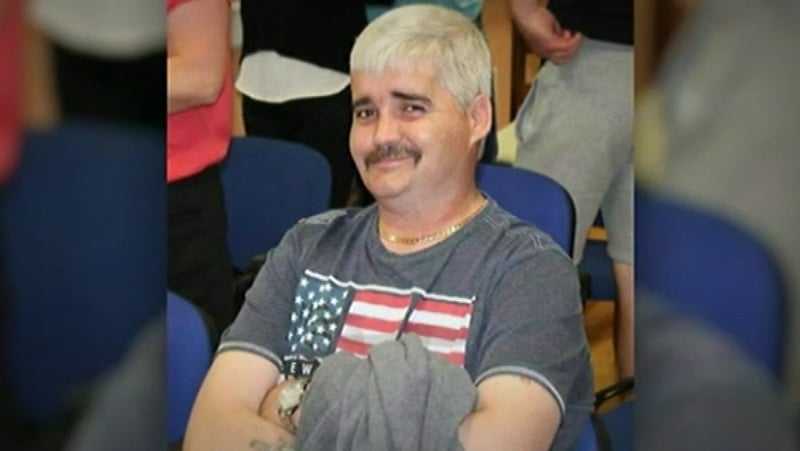

A 35-year-old man who meticulously planned and executed a plot to shoot and kill another man in his own home has been sentenced to seven and a half years in prison.
Joseph Richards from Lanesborough Square, in Finglas, was originally charged with Robert Sheridan's murder but pleaded guilty last month to conspiring to murder the 45-year-old man.
Mr Justice Paul McDermott said the victim's "life and value" must be marked by a consecutive sentence. The sentence will be served in addition to a current term Richards is serving for unrelated offending. The final six months was suspended.
Robert Sheridan was fatally wounded when he answered the door of his house at Poppintree Crescent, Ballymun, Dublin, on 5 October 2018.
The victim had received a Garda Information Message (GIM) warning that his life was under threat shortly before he was killed.
There had also been previous attacks on his home, during which his car was burned out, and shots were fired at the property.
Richards had used someone known and trusted by the victim to knock at his door before he was shot.
The court was told a witness to whom Richards later confessed had come forward with information and Richards was charged with murder. But there was a delay in getting the case to trial because of the health of the key witness.
A plea to conspiracy was initially rejected by the DPP but later accepted on what is known as a "full facts basis" meaning Richards admitted to conspiracy to murder as well as being the shooter.
Victim was 'gunned down in his own home' - Judge
Mr Justice McDermott said Robert Sheridan was a man "gunned down in his own home and was murdered in a horrible way having been lured to his door".
He said the victim's family had suffered a devastating loss, their home was violated and they had to endure a lifelong loss. Different generations had been affected in different but enduring ways, the judge added.
He noted the offence took place before the law was changed in 2023 to allow for a maximum sentence of life in prison for conspiracy to murder. The maximum sentence in this case was therefore ten years in jail.
Judge McDermott said there was a very high degree of culpability for those who planned and committed the murder.
He said it was known to Robert Sheridan that someone wished to kill him and "tragically this was true".
"That person or persons went to considerable lengths to plan it and Joseph Richards was involved in careful planning," the judge said adding that it was decided that someone would betray the victim by calling to his door.
Judge McDermott said Joseph Richards "could not have been more involved in the conspiracy and was the man who completed it".
At a sentence hearing last week, Detective Sergeant Patrick O'Toole told prosecuting senior counsel, Garrett McCormack, that gardaí received a call shortly after 11pm on 5 October 2018 reporting that a man had been shot. Mr Sheridan sustained gunshot wounds to the head and body and was pronounced dead at the scene.
Mr Sheridan’s partner Maria Barrett told gardaí he had answered a knock on the door and she heard a sound like firecrackers and found him lying on the ground with blood coming from his head. The court heard that Mr Sheridan had armed himself with a knife before answering the door because he feared for his safety.
Det Sgt O’Toole said Mr Sheridan was aware there was a threat to his life and the accused had to source someone he knew to get him to open the door.
Gardaí seized several mobile phones during the investigation, including one belonging to Richards. The court heard that his phone had pinged in the area immediately before and after the shooting.
No breakthrough in investigation until April 2021
There was no breakthrough in the investigation until April 2021, when a witness came forward and provided an account of Richards confessing to the murder.
The witness, who had significant drug addiction issues at the time, told gardaí she knew the defendant through a group involved in taking and selling drugs in the Ballymun area.
She said Richards "broke down" and admitted shooting Mr Sheridan. He told her he had enlisted help from another individual and outlined a plan to use someone known to the victim to get the deceased to answer the door.
She told gardaí that Richards had been "crack crazy" and desperate for drugs when he was asked to carry out the killing, and that he did it "effectively for payment".
Richards was subsequently charged with murder and returned for trial.
Prosecuting counsel told the court that Richards entered a plea of guilty on the conspiracy to murder charge in January this year and the plea was acceptable to the Director of Public Prosecutions on a full facts basis.
Det Sgt O'Toole said Richards has 99 previous convictions, including those for endangerment, dangerous driving, criminal damage, possession of drugs, unlawful taking of a vehicle, robbery and possession of knives.
He said the defendant is currently serving a prison sentence of six years and five months.
Defence counsel Seamus Clarke said Richards was dealing with significant grief at the time and had a chronic drug addiction. A letter of apology from Richards was handed into court.
He said the plea was a valuable one because of the health of the witness and her frailty, while it had also saved the gardaí time and resources.
Murder 'devastated our family', says son
In a victim impact statement, the deceased's daughter, Lauren King Sheridan, said she had to be physically restrained when she arrived at the scene and saw her father with gunshot wounds to his head.
Ms King Sheridan said the next morning, she woke to pictures of her father being "wheeled out in a body bag" and this plays in her head "over and over".
The now 26-year-old said the image of her father with a hole in his face is "permanently imprinted on my mind".
She told the court that her father had completed studies in addiction counselling and planned to work in that field. He had previously suffered a brain injury in a traffic accident, which she said made him "a vulnerable target".
Ms King Sheridan said her father "wasn’t a dangerous man" and wasn’t involved in criminal activities.
Mr Sheridan's son, Dylan King Sheridan, said that since his father’s death he continues to experience persistent psychological distress.
He said he questions how long his father may have suffered, "whether he was in fear or pain, these thoughts are uncontrollable and extremely distressing".
Mr Sheridan King said Covid hit a year after his father’s death and his mental health suffered severely because of these combined factors.
He said before his father’s murder, he had a large circle of friends but since then "my world has dramatically narrowed".
Mr Sheridan King said his father’s murder had "devastated our family". He said at the time of his death, his father was "no longer involved in drugs after many years of addiction".
A victim impact statement read on behalf of the wider family described the killing as a "cold-blooded execution" and said they remained shattered by their loss.