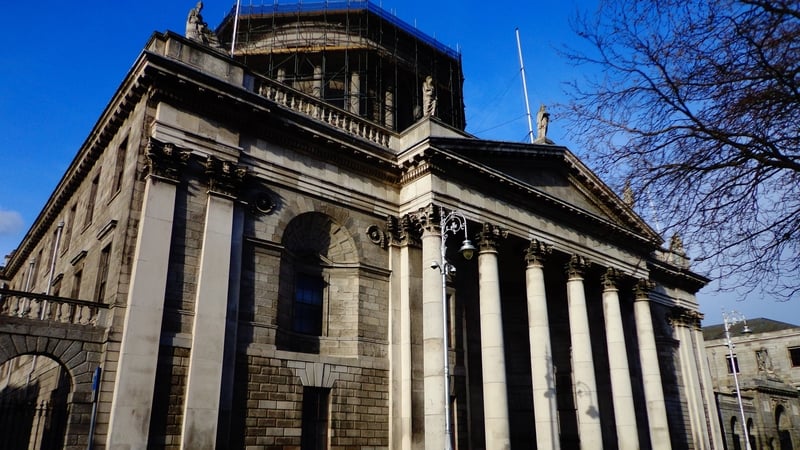

The High Court has awarded damages to two men who became homeless in Dublin after applying for international protection in 2023.
The two cases were chosen as test cases from a pool of some 50 such cases.
The two applicants alleged that the Irish authorities had breached their rights under the Reception Conditions Directive and the Charter of Fundamental Rights of the European Union.
The applicant known as SA, was awarded €9,500; while a second applicant known as RJ was awarded €6,000.
The men were denied housing when they arrived in Ireland three years ago and received a €25 voucher.
They were also deemed ineligible for daily allowances. Consequently, both ended up homeless in Dublin.
The Government argued the breaches were due to exceptional circumstances, namely an influx of asylum seekers, which amounted to "force majeure" under EU law.
Force majeure refers to an abnormal or unforeseen event beyond the control of a state, making it materially impossible to fulfil an obligation.
In his judgment, Mr Justice Cian Ferriter said that, in determining compensatory damages, he had "regard to the fact that there was a serious breach by the State of the applicant's rights ... it is relevant to an assessment of damages that the provision of mandatory and minimum material reception conditions, including accommodation, under the Directive is intended to ensure respect for human dignity".
Last year, the High Court sought a ruling from the European Court of Justice, that was sent to the Advocate General Laila Medina for an opinion on the case.
Ms Medina suggested that force majeure may apply temporarily, it should only be for a reasonable period to resolve the issue.
She concluded the right to dignity is non-derogable, an absolute right, and if a member state fails to meet the basic needs of applicants for international protection, it infringed EU law.
Ultimately, her view was that the member state cannot invoke force majeure as a defence.
The European Court of Justice then rejected the Government's claim that an influx of international protection applicants impacted its obligation to cover asylum seekers' basic needs.
It stressed that EU law requires countries to guarantee an adequate standard of living for asylum applicants, even in times of crisis, through means such as housing, financial aid, or vouchers.
The Irish Refugee Council's Independent Law Centre which represented SA welcomed the judgment.
SA fled the Taliban in Afghanistan, and without the right to work in Ireland, spent 71 days sleeping rough in Dublin without state support to access shelter, food, or basic hygiene facilities.
The IRC said this left him exposed to serious safety and health risks, deprived of his basic needs and fundamental right to dignity.
Mr Justice Ferritor considered the absence of meaningful financial support, the fear and humiliation caused by being homeless, the vulnerability of the applicant, and poor weather conditions.
In a statement the IRC said that while the award "is an important step" in acknowledging the harm suffered and remedying State failure, it comes amid "an ongoing government policy that still requires newly arrived men to prove their need for accommodation by sleeping rough".
CEO Nick Henderson said "...we continue to meet people who, without adequate supports, are forced to sleep in wet and freezing conditions and exposed to far-right abuse, before they are offered a bed. It is wrong, unlawful and dangerous".
Read more: Achieving international protection targets by June will be 'bumpy', PAC told