


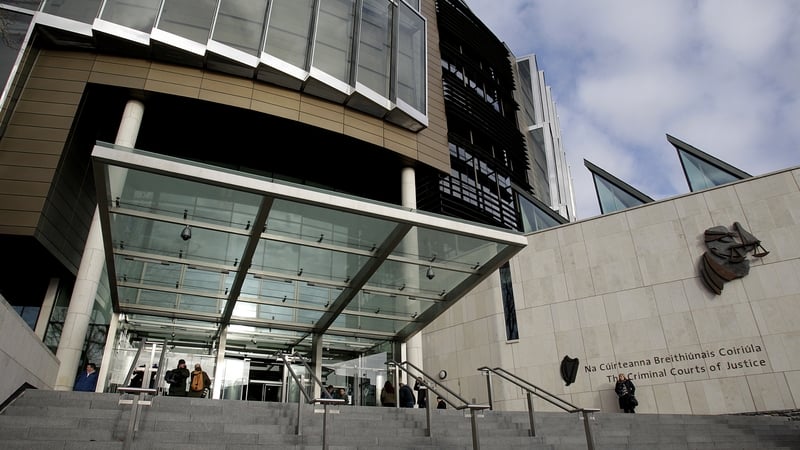
A Limerick car dealer on trial for alleged garda corruption told investigators that senior gardaí were involved in extorting money from him, a trial has heard.
Stephen O'Sullivan, 43, is accused of giving or agreeing to give to Detective Garda David Bourke a monetary gain as an inducement to reveal confidential information concerning an investigation being carried out by the Criminal Assets Bureau (CAB) in relation to Stephen Bawn Motors, trading as Bawn Motors.
Mr O'Sullivan, of Farrehy, Broadford, Co Limerick, is a director of the business.
He has pleaded not guilty at Dublin Circuit Criminal Court to the single count of corruption at Bruree, Co Limerick on 22 December, 2018.
On day three of his trial, David Gilmore told Eoin Lawlor SC, prosecuting, that in January 2019 he was a serving garda with the rank of detective sergeant and attached to the National Bureau of Criminal Investigation (NBCI).
He said that on the morning of 23 January, 2019, he travelled to Cluain Arra, Newcastle West, Co Limerick in order to arrest Mr O'Sullivan.
The defendant was not at this address and he travelled on to Farrehy, Broadford where he met Mr O'Sullivan and his father.
Mr O'Sullivan had two mobile phones, one for work and one personal, on him. Gardaí seized these and asked the defendant to provide the PIN for them, but he declined to do so.
He arrested Mr O'Sullivan and gardaí conducted a number of interviews with the defendant. From the outset of the first interview, Mr O'Sullivan told gardaí that he felt he was "being stitched up" and that he would not answer any more questions, the witness told Mark Lynam SC, defending.
On 6 December the same year, gardaí re-arrested Mr O'Sullivan at his home, this time for the purpose of charge. At Shannon Garda Station, gardaí charged him with an offence of corruption. He was later admitted to bail after an appearance at Limerick District Court.
'Criminality going on in your yard'
The jury heard that in January 2022, Mr O'Sullivan met with investigators from NBCI for voluntary interview. Before the interview, Mr O'Sullivan read a prepared statement to gardaí in which he claimed he first became aware of Dt Gda Bourke of Oola, Co Limerick, through an associate identified in court only as JC.
He said JC told him that a senior detective wished to meet him about alleged criminality in his business. The defendant told gardaí that JC drove him out to a remote rural area near Oola.
Mr O'Sullivan said he got into a white Berlingo van occupied by Dt Gda Bourke. He said Dt Gda Bourke said he wanted to speak to him about alleged "criminality going on in your yard" which he was "personally investigating".
He said the detective named a number of people - none of whom he knew - and he told him that there was going to be a CAB investigation of his business.
The jury heard that the defendant told gardaí: "I was extremely shocked and perturbed. I was unaware of any criminal activity...He indicated he might want to meet me again."
Mr O'Sullivan said he made it clear he wanted any future meetings to take place in a garda station and described meeting a senior detective in this way was "extraordinary", the court heard.
He said he subsequently made inquiries about Dt Gda Bourke and was informed that he was a "most powerful man with great influence" and "a powerful and devious man capable of doing anything".
He said he was informed that Dt Gda Bourke "operated closely and was friendly with Superintendent Eamonn O'Neill", the court heard.
He said JC told him "if you were helpful to him he would be extremely helpful", including in relation to issues with road traffic offences. He told gardaí that as far as he was concerned, his business was transparent and there was no illegality.
He said two weeks later, JC pressurised him into meeting with Dt Gda Bourke again and the detective told him he was under investigation and referred again to Supt O'Neill.
Mr O'Sullivan told gardaí that after this meeting, JC visited him again and told him that Dt Gda Bourke was "looking for money" and it was "imperative" that he meet him again.
He said he was informed that Dt Gda Bourke and Supt O'Neill "would be involved in the CAB investigation", "they would be in a position to put it away" and "they would need €120,000".
"I felt I was being set up" and that this was an attempt to extort money from him, he claimed in his statement.
He said that JC told him "that man and Eamonn O'Neill could make life very difficult and awkward" for him.
Mr O'Sullivan said he met Dt Gda Bourke again and he asked him if he had anything for him. He said Dt Gda Bourke told him "he and Eamonn O'Neill would be able to stop or delay CAB or any other matters".
He said at this point he considered making a formal complaint to gardaí but said: "I feared any complaint would result in reprisals."
Mr O'Sullivan also stated that he then began to notice he was being "followed and harassed". He said Eamonn O'Neill began appearing at the defendant's regular eateries.
He said Supt O'Neill drove into his car yard in an unmarked car and Dt Gda Bourke was in the passenger seat. He said he felt so fed up that he approached the car to speak to them, but the car was driven off.
"I was concerned for my own safety and my family. I had nowhere to go. I was so anxious depressed and worried.
"I had no interest in the information being offered. I was concerned evidence could be planted at my premises. I was under extreme pressure," he told gardaí in the prepared statement.
'I'm sorry, it's too late now'
Mr O Sullivan also told gardaí that after his second arrest and while he was being taken to Shannon Garda Station, he told Dt Sgt Gilmore that he wanted to "tell (him) the truth" about everything.
He said that Dt Sgt Gilmore told him that he would need to call his superior first and he made this call in the car. He said after this call Dt Sgt Gilmore told him: "I'm sorry, it's too late now."
Under cross-examination, Mr Gilmore told defence counsel that he had no memory of this conversation and that he would remember it. He told the jury that if such a conversation had taken place, he would have made a note at the time in his garda notebook and that there was no such note made.
The witness told Mr Lawlor, prosecuting, that the obligation of gardaí to seek out evidence does not end after a suspect is charged.
The trial continues in evidence before the jury and Judge Sinéad Ní Chúlacháin.
